
TL;DR:
- Unreported sexual harassment in Beverly Grove media offices still falls under California law protections, regardless of public records.
- Understanding harassment definitions, legal evaluation factors, and evidence preservation is crucial for employees seeking justice and proper employer accountability.
If you work in a media office in Beverly Grove and have experienced unwanted sexual conduct at work, you might assume that the absence of local headlines means your situation is unusual or that your rights are somehow limited. That assumption is wrong. While no public records specifically document sexual harassment claims by employees at media offices in Beverly Grove, California law protects every worker in every workplace, regardless of whether a case ever made the news. This guide is written specifically for you, to clarify what counts as harassment, how claims are evaluated, and what concrete steps you can take right now.
Table of Contents
- Setting the context: Sexual harassment in media offices
- What counts as sexual harassment? Key definitions and scenarios
- How claims are evaluated: The core legal factors
- Building your case: Preserving evidence and taking action
- Resources and support for Beverly Grove media employees
- The truth most Beverly Grove media employees miss about sexual harassment claims
- How Justice Shield Law helps Beverly Grove media employees
- Frequently asked questions
Key Takeaways
| Point | Details |
|---|---|
| Few public cases | Despite wide attention on media harassment, Beverly Grove-specific claims are rarely documented. |
| Rights still apply | Employees in Beverly Grove media offices are protected by the same laws as anyone in Los Angeles. |
| Supervisor role matters | Who the alleged harasser is can change the employer's liability and your claim's process. |
| Document everything | Preserving emails, messages, and written records can make or break a harassment claim. |
| Help is available | Local legal experts and support can guide you if you're unsure or facing a hostile environment. |
Setting the context: Sexual harassment in media offices
Los Angeles has long been at the center of high-profile harassment cases. From studio executives to broadcast networks, the entertainment and media industry has faced sustained scrutiny over workplace culture. Beverly Grove, a neighborhood with a growing presence of creative agencies, production companies, and media firms, sits squarely within this landscape.
Yet local cases rarely surface in public reporting. That silence does not mean harassment is not happening. It often reflects something more troubling: employees who do not report because they fear retaliation, worry about damaging professional relationships, or simply do not know that what they experienced legally qualifies as harassment. In tightly knit creative offices, where relationships feel personal and career advancement feels fragile, those barriers to reporting are especially high.
Major employers in the LA media space have faced sexual harassment litigation that highlights the same patterns seen in smaller offices: power imbalances, inadequate HR responses, and employees left without clear paths forward. The dynamics in a Beverly Grove media firm are no different in legal terms from those at a major studio.
Key barriers employees typically face when deciding whether to report include:
- Fear of being labeled "difficult" or passed over for projects
- Uncertainty about whether their experience meets the legal standard
- Concern that HR will protect the employer rather than them
- Worry about confidentiality and being identified as the complainant
- Lack of knowledge about external reporting options beyond internal HR
Understanding your California workplace sexual harassment rights is the first step toward overcoming those barriers. Knowledge is what converts confusion into the ability to act.
"The absence of publicized cases does not mean the absence of protected rights. Every employee in California, whether working at a major network or a small Beverly Grove media firm, is covered by the same anti-harassment laws."
What counts as sexual harassment? Key definitions and scenarios
Many employees hesitate to come forward because they are unsure whether what happened to them actually "counts." This section breaks that down clearly so you can recognize whether your experience qualifies under California law.
Sexual harassment falls into two main legal categories. The first is hostile work environment harassment, which occurs when unwelcome conduct based on sex is severe or pervasive enough to create an abusive, intimidating, or offensive work environment. The second is quid pro quo harassment, which happens when a person in authority conditions job benefits, such as a promotion, a raise, or continued employment, on submitting to sexual advances or requests.
Examples of conduct that may qualify under one or both categories include:
- Unwanted sexual comments, jokes, or innuendo made repeatedly by a coworker or supervisor
- Unsolicited physical contact, such as touching, hugging, or cornering
- Sharing or displaying sexually explicit images or content in shared work spaces or group chats
- Requests for sexual favors in exchange for favorable project assignments or performance reviews
- Unwanted and persistent romantic pursuit even after you have said no
- Demeaning comments about your gender or sexual orientation that affect your ability to work
One critical point: the harasser's role as supervisor significantly affects how the law assigns liability to your employer. When a supervisor is the harasser, the employer faces stricter accountability than when the harasser is a peer. Courts look closely at the power dynamic, what the employer knew, and what action the employer took after learning of the conduct. Any worker, whether you are a staff writer, a producer, a coordinator, or an on-air talent, has the right to make a claim regardless of their level within the organization.
Pro Tip: You do not need to have formally objected to the conduct out loud for it to qualify. California law looks at whether the conduct was objectively and subjectively unwelcome, not whether you verbally protested every incident.
Understanding sexual harassment definitions under California's Fair Employment and Housing Act is important because state law often provides broader protections than federal law, covering employers with five or more employees for harassment claims.
How claims are evaluated: The core legal factors
Once you decide to move forward, it helps to understand how courts and investigators actually assess a sexual harassment claim. This is not a mystery process. There is a clear framework, and knowing it helps you evaluate your own situation more accurately.
The three-step evaluation used in most harassment cases:
-
Identify the relationship between you and the harasser. Was this person your direct supervisor, a manager with indirect authority over you, a peer, a client, or a vendor? The legal standards differ depending on this relationship. Supervisor harassment triggers what is called "strict liability" in many situations, meaning the employer is automatically responsible in some cases without needing to prove they knew about it.
-
Assess employer notice. Did the employer know, or should they reasonably have known, about the harassment? This includes formal reports you made to HR, complaints to a manager, or conduct that was so obvious it could not have been missed. Courts examine whether the company had anti-harassment policies, whether they were distributed and enforced, and whether employees had accessible, safe ways to report.
-
Review the remedial action taken. Once the employer had notice, what did they do? Did they investigate promptly and in good faith? Did they take steps proportional to the seriousness of the conduct? Or did they ignore the complaint, move you to a different team without addressing the harasser, or take action that exposed you to retaliation? As the Fox News harassment case illustrates, procedural details around employer response are often decisive.
| Factor | Employee's role | Employer's obligation |
|---|---|---|
| Report the conduct | File a complaint promptly through available channels | Maintain clear, accessible reporting procedures |
| Preserve evidence | Save relevant messages, emails, and records | Investigate all complaints in good faith |
| Cooperate with investigation | Participate honestly in any inquiry | Maintain confidentiality to the extent possible |
| Avoid retaliation | Document any adverse action after reporting | Prohibit and respond to retaliation immediately |
| Seek legal counsel | Consult an attorney about your options | Follow all applicable state and federal law |
Working with a skilled Los Angeles employment lawyer helps you understand where your situation fits within this framework and whether your employer met their obligations.
Pro Tip: If you were transferred, reassigned, demoted, or treated differently at work after making a complaint, that may constitute illegal retaliation, which is a separate and additional claim on top of the underlying harassment.
Building your case: Preserving evidence and taking action
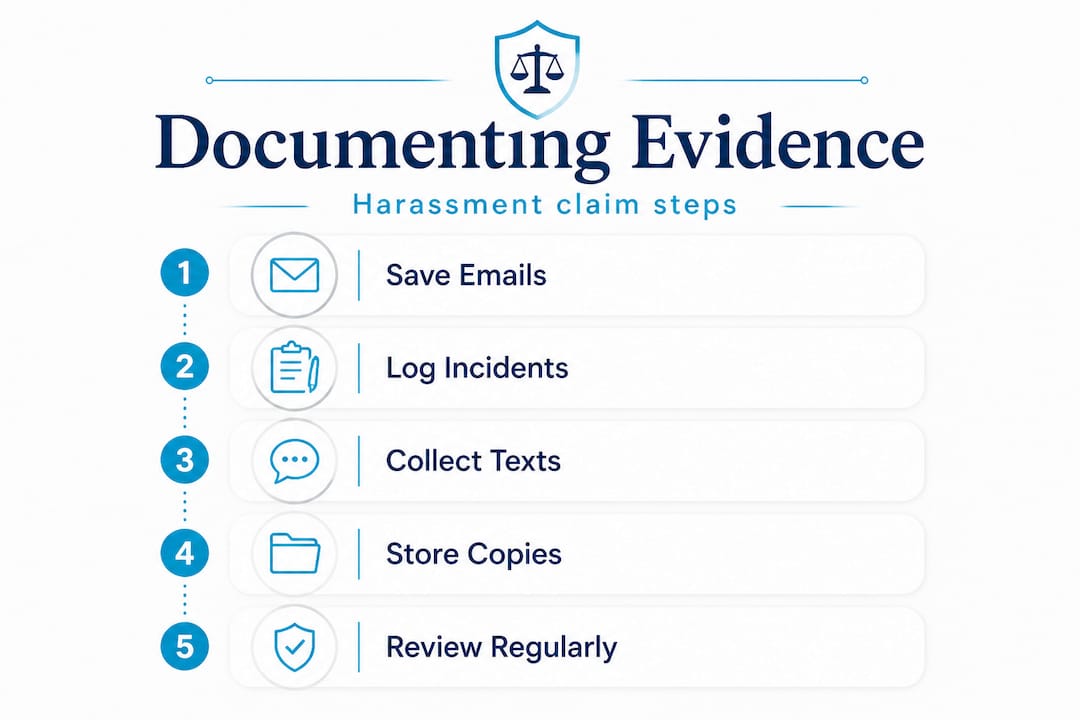
Evidence is the backbone of any successful harassment claim. You may be surprised by how much documentation already exists, and how much more you can create right now by acting quickly and systematically.
The most effective evidence in harassment cases tends to be contemporaneous, meaning it was created close in time to when the incident occurred. Courts and investigators trust records made in the moment far more than descriptions reconstructed months later. A recent high-profile case involving MrBeast's company illustrates how preserved communications and records supported the allegations made by the plaintiff.

Here is a practical breakdown of the types of evidence you should actively preserve:
| Evidence type | Where to find it | How to preserve it |
|---|---|---|
| Emails and direct messages | Work email, Slack, Teams, text messages | Screenshot and save to personal device or secure cloud |
| Voicemails and recordings | Phone, work voicemail systems | Save audio files, note date and time |
| Written HR complaints | HR portal, email to HR | Keep copies in personal files outside work systems |
| Witness information | Coworkers who observed incidents | Note names and what they saw, as soon as possible |
| Performance records | Annual reviews, project feedback | Collect before reporting, to establish baseline |
| Timeline of incidents | Your own memory and records | Write a detailed, dated log of each incident |
Additional steps you should take as early as possible include:
- Report the conduct in writing to HR or a supervisor above the harasser, so there is a record that the employer had notice
- Learn whether your company has an ethics hotline or third-party reporting option for greater confidentiality
- Check whether your employer has a written anti-harassment policy and save a copy
- Contact the California Civil Rights Department (formerly DFEH) or the EEOC to understand external reporting deadlines, which can be as short as 300 days from the discriminatory act
- Consult an employment attorney before signing any settlement, separation agreement, or non-disclosure agreement
Knowing how to report workplace discrimination in California also matters because the steps you take internally, and how you document them, can directly affect your legal options later.
Pro Tip: Use a personal email address, not your work email, to save copies of relevant evidence. Work accounts can be revoked without notice, especially if you are terminated after making a complaint.
Resources and support for Beverly Grove media employees
You do not have to navigate this alone. Several resources are available specifically for employees in the Los Angeles area, and some are designed to address the unique challenges of media and entertainment workplaces.
- California Civil Rights Department (CRD): The state agency that handles harassment and discrimination complaints. You can file online, by mail, or by phone, and the process is confidential at initial stages.
- U.S. Equal Employment Opportunity Commission (EEOC): The federal agency for harassment claims. Filing a charge preserves your federal legal rights and must be done within 300 days of the discriminatory act.
- California Employment Lawyers Association (CELA): Provides referrals to plaintiff-side employment attorneys in Los Angeles.
- Free legal consultations: Many plaintiff-side employment law firms, including Justice Shield Law, offer confidential consultations at no cost so you can assess your situation before committing to any legal action.
- Time Off for Legal Matters: California law provides protections for employees who take time to appear at legal proceedings related to their own cases.
While no Beverly Grove-specific public cases appear in current records, the legal frameworks and support structures that apply broadly across Los Angeles fully cover you as a media office employee in this neighborhood. You have access to the same protections as any other California worker, and these resources are real, accessible, and available now.
For employees concerned about workplace rights in Beverly Grove and surrounding areas, regional legal expertise matters. Attorneys familiar with LA-area employment law understand the specific industry dynamics, employer behaviors, and local courts relevant to your situation.
The truth most Beverly Grove media employees miss about sexual harassment claims
Here is something we see repeatedly in our work with employees across Los Angeles media offices. The people most harmed are often the last to act, not because they do not have a strong case, but because the environment itself teaches them to doubt their own experience.
Media and creative offices have a specific culture that can be weaponized against employees who speak up. The informality, the long hours, the blurred line between professional and social, and the sense that you are "lucky to be here" all create conditions where harassment gets normalized or minimized. Employees tell themselves it was just how that person is, or that nothing will come of reporting it anyway, or that they might lose opportunities if they make waves.
The reality is that California law does not care about the industry's informal norms. It does not care whether your office has a cool vibe or whether your harasser has industry connections. What the law cares about is whether conduct was unwelcome, whether it was severe or pervasive, and whether your employer responded appropriately. That standard applies equally to a small Beverly Grove production company and to any major studio.
The fact that few Beverly Grove cases surface publicly does not reflect a clean record. It reflects the barriers we described earlier: fear, confusion, and a system that makes reporting feel riskier than it should. Our experience tells us that waiting rarely improves the situation and often weakens the case as evidence ages and memories fade.
If you are sitting with uncertainty right now, the most important thing you can do is speak with someone who can give you a clear, honest assessment of your situation. Understanding your California sexual harassment rights does not obligate you to take any action. But it gives you the power to decide from a position of knowledge rather than fear.
How Justice Shield Law helps Beverly Grove media employees
At Justice Shield Law, we work exclusively on the employee side of employment law cases, including sexual harassment claims in media offices throughout Los Angeles. We understand the pressures that media workers face, from concerns about reputation and career continuity to uncertainty about how to start the legal process.
Our employment law attorneys offer free, confidential consultations so you can discuss what happened, ask questions, and understand your options without any commitment or cost. We provide clear, honest guidance on whether you have a viable claim, what evidence you need, and what the process looks like from start to finish.
If you are a media employee in Beverly Grove and you need Los Angeles employment law help, we are here. You have rights. We help you use them.
Frequently asked questions
Is there a public record of sexual harassment cases in Beverly Grove media offices?
No credible public records specifically document sexual harassment cases filed by media office employees in Beverly Grove, though this absence reflects underreporting rather than the absence of incidents.
Does it matter if my harasser is a supervisor in my workplace?
Yes. Under California law, supervisor harassment triggers stricter employer liability, meaning your employer may be held directly responsible even without prior knowledge of the conduct.
How should I document my harassment experience?
Save emails, texts, and any written communications as soon as possible, and keep a dated written log of each incident, because contemporaneous records carry significantly more weight in legal proceedings than accounts reconstructed later.
Do I need a lawyer to file a sexual harassment claim in Beverly Grove?
While you are not legally required to have an attorney, working with an employment lawyer who specializes in plaintiff-side cases significantly improves your ability to navigate the process, preserve your rights, and achieve a fair resolution.
Can I file a claim if my employer did not act on my complaint?
Yes. If your employer failed to take prompt and effective remedial action after receiving notice of harassment, that failure can be a central part of your legal claim and may strengthen your case against the employer.