
TL;DR:
- Employees face barriers like unclear procedures, retaliation fears, and tight legal deadlines.
- Reporting involves documenting incidents, internal reporting, and potentially filing with the CRD within three years.
- Agencies are legally required to provide anti-harassment training and enforce strict policies to prevent misconduct.
Reporting sexual harassment inside a Sacramento state agency sounds straightforward on paper. In practice, many employees discover barriers they never anticipated: unclear internal procedures, fear of retaliation, and strict deadlines that can eliminate legal options before an attorney is ever consulted. If you work for a California state agency and are facing this situation, you are not alone, and you do have rights. This guide walks you through what qualifies as harassment under California law, how to report it, what protections exist against retaliation, and what a realistic outcome actually looks like.
Table of Contents
- Understanding sexual harassment claims in Sacramento state offices
- Reporting sexual harassment: Step-by-step guide for Sacramento offices
- Training, prevention, and mandated policies in Sacramento state agencies
- Navigating retaliation and legal challenges in sexual harassment cases
- A sharper perspective: What employees in Sacramento should really expect
- Get legal guidance for sexual harassment claims in Sacramento
- Frequently asked questions
Key Takeaways
| Point | Details |
|---|---|
| Identify harassment | Sexual harassment covers both explicit offers and hostile environments, affecting all genders. |
| Report promptly | Sacramento state employees must first report internally, then can file with the Civil Rights Department within three years. |
| Mandatory training | All agency employees and supervisors are required to complete harassment prevention training every two years. |
| Retaliation protections | California law protects anyone reporting sexual harassment from employer retaliation. |
| Legal support | Seeking legal advice improves your chances of navigating complex procedures and overcoming barriers to your claim. |
Understanding sexual harassment claims in Sacramento state offices
Sexual harassment is not limited to obvious, overtly physical behavior. Under California law, it covers a wide range of conduct that creates an intimidating, hostile, or offensive work environment. Understanding exactly what qualifies matters because many employees either underestimate what happened to them or worry their experience does not rise to the legal standard.
California recognizes two primary categories:
- Quid pro quo harassment: This occurs when a supervisor or person in authority offers or withholds job benefits, promotions, or favorable treatment in exchange for sexual favors. The power imbalance is central to this type.
- Hostile work environment harassment: This applies when conduct is severe or pervasive enough to make a reasonable person's work conditions intolerable. A single extreme incident or repeated, persistent behavior can both qualify.
- Who is protected: Any employee regardless of gender, gender identity, or sexual orientation is protected. Harassment by someone of the same gender is fully actionable under California law.
- Third-party and contractor coverage: Contractors, interns, and volunteers working in state offices may also have protections depending on their specific arrangements.
As stated in the CalPERS Harassment Prevention Policy, quid pro quo and hostile environment harassment affects any gender and retaliation against those who report is strictly prohibited.
One of the most common misconceptions is that a single inappropriate comment cannot constitute harassment. Context matters enormously. A pattern of comments, gestures, or messages, even ones that seem minor in isolation, can cumulatively create a hostile environment.
Know your rights: California state employees facing sexual harassment must first report internally to their supervisor, EEO office, or HR per their agency's policies, and can then file with the Civil Rights Department (CRD) within three years. Understanding California workers protections helps you act before deadlines close your options.
Retaliation protection is also built into the framework from the start. You cannot legally be demoted, fired, disciplined, or otherwise punished for reporting sexual harassment in good faith, even if your complaint is ultimately not upheld.
Reporting sexual harassment: Step-by-step guide for Sacramento offices
Knowing your rights is only the first step. Acting on them requires following a specific process, and missing any stage can limit or delay your ability to seek justice. Here is how the process works in Sacramento state agencies.
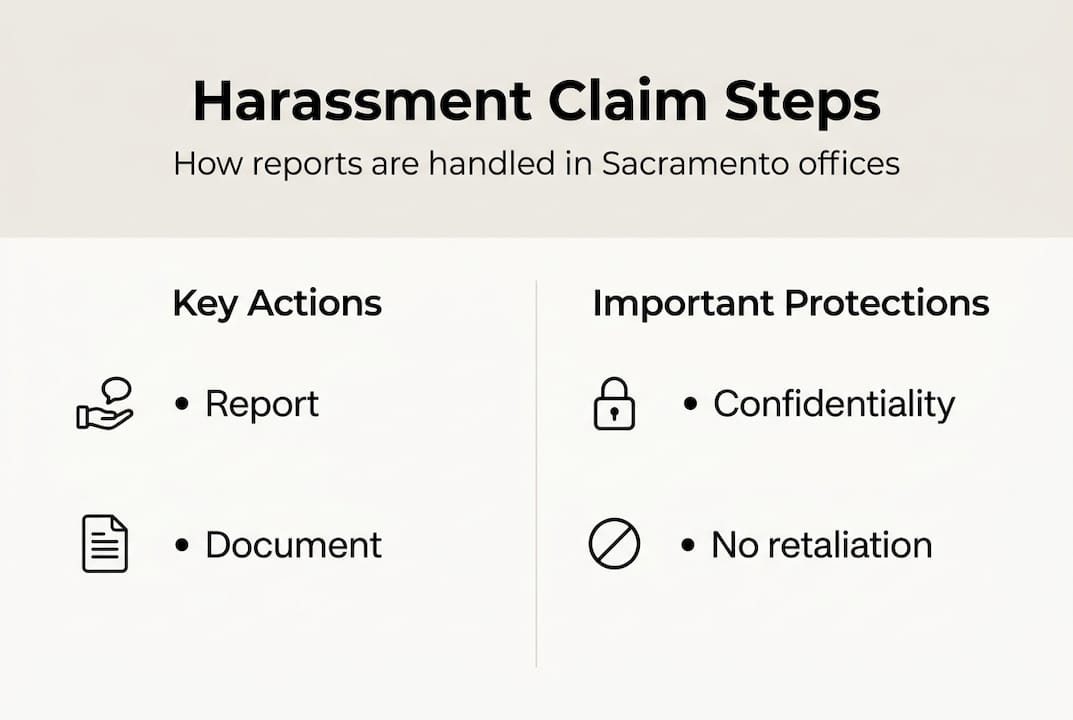
- Document everything first. Before making any formal report, write down dates, times, locations, what was said or done, and any witnesses. Save emails, messages, or voicemails as evidence.
- Report internally. Per CalPERS Harassment Prevention Policy, California state employees must initially report to their supervisor, EEO office, or HR department. If your supervisor is the harasser, go directly to HR or the EEO office.
- Follow up in writing. After any verbal report, send a follow-up email summarizing what you reported and when. This creates a paper trail.
- Escalate to the CRD if needed. If internal reporting does not resolve the issue, you can file a complaint with the California Civil Rights Department. Per CRD guidance, the complaint must be filed within three years of the harmful incident.
- Attend the intake interview. After filing, the CRD will schedule an intake interview to gather facts and determine how to proceed.
- Pursue resolution or litigation. The CRD may attempt mediation or settlement. If unresolved, you may receive a right-to-sue notice, allowing you to take the matter to civil court.
For more guidance on reporting discrimination steps in California or filing complaints California with state agencies, our blog covers both processes in detail.
| Stage | Action required | Timeline |
|---|---|---|
| Internal report | Notify supervisor, EEO, or HR | As soon as possible |
| CRD complaint | File online or in person | Within 3 years of harm |
| Intake interview | CRD reviews your claim | Shortly after filing |
| Investigation | CRD investigates facts | Varies by case |
| Resolution | Mediation, settlement, or right-to-sue | Ongoing |
Pro Tip: Do not wait to see if the internal complaint resolves itself. Start your personal documentation immediately, regardless of how the agency responds internally. The clock on your CRD filing deadline begins on the date of the incident, not the date you gave up on internal resolution.
Training, prevention, and mandated policies in Sacramento state agencies
Sacramento state agencies are not simply encouraged to address sexual harassment. They are legally required to implement specific prevention frameworks, including mandatory training for all employees.

Under California law and reinforced by the Harassment Prevention Guide 2025, state agencies must provide mandatory prevention training: one hour for nonsupervisory employees and two hours for supervisors, repeated every two years.
| Employee type | Required training hours | Frequency |
|---|---|---|
| Nonsupervisory employees | 1 hour | Every 2 years |
| Supervisors and managers | 2 hours | Every 2 years |
Beyond training duration, agencies must maintain written anti-harassment policies. These policies should be distributed to every employee, not just posted in a break room. You have a right to access your agency's policy and understand the reporting procedures it outlines.
Key elements required in agency prevention frameworks include:
- A clear definition of prohibited conduct
- Designated individuals or offices to receive complaints
- A confidentiality commitment for those who report
- A process for investigating complaints promptly and impartially
- A written statement prohibiting retaliation
Why does this matter to you? If your agency failed to provide required training or maintain a compliant policy, that failure can be relevant evidence in your harassment claim. It may show the agency created conditions where harassment was more likely to occur. Reviewing California employment law guide resources can help you understand what standards your employer is held to.
Agencies that skip training cycles or allow supervisors to go without required instruction are not simply cutting corners. They are violating state law, and that violation can strengthen your case.
Navigating retaliation and legal challenges in sexual harassment cases
Many employees who understand their rights still hesitate to report because they fear what comes next. Retaliation is real, it is common, and it takes many forms that are not always obvious.
Retaliation can include:
- Demotion or reduction in responsibilities shortly after a complaint is filed
- Negative performance reviews that were not an issue before reporting
- Exclusion from meetings, projects, or communications that affect your career
- Increased scrutiny or micromanagement targeting only you
- Termination, either shortly after the report or disguised as a layoff or restructuring
California law prohibits all of these responses. As noted by the California Civil Rights Department, retaliation fear is a leading reason for underreporting, even though the law explicitly protects those who come forward.
Reality check: Employers frequently counter retaliation claims by arguing the adverse action was based on performance or business needs, not the complaint. Documentation you gathered before any retaliation occurred is often the most powerful tool to refute that defense.
For employees in law enforcement or similar fields, the legal challenges are even steeper. Data from the CA OAG RIPA Draft Report shows that 61% of civilian complaints in certain fields are dismissed as unfounded, illustrating how difficult proving misconduct claims can be without strong evidence and legal support.
If you believe you are experiencing retaliation, explore your retaliation claims legal options and consult an attorney before responding to any adverse actions your employer takes. Your response in the early stages of retaliation can significantly affect your case.
Pro Tip: If your employer takes any negative action within a few months of your complaint, document it immediately with dates and written records. Courts and investigators recognize a close timeline between a complaint and adverse action as a meaningful indicator of retaliation.
For specific steps on reporting retaliation California, the process overlaps with discrimination reporting and is worth reviewing separately.
A sharper perspective: What employees in Sacramento should really expect
Most guides on sexual harassment present the process as linear: report, investigate, resolve. Our experience working with employees tells a different story.
Agency enforcement is frequently weaker than employees expect. Internal HR departments serve the agency, not the employee. Investigators assigned by the same employer who is accused of creating a hostile environment rarely produce fully impartial outcomes. This is not cynicism. It is a pattern we observe consistently.
The data reinforces this concern. The CA OAG RIPA Draft Report found that over 61% of complaints are dismissed as unfounded in some sectors, which reflects how high the burden of proof can be without an attorney helping you build your case from day one.
The employees who get the best real-life case outcomes share one thing: they treated documentation and legal consultation as urgent priorities, not afterthoughts. Waiting for the internal process to play out before consulting an attorney is one of the most common and costly mistakes.
Your agency's compliance with training mandates matters. Your evidence matters. And the attorney you work with matters more than any of it.
Get legal guidance for sexual harassment claims in Sacramento
If you are a Sacramento state employee facing sexual harassment, retaliation, or an agency that is not taking your complaint seriously, Justice Shield Law is here to help. We work exclusively on the employee side, and we offer free consultations to evaluate your case and explain your options clearly. You do not need to navigate internal investigations or CRD filings alone. Our attorneys understand California employment law and the specific challenges Sacramento state workers face. Explore your options for Sacramento legal representation today, or review our workplace reporting advice to take your first step toward accountability.

Frequently asked questions
What qualifies as sexual harassment in Sacramento state offices?
Sexual harassment includes both quid pro quo and hostile environment behaviors, and it affects employees of any gender. Both types are fully actionable under California law.
How long do I have to file a sexual harassment claim with the CRD?
You have up to three years from the date of the harmful incident to file a complaint with the Civil Rights Department. Missing this window can permanently eliminate your legal options.
What happens after I file a complaint with the CRD?
After filing, the CRD schedules an intake interview, followed by an investigation and possible mediation. If the matter is not resolved, you may receive a right-to-sue notice to pursue the case in civil court.
Are Sacramento employees protected from retaliation if they report harassment?
Yes. California law explicitly prohibits retaliation against any employee who reports sexual harassment in good faith, even if the final investigation does not fully substantiate the complaint.
Is sexual harassment training mandatory for Sacramento agency employees?
Yes. Per the 2025 Harassment Prevention Guide, training is required every two years: one hour for nonsupervisory employees and two hours for supervisors and managers.