
TL;DR:
- Beverly Hills retail workers face safety violations despite the luxury shopping environment.
- California laws protect workers, but enforcement gaps limit workplace safety improvements.
- Documenting violations and consulting legal help are crucial for employee protection.
Retail work in Beverly Hills looks polished from the outside. But for the employees behind those counters, the reality can be very different. 14% of LA-area retail workers are injured on the job, and 24% report being pressured to work unsafely. Whether you work on Rodeo Drive or in a boutique off Wilshire, you have legal rights that protect you from hazardous conditions, wage theft, and retaliation. This guide explains what violations look like, which California laws apply, and what steps you can take right now to protect yourself.
Table of Contents
- Common workplace safety violations in Beverly Hills retail
- California workplace safety laws: What protects retail workers?
- Why enforcement gaps remain: Cal/OSHA challenges
- How to respond to violations: Reporting, documentation, and legal options
- The uncomfortable truth: Brand image vs. reality in Beverly Hills retail
- Need help? Connect with experienced California employment lawyers
- Frequently asked questions
Key Takeaways
| Point | Details |
|---|---|
| Frequent safety violations | Break denials, lack of violence plans, and wage theft are common—even in luxury retail. |
| Strong legal rights | California law offers thorough worker protections and penalties for noncompliant employers. |
| Documentation is critical | Careful record-keeping and photos help overcome enforcement gaps caused by agency understaffing. |
| Legal guidance helps | Professional support maximizes your chance of success in workplace safety actions. |
Common workplace safety violations in Beverly Hills retail
With the broad problem established, let's explore exactly what kinds of safety violations happen on the job.
Many retail workers assume that upscale environments mean safer working conditions. That assumption is wrong. Luxury stores face the same categories of risk as any other retail environment, and in some cases the pressure to maintain a perfect brand image actually makes safety problems worse. Managers may discourage workers from reporting injuries to avoid bad publicity. Hazards get minimized. Complaints get ignored.
Here are the most common violations Beverly Hills retail employees report:
- Unsafe working conditions: Blocked emergency exits, inadequate lighting in stockrooms, heavy lifting without proper equipment or training.
- Lack of violence prevention planning: California law now requires employers to have a formal Workplace Violence Prevention Plan. Many retailers still don't have one.
- Wage theft and break denials: 40% of LA retail workers experience wage theft, including being denied legally required meal and rest breaks.
- Improper hazard reporting procedures: Employers are required to log and investigate workplace injuries. Skipping this step is a direct violation.
- Unsafe security procedures: Workers in high-value retail environments sometimes face increased risk from theft incidents without proper training or protocols.
Even luxury brands on Rodeo Drive are not immune. PAGA lawsuits have been filed against prominent retailers for failing to establish Workplace Violence Prevention Plans and for wage violations. PAGA, or the Private Attorneys General Act, allows employees to sue on behalf of themselves and other workers when employers break California labor laws.
"The glamour of Beverly Hills retail does not protect workers from exploitation. Violations happen in plain sight, and employees often don't realize they have legal recourse."
If you've experienced any of these issues, understanding your rights is the first step. Learning about reporting workplace discrimination can also help you recognize when unsafe conditions cross into illegal treatment.
California workplace safety laws: What protects retail workers?
To defend your rights, it's important to know which laws protect you and what employers must provide.
California has some of the strongest worker protections in the country. Several specific laws apply directly to retail employees in Beverly Hills.
Cal/OSHA is the state agency responsible for enforcing workplace safety standards. Every California employer must follow Cal/OSHA regulations, which cover everything from ergonomics and hazard communication to emergency action plans.
Labor Code sections 6401.7 through 6401.9 require employers to create and maintain an Injury and Illness Prevention Program (IIPP). Since 2024, this also includes a written Workplace Violence Prevention Plan for most retail employers. Failing to have either document in place is a citable violation.
SB 606, signed into law and now actively enforced, created a new category called "enterprise-wide" violations. This matters a lot for retail chains. If a safety violation is found to be a company-wide policy or practice, SB 606 penalties can exceed $100,000 per violation for multi-location retailers.
Here's a quick overview of violation categories and what they mean:
| Violation type | Description | Potential penalty |
|---|---|---|
| General | Minor hazard, no immediate risk | Up to $15,625 |
| Serious | Substantial probability of injury | Up to $15,625 |
| Willful or repeat | Employer knew and ignored the hazard | Up to $156,259 |
| Enterprise-wide | Pattern across multiple locations | Can exceed $100,000 |
For wage and break issues, the California Division of Labor Standards Enforcement (DLSE) handles complaints. DLSE protections cover minimum wage, overtime, meal periods, and rest breaks. These are separate from Cal/OSHA, so it's important to file with the right agency.
Here's how to identify which agency handles your issue:
- Physical hazards, unsafe equipment, or violence risks: File with Cal/OSHA.
- Unpaid wages, denied breaks, or paycheck errors: File with the DLSE.
- Retaliation for reporting: Both agencies have protections, and a lawyer can help you decide where to start.
Pro Tip: Keep a copy of your employer's IIPP and Workplace Violence Prevention Plan. You have the right to request these documents. If your employer refuses or can't produce them, that refusal itself may be a violation worth documenting.
Understanding worker rights under California law gives you a stronger foundation before you take any formal action.
Why enforcement gaps remain: Cal/OSHA challenges
Even with these legal protections, getting justice isn't automatic. There are pitfalls workers need to anticipate.
California's labor laws are strong on paper. Enforcement is another story. Cal/OSHA reported a 32% vacancy rate in 2023 to 2024, meaning roughly one in three inspector positions was unfilled. The result is that some workplace complaints are closed without any inspection ever taking place.
This is a serious problem for Beverly Hills retail workers. If you file a complaint and no inspector ever shows up, the violation continues. Workers may face ongoing hazards while waiting for a response that never comes.
Here's a realistic look at what the staffing shortage means for enforcement:
| Factor | Impact on workers |
|---|---|
| Inspector vacancies (32%) | Fewer inspections completed |
| High complaint volume | Longer wait times for response |
| Priority triage system | Low-severity complaints may be deprioritized |
| Limited follow-up capacity | Violations may recur without accountability |
"A complaint filed without strong documentation is much easier for an agency to close without action. Workers who build a clear record give inspectors and attorneys more to work with."
This doesn't mean you shouldn't file. It means you need to be strategic. Document everything before you file. Take photos of hazards. Write down dates, times, and names of anyone involved. Save any written communications from your employer about the issue.
Pro Tip: After filing a Cal/OSHA complaint, follow up in writing. Ask for a case number and request updates. A paper trail shows you are serious and makes it harder for your complaint to be quietly closed.
If your employer retaliates after you report a safety issue, that is a separate legal violation. Reviewing retaliation claims guidance can help you understand what protections apply and how to respond.
How to respond to violations: Reporting, documentation, and legal options
Awareness alone isn't enough. Taking the right steps is the key to making changes and protecting yourself.
Knowing your rights matters. Acting on them matters more. Here is a clear process for Beverly Hills retail workers who have experienced safety violations.
Step 1: Document the violation immediately. Write down what happened, when it happened, and who was present. Take photos if it is safe to do so. Keep records in a personal location, not on a work device.
Step 2: Report internally if you feel safe doing so. Some violations can be resolved by notifying a manager or HR. Always do this in writing so you have a record. If the employer retaliates or ignores you, that becomes part of your case.
Step 3: File with the appropriate agency.
- Physical hazards or violence risks: File a complaint with Cal/OSHA.
- Wage theft, denied breaks, or paycheck problems: File with the DLSE for wage protections.
- Both agencies allow anonymous complaints in some situations.
Step 4: Explore PAGA claims for widespread violations. If your employer has violated the same laws against multiple workers, a PAGA claim can hold them accountable at a larger scale. This is especially powerful for chain retailers with locations across California.
Step 5: Contact an employment attorney. An attorney can evaluate your situation, advise on the strongest legal path, and handle filings on your behalf. Many employment lawyers work on contingency, meaning you pay nothing unless you win.
Key protections to remember:
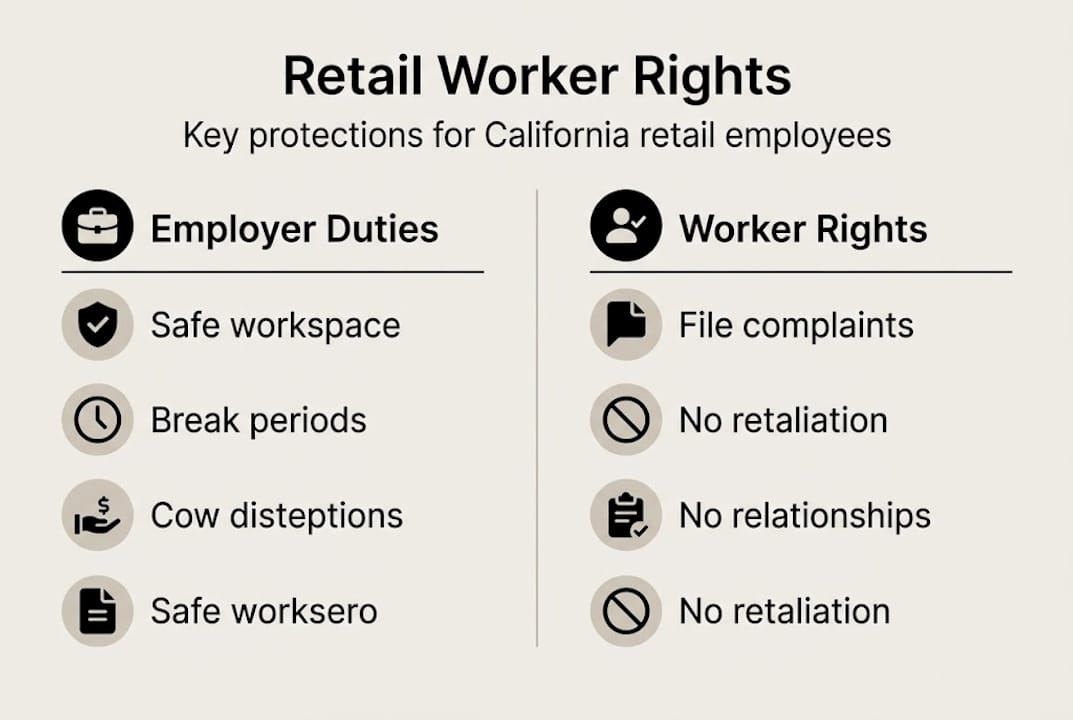
- Retaliation for reporting safety violations is illegal under California law.
- You cannot be fired, demoted, or disciplined for filing a complaint in good faith.
- Filing workplace complaints is a protected activity under multiple California statutes.
- Wage and hour protections apply to all California employees regardless of immigration status.
Taking these steps protects you and can also help other workers in your store or company who may be experiencing the same issues.
The uncomfortable truth: Brand image vs. reality in Beverly Hills retail
Customers walking into a Beverly Hills boutique see marble floors, attentive staff, and an atmosphere of exclusivity. What they don't see is the stockroom where workers lift heavy boxes without ergonomic support, or the break room where meal periods are routinely cut short.
The polished image of luxury retail often works against workers. Employers in these environments have strong incentives to suppress complaints because bad press can damage the brand. That pressure creates a culture where employees feel they cannot speak up without risking their jobs.
Strict California worker protections exist precisely because market forces alone don't fix these problems. But laws only work when workers know about them and use them. Employee reports consistently show that Beverly Hills retail faces systemic violations despite its upscale image.
The most effective change happens when workers document violations, file complaints, and connect with legal advocates who understand the system. Individual action matters. Collective action matters more.
Need help? Connect with experienced California employment lawyers
If you are dealing with unsafe conditions, wage theft, or retaliation at a Beverly Hills retail job, you don't have to navigate this alone. The Justice Shield Law team represents employees exclusively, with a focused approach to holding employers accountable under California law. We offer free, confidential consultations with no obligation. Whether you need help understanding your options, filing a complaint, or pursuing a legal claim, we are here to support you. Start with our free discrimination reporting guide to learn what to document and how to protect yourself from the start. Reach out today and let us review your situation.
Frequently asked questions
How do I file a safety complaint about a Beverly Hills retail job?
You can file with Cal/OSHA for physical safety hazards and with the California DLSE for wage, break, or retaliation issues. Both agencies accept complaints online or by phone.
What evidence helps most with workplace safety claims?
Photos, written records, witness contacts, and documented patterns of incidents are the strongest forms of evidence. Because Cal/OSHA has a 32% inspector vacancy rate, detailed documentation makes it much harder for your complaint to be dismissed.
Can I get fired for reporting unsafe work conditions?
No. Retaliation for reporting safety violations is illegal under California law, and DLSE protections give you the right to file a retaliation complaint if your employer takes adverse action against you.
Are luxury retail stores in Beverly Hills less likely to violate safety laws?
Not at all. PAGA lawsuits against Rodeo Drive retailers show that even high-end stores face serious compliance failures, including missing violence prevention plans and wage violations.
Recommended
- Justice Shield Law | California Employment Lawyers — Free Consultation
- Justice Shield Law | California Employment Lawyers — Free Consultation
- Justice Shield Law | California Employment Lawyers — Free Consultation
- Justice Shield Law | California Employment Lawyers — Free Consultation
- Safety Complaints and Retaliation in Huntington Beach | Serendib Law Firm