

TL;DR:
- Employees may face wrongful termination or retaliation after reporting workplace issues in Pasadena startups, despite beliefs that speaking up protects them.
- Legal protections are available, but employees must document their complaints and act promptly, preferably with legal assistance, to preserve their rights.
Many employees believe that speaking up about a workplace problem will shield them from being fired. That belief is understandable, but it is often dangerously wrong. In Pasadena's growing startup scene, employees who report harassment, safety violations, or discriminatory conduct can still face termination, and retaliation tied to complaints about workplace treatment has already affected employment status in this region. This article explains what qualifies as wrongful termination, what evidence matters most, and exactly what steps you should take if you were fired after raising a concern at your Pasadena startup.
Table of Contents
- Understanding wrongful termination and retaliation in Pasadena startups
- Real-life case studies: What Pasadena employees have faced
- The evidence you need: Building a wrongful termination case
- How to take action: Filing retaliation claims and seeking help
- Why conventional wisdom often fails Pasadena startup employees
- Get experienced legal support for wrongful termination claims
- Frequently asked questions
Key Takeaways
| Point | Details |
|---|---|
| Retaliation risk is real | Even employees who speak up in Pasadena startups can be unfairly terminated, so awareness is vital. |
| Strong documentation matters | Recording your complaint and maintaining written proof greatly improves your chances in a wrongful termination claim. |
| Act quickly for best results | There are strict time limits on filing retaliation claims, so seeking legal advice promptly is critical. |
| Legal support is available | Experienced Pasadena employment attorneys help protect your rights and explain the best steps forward. |
Understanding wrongful termination and retaliation in Pasadena startups
Wrongful termination occurs when an employer fires an employee for an illegal reason. This is different from a standard layoff, where a company eliminates positions due to budget cuts or restructuring. In a wrongful termination case, the firing itself violates a law or public policy, even if the employer frames it as a routine business decision.
Retaliation is a specific form of wrongful termination. It happens when an employer fires, demotes, or otherwise punishes an employee because that employee engaged in a legally protected activity. Reporting harassment, raising safety concerns, whistleblowing about fraud, or participating in a workplace investigation are all examples of protected activities under California and federal law.
Pasadena employment rights are shaped by both state and federal protections, and California is actually one of the strongest states for employee protections in the country. However, legal safeguards only work when employees know how to use them.
Startups create a unique and often riskier environment for these situations. Consider the dynamics:
- Smaller teams mean there is less organizational distance between the person who complained and the person making termination decisions.
- Informal HR processes are common at early-stage startups, which means complaints may not be handled through proper channels or documented carefully.
- Founder-driven culture can lead to retaliation that feels personal rather than procedural.
- Fear of disruption in small, tight-knit teams can make management view a complaining employee as a problem rather than a protected individual.
- Less legal oversight at small companies means managers may be unaware of, or indifferent to, anti-retaliation laws.
As wrongful termination matters in Southern California's tech and startup sectors show, terminations that follow internal complaints about safety or workplace conduct can quickly become the subject of serious legal action. The pattern is consistent: an employee speaks up, something changes in how they are treated, and termination follows.
"The most dangerous moment for a startup employee is not before they make a complaint. It is the weeks immediately after."
Common types of complaints that frequently trigger retaliation include reports of sexual harassment or gender discrimination, racial discrimination, unsafe working conditions, unpaid wages or overtime violations, and concerns about financial fraud or ethical misconduct. Understanding the legal definitions and startup context is your first step toward protecting yourself. To go deeper on your California wrongful termination rights, review the key protections that apply specifically to your situation.
Real-life case studies: What Pasadena employees have faced
Legal theory becomes much more meaningful when you see it play out in real cases. Pasadena and the broader California startup corridor have produced documented examples of exactly what employees in your position may face.
The JPL case in Pasadena
One of the most illustrative local examples involves a Pasadena employee at JPL, a federally funded research and development center managed by Caltech. A JPL employee named Emily Telles settled a lawsuit alleging sex and age discrimination and retaliation after she reported how a male subordinate treated her and other women. Her allegations included a "sham investigation," demotion, and adverse employment outcomes that followed her complaint. The case settled, meaning the matter did not go to full trial, but it illustrates a critical pattern: when employees raise concerns, investigations do not always protect them. In fact, the investigation itself can become a tool of retaliation.
The Lucid Motors case
For a more recent example that speaks directly to California tech and startup culture, the Lucid Motors chief engineer suit is worth examining closely. The former chief engineer filed a lawsuit alleging wrongful termination, discrimination, and retaliation. Central to the case were specific allegations about how the HR investigation was handled and the subsequent termination. This is a pattern seen repeatedly in tech companies: an employee raises a concern through HR, the investigation process treats them as the problem rather than the victim, and termination follows shortly after.
| Case | Location | Complaint type | Alleged outcome | Status |
|---|---|---|---|---|
| Emily Telles v. JPL | Pasadena, CA | Sex and age discrimination, harassment | Demotion, adverse outcomes, alleged sham investigation | Settled |
| Lucid Motors (chief engineer) | California | Discrimination, retaliation | HR investigation, termination | Lawsuit filed |
These are not isolated incidents. They reflect a broader pattern in California's rights for laid-off Pasadena workers and tech employees statewide. What stands out in both cases is the role of the internal investigation. Rather than protecting the complaining employee, the investigation became part of the adverse employment action.
What this means for you
If you work at a Pasadena startup and recently raised a concern, these cases should prompt you to take your situation seriously. Do not assume your employer's HR department is acting in your interest. Do not assume that because your complaint was filed formally, you are protected. The cases above show that documentation, timing, and legal support are all critical factors.
The evidence you need: Building a wrongful termination case
One of the most important things you can do right now is start gathering and preserving evidence. In wrongful termination and retaliation cases, building your claim in Southern California requires documenting the connection between your protected activity and your termination. Courts look for that link, and so do attorneys when evaluating whether your case is viable.
Here is what you need to collect and preserve:
Types of evidence that matter most
| Evidence type | Why it matters | Where to find it |
|---|---|---|
| Written complaints | Establishes date and content of your protected activity | Email records, HR portal, certified letters |
| Employer responses | Shows how management reacted after the complaint | Email chains, meeting notes |
| Performance records | Pre-complaint reviews show your standing before you spoke up | HR files, email attachments |
| Witness statements | Corroborates your account of events | Colleagues present during key events |
| Termination notice | Documents the stated reason for firing | Written notice, email notification |
| Timeline of events | Shows suspicious proximity of complaint and termination | Calendar records, email timestamps |
Pro Tip: Start documenting before you formally complain if you sense something is wrong. Note dates, names, and the exact words said to you. A contemporaneous record created at the time of an event carries far more weight than one reconstructed later from memory.
Step-by-step approach to building your case
- Preserve all communications. Forward work emails to a personal account before you lose access. Screenshot internal messaging platforms if permitted. Do not delete anything.
- Write a detailed timeline. List every significant event in chronological order: dates, times, who was present, what was said, and what changed after your complaint.
- Request your employment file. California law gives you the right to inspect and copy your personnel records. This can reveal whether negative performance notes appeared only after your complaint.
- Identify witnesses. Think about coworkers who observed the complaint, the aftermath, or the retaliation. Their accounts can be invaluable.
- Document the gap. Courts pay close attention to how much time passed between your complaint and your termination. A firing that comes days or weeks after a complaint is much more suspicious than one that comes a year later.
- Avoid signing anything without legal review. Employers often present severance agreements quickly and under pressure. These agreements can waive your right to sue if signed without legal counsel.
Understanding how to gather evidence for wrongful termination is one of the most powerful things you can do in the early stages of your case. Similarly, knowing how to file workplace complaints properly from the beginning can create an official record that supports your legal claim later.
How to take action: Filing retaliation claims and seeking help
Once you have gathered your evidence, the next step is knowing where to go and how to act. Taking the right steps in the right order can make a significant difference in the strength of your case.
Step 1: Report internally if you have not already done so
If you have not yet made a formal complaint, do so in writing. Use your company's official HR channels and send an email so there is a written record. Be specific: describe the conduct, name the people involved, and include dates.
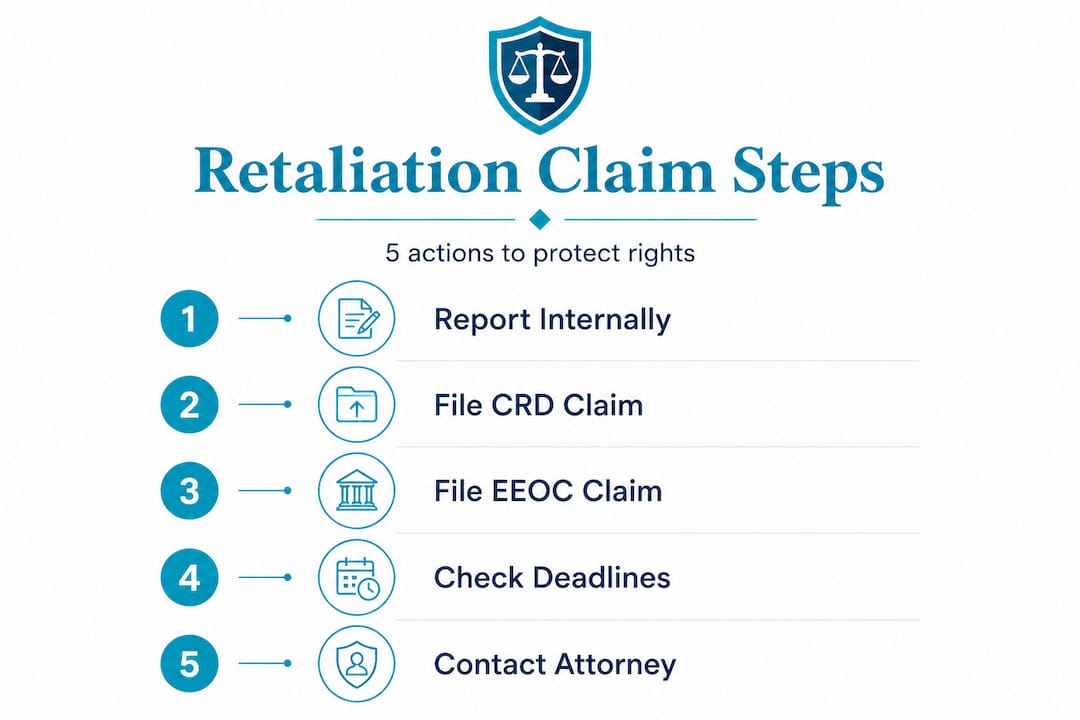
Step 2: Contact the California Civil Rights Department (CRD)
The CRD (formerly the DFEH) handles discrimination and retaliation complaints in California. Filing a complaint here is a required step before you can sue in state court under FEHA (the Fair Employment and Housing Act). You have three years from the date of the unlawful act to file with the CRD.
Step 3: Consider filing with the EEOC
For federal claims, the Equal Employment Opportunity Commission (EEOC) is your agency. Federal deadlines are shorter, typically 180 to 300 days from the act of retaliation. If you are pursuing federal claims alongside state claims, you need to act quickly.
Step 4: Be aware of the statute of limitations
Pro Tip: California's deadline for filing a CRD complaint was extended to three years in recent years, but other claims, including some federal claims and wage-related retaliation claims, have shorter windows. An attorney can help you identify all applicable deadlines before any expire.
Step 5: Consult an employment attorney
This is the step many employees delay, often to their detriment. An attorney who specializes in employee-side employment law can evaluate your evidence, identify the strongest claims, guide you through administrative filings, and represent you in litigation if necessary. As cases across California show, filing retaliation claims correctly requires both legal knowledge and strategic timing.
Wrongful-termination cases in Southern California startups consistently show that employees who act quickly, document thoroughly, and get qualified legal support are far better positioned than those who wait and hope the situation resolves on its own.
Why conventional wisdom often fails Pasadena startup employees
Most advice you will encounter tells you to report the problem, trust the process, and let HR do its job. That advice is incomplete at best and harmful at worst in the context of Pasadena startups.
Here is the reality: HR departments at startups are often small, understaffed, or entirely absent. The HR function may be handled by a founder, a part-time contractor, or a generalist with no training in employment law. When you report a complaint, that person is still a company employee whose primary obligation is to the company, not to you.
The retaliation patterns seen in Pasadena-area cases confirm that investigations can be used to manage employees out rather than protect them. What gets called an investigation may actually be a process designed to build a paper trail justifying termination, not to find the truth.
Conventional wisdom also fails to address the power imbalance in small startups. In a 15-person company, you may report directly to a founder who is close friends with the person you are reporting. Your complaint does not exist in a neutral institutional context. It lands directly in a personal and professional network that has every incentive to protect its own.
The whistleblower protections in tech startups that exist on paper are only as effective as your ability to invoke them. That requires documentation, awareness of your rights, and often an attorney who can apply pressure before the situation fully spirals.
Legal safeguards are real. But they are tools, not guarantees. The employees who succeed in these cases are the ones who treated their complaint as the beginning of a legal process, not just an internal HR matter. They kept records, sought advice, and moved with purpose. That is the approach we encourage you to take.
Get experienced legal support for wrongful termination claims

If you were fired after raising a concern at your Pasadena startup, you may have a strong wrongful termination or retaliation claim. At Justice Shield Law, our employment law attorneys represent employees exclusively. We do not represent employers. That focus means our entire strategy is built around fighting for your rights and holding companies accountable. We serve clients across Los Angeles and work with a Pasadena employment lawyer who understands the unique dynamics of local startup culture, the relevant courts, and the strongest arguments under California law. Contact us today for a free consultation. The sooner you reach out, the better we can protect your claim before deadlines pass.
Frequently asked questions
What kinds of workplace complaints are most likely to trigger retaliation in Pasadena startups?
Complaints about discrimination, harassment, safety violations, or unethical practices are most closely associated with retaliation in Pasadena startup environments. Retaliation tied to complaints about workplace treatment has been documented in several Pasadena-area cases.
Do I have to report my concerns internally before taking legal action?
While internal reporting is often advisable, California law does not always require it as a prerequisite for legal action. Even informal complaints can establish the foundation for a retaliation claim if terminations are tied to internal complaints about workplace conditions.
How long do I have to file a wrongful termination or retaliation claim in California?
Deadlines vary from 180 days to three years depending on the claim type and the agency you file with, but waiting even a short time can hurt your case. Consult a specialized employment attorney as soon as possible to identify all applicable deadlines.
What evidence is most persuasive for wrongful termination after a complaint?
Written complaints, dated emails, performance records from before and after the complaint, and witness statements are highly persuasive. A clear timeline showing terminations tied to internal complaints about workplace issues can be the strongest element in your case.
Can I be fired for making a complaint if the company says it was for "performance"?
Yes, employers routinely cite performance as the official reason for a termination, but that explanation does not automatically defeat a retaliation claim. If your performance record was positive before your complaint and negative notices appeared only afterward, California courts recognize that pattern as consistent with retaliation. Cases in this space have addressed this exact scenario, where an engineer fired after safety complaints faced a performance-based defense from the employer.