

TL;DR:
- Retaliation in Silicon Valley often involves subtle actions like demotions or exclusion rather than immediate firing.
- California law offers strong protections, but timely documentation and legal advice are crucial.
- Act quickly to document, seek legal support, and report through appropriate channels to defend your rights.
Reporting unethical behavior at a San Francisco tech company takes real courage, and far too many employees discover that doing the right thing comes with a steep professional price. Despite strong protections under California and federal law, retaliation remains a serious and ongoing risk. Many tech workers are uncertain whether their experience qualifies as whistleblowing, or they are unsure how to respond when their employer begins pushing back. This guide will give you a clear picture of what retaliation looks like in the tech industry, what legal protections apply to you, and exactly what steps to take to defend your rights.
Table of Contents
- Understanding whistleblower retaliation in San Francisco tech
- Common scenarios and signs of retaliation at tech companies
- Legal protections for whistleblowers in California tech
- How to report retaliation and protect your rights
- Why many San Francisco tech workers hesitate—and what actually works
- Need help with whistleblower retaliation? Legal support is available
- Frequently asked questions
Key Takeaways
| Point | Details |
|---|---|
| Recognize retaliation | Retaliation can be overt or subtle and often starts soon after whistleblowing. |
| Know your legal rights | California laws provide robust protections for tech workers facing retaliation. |
| Document everything | Save communications and records to support your case and defend your rights. |
| Act quickly | Strict deadlines for legal claims mean early action is essential for whistleblowers. |
| Seek expert support | Consult experienced legal professionals to navigate complex tech company cases. |
Understanding whistleblower retaliation in San Francisco tech
Whistleblower retaliation happens when an employer takes adverse action against you because you reported illegal conduct, safety violations, fraud, discrimination, or other workplace misconduct. In the San Francisco tech industry, retaliation does not always look the way you might expect. It rarely starts with a pink slip.
More often, it begins quietly. You report a data privacy concern to your compliance team, and two weeks later you are removed from a high-visibility project. You raise concerns about discriminatory hiring practices, and suddenly your performance reviews shift from glowing to critical. These subtle forms of retaliation are just as illegal as outright termination, but they are harder to recognize and easier for employers to deny.
Common forms of retaliation include:
- Demotion or reduction in job responsibilities
- Termination or layoff shortly after a report is made
- Reduction in pay, hours, or benefits
- Exclusion from meetings, projects, or key communications
- Hostile treatment or harassment from management
- Negative performance evaluations with no prior warning
- Blacklisting or negative references that affect future employment
The San Francisco tech community is tightly networked, which makes blacklisting a particularly sharp concern. A negative word from a manager at one major firm can travel fast through industry circles.
California worker protections cover employees across a wide range of industries, and tech workers are no exception. California Labor Code Section 1102.5, one of the most robust whistleblower statutes in the country, prohibits employers from retaliating against employees who report violations of state or federal law to a supervisor, government agency, or law enforcement. Federal laws including the Sarbanes-Oxley Act and the Dodd-Frank Act offer additional protections, especially relevant for publicly traded tech companies.
"Whistleblower retaliation claims against Bay Area technology companies have increased significantly as the industry faces greater regulatory scrutiny, with retaliation claims reflecting a pattern of subtle adverse actions that courts have found unlawful."
Understanding your rights starts with recognizing that the law is genuinely on your side. The challenge is knowing how to use it effectively.
Common scenarios and signs of retaliation at tech companies
Now that you know what retaliation is, let's get specific with examples and warning signs you can watch for in a real tech workplace environment.
Tech companies often have sophisticated HR teams and legal departments. That means retaliation tends to be documented carefully enough to look like legitimate business decisions on paper. Knowing the difference between a genuine performance concern and a manufactured pretext is critical.

Here is a look at common whistleblowing actions and the types of employer responses that may constitute retaliation:
| Whistleblowing action | Common retaliatory response |
|---|---|
| Reporting data privacy violations | Removed from product team; reassigned to lower-priority work |
| Raising concerns about gender pay gaps | Negative performance review; passed over for promotion |
| Reporting safety violations or labor law breaches | Reduced hours; labeled as "not a team player" |
| Disclosing financial fraud to regulators | Sudden termination; cited for unrelated policy violations |
| Reporting discrimination or harassment | Isolated from team; excluded from key meetings |
| Reporting immigration compliance issues | Transferred to different department without explanation |
Retaliation signs can be overt (obvious) or subtle (harder to pin down). Overt signs include formal write-ups, termination letters, or official demotions shortly after you made a report. Subtle signs are trickier:
- Your access to certain internal systems is restricted without explanation
- Your name is left off key email threads or project invites
- Colleagues begin treating you differently or avoiding you
- Your manager becomes dismissive or stops including you in decisions
- Praise and recognition you previously received suddenly stops
- You receive vague or shifting feedback that was not present before your report
San Francisco tech employee retaliation claims show a consistent pattern: retaliation begins within weeks of a report, and it builds gradually. That pattern is important because courts look at the timing and context of adverse actions.
Pro Tip: Start a private, dated journal the moment you notice any change in your treatment after making a report. Record what happened, who was involved, what was said or done, and when. Store this record outside company systems, such as a personal email or a secure personal device.
Legal protections for whistleblowers in California tech
With practical examples in mind, the next step is understanding exactly what legal protections exist and how to use them effectively.
California offers some of the strongest whistleblower protections in the United States. When you work in tech in San Francisco, several overlapping laws may apply to your situation, depending on what you reported and how your employer responded.
| Law | What it covers | Filing deadline |
|---|---|---|
| California Labor Code Section 1102.5 | Reporting violations of any state or federal law | 3 years to file civil lawsuit |
| California Whistleblower Protection Act | State employees reporting government misconduct | 12 months with DFEH |
| Sarbanes-Oxley Act (SOX) | Reporting securities fraud at publicly traded companies | 180 days with OSHA |
| Dodd-Frank Act | Reporting securities violations to the SEC | Up to 6 years |
| False Claims Act | Reporting government contract fraud | Varies; often 6 years |
| OSHA whistleblower statutes | Reporting workplace safety violations | 30 to 180 days depending on statute |
The deadlines are real and unforgiving. Missing a filing window can mean losing your right to pursue a claim entirely.
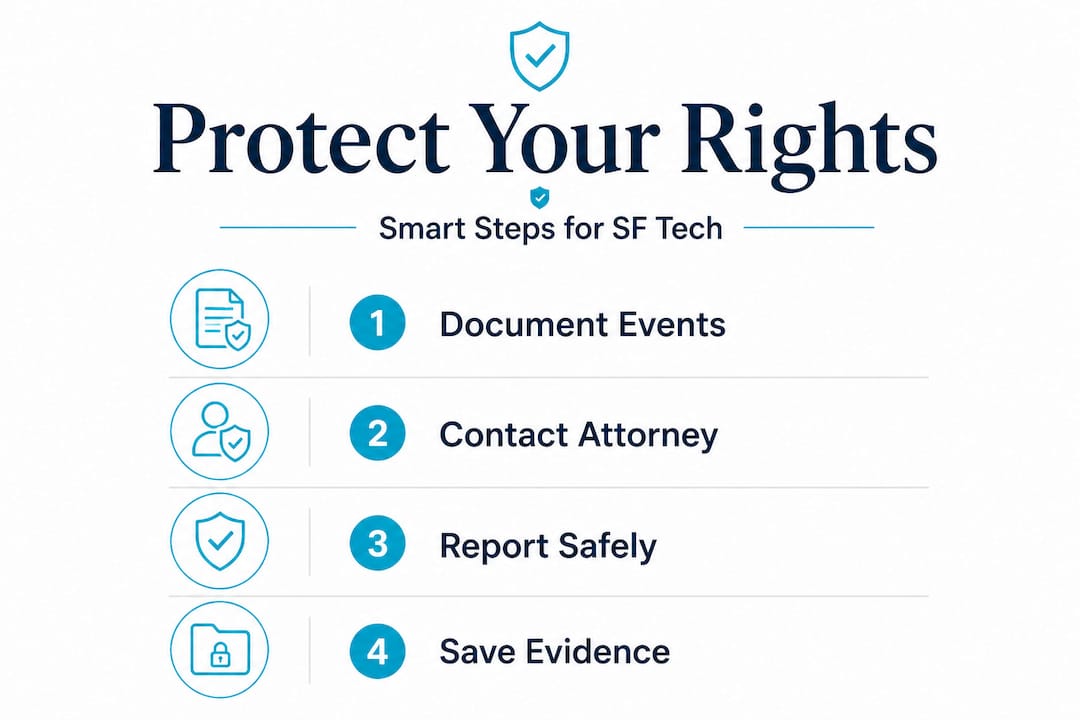
If you believe you are facing retaliation, here is what to do:
- Stop and document immediately. Write down everything that has happened since your report, including dates, names, conversations, and decisions that affected your role.
- Preserve all evidence. Save relevant emails, performance reviews, meeting notes, and any communications that show a change in treatment after your report.
- Review your employment contract. Many tech companies include arbitration clauses that limit where and how you can file a claim. Understanding your contract is an urgent first step.
- Consult an employment attorney before taking any formal action. An attorney can assess whether your arbitration agreement affects your options and advise on the strongest path forward.
- File a complaint with the appropriate agency. Depending on your situation, this could be the California Labor Commissioner, the Department of Fair Employment and Housing, OSHA, or the SEC.
- Continue to perform your job duties. Courts and agencies consider whether the employee behaved professionally. Maintaining your performance record protects your credibility.
Information about workplace safety protections and reporting discrimination steps can also help you understand how these protections interact with whistleblower law in California.
Pro Tip: Many tech employment contracts include mandatory arbitration clauses. These clauses can limit your right to file a lawsuit in court. Seek legal advice before signing any severance agreement or waiver, since these documents are often presented under pressure and can permanently affect your legal rights.
How to report retaliation and protect your rights
Armed with knowledge about your protections, it's time to learn exactly how to act if you are facing retaliation right now.
Acting quickly and systematically gives you the best chance of protecting your legal rights and your livelihood. Here is a step-by-step approach:
- Report internally first if it is safe to do so. Use your company's HR department, ethics hotline, or compliance team. Keep a copy of everything you submit and note the date and who received your report.
- Escalate to external agencies if internal channels fail or feel unsafe. File with the California Labor Commissioner's Office for state law violations, OSHA for safety-related retaliation, or the SEC's Office of the Whistleblower for securities-related reports.
- Contact an employment attorney as soon as retaliation begins. Time limits apply to nearly every claim. An attorney can help you file the right complaint with the right agency before the deadline passes.
- Request a formal record of any adverse employment actions. Ask in writing for documentation of any demotion, termination, or changes to your role or compensation.
- Build a support network carefully. Trusted colleagues, employee advocacy groups, and mental health professionals can all provide important support during a difficult process.
Understanding reporting workplace discrimination is closely connected to whistleblower reporting, since many retaliation cases involve overlapping claims. You may also find the sexual harassment complaint guide useful if your situation involves harassment as a form of retaliation.
Key documentation to gather and preserve includes:
- Emails and instant messages that show changes in your responsibilities or treatment
- Performance reviews from before and after your report, showing any sudden shift
- Copies of your original report and any responses from HR or management
- Witness statements from colleagues who observed the change in your treatment
- Records of meetings you were excluded from after making your report
- Payroll records if your compensation changed
- Your employment contract, including any non-disclosure or arbitration agreements
Confidential legal support is available to you. You do not need to navigate this process alone, and speaking with an attorney does not mean you have committed to filing a lawsuit. A free consultation can clarify your options without any obligation.
Why many San Francisco tech workers hesitate—and what actually works
We work with a lot of tech employees across California, and one of the most consistent things we hear is this: "I knew something was wrong, but I was afraid of what would happen to my career." That fear is understandable, and it is also one of the most effective tools employers have.
The San Francisco tech industry is built on relationships. People move between companies, serve on each other's advisory boards, and share investor networks. The worry about being blacklisted is not irrational. It is a real professional risk. What workers often underestimate, though, is how much that risk can be managed with the right strategy.
The employees who successfully navigate whistleblower retaliation cases share some common habits. They document obsessively, not out of paranoia, but out of discipline. They seek legal advice early, before they make any formal report, so they understand exactly what protections apply to them. They build quiet alliances with trustworthy colleagues who can serve as witnesses later if needed.
Counter to what many people assume, the bold, confrontational approach rarely works best. Filing a public complaint before consulting an attorney, threatening your employer openly, or discussing your situation widely in the workplace can actually weaken your legal position. Courts and agencies look for employees who followed proper procedures and acted in good faith.
Here is the part that surprises many people: employee rights in tech are genuinely enforceable when you have the evidence and the process to back them up. The law is not just a symbolic protection. Companies settle retaliation claims regularly because the liability is real. Knowing that changes the equation significantly.
We also encourage tech professionals to think beyond their individual situation. When you report misconduct and protect your rights, you make the industry safer for everyone. That is not a small thing, even when it feels isolating.
Need help with whistleblower retaliation? Legal support is available
If you are a tech employee in San Francisco who has reported misconduct and is now facing adverse treatment, you do not need to figure this out on your own. At Justice Shield Law, we represent employees exclusively. We understand the specific pressures and dynamics of the tech industry, including arbitration clauses, equity compensation at risk, and the fear of reputational harm. Our attorneys offer confidential consultations so you can explore your legal options without pressure or obligation. The earlier you reach out, the more options we can preserve for you. Your report mattered. Your rights matter too. Let us help you protect them.
Frequently asked questions
What counts as whistleblower retaliation in San Francisco tech companies?
Retaliation includes any adverse action taken because you reported illegal or unethical conduct, such as firing, demotion, pay cuts, or subtle forms like negative performance reviews and exclusion from projects. California retaliation claims cover a wide range of employer conduct, and you do not need to prove intent to win a case.
How soon should I act if I suspect retaliation after whistleblowing?
Act immediately by documenting every incident and contacting an employment attorney, since deadlines for filing state and federal whistleblower retaliation claims can be as short as 30 days under certain laws. Waiting can permanently close off your legal options.
Can I report retaliation anonymously as a tech employee in San Francisco?
You can report anonymously to external agencies like the SEC or OSHA, but internal company ethics hotlines may not guarantee true anonymity. Seeking legal guidance before filing any report will help you choose the safest and most effective approach for your situation.
What kind of evidence will strengthen my whistleblower retaliation claim?
The strongest claims include emails, performance reviews, payroll records, and witness accounts that show a clear timeline of adverse treatment following your report. Courts look for documented patterns of retaliation that began after you engaged in protected whistleblowing activity.
Recommended
- Justice Shield Law | California Employment Lawyers — Free Consultation
- Justice Shield Law | California Employment Lawyers — Free Consultation
- Justice Shield Law | California Employment Lawyers — Free Consultation
- Justice Shield Law | California Employment Lawyers — Free Consultation
- Snap Inc. reporting issues: California employee protections explained - California United Law Group
- Fight Workplace Retaliation In LA Tech Firms: 28M Reasons - Law Office of Brian Y. Shirazi, PC