
TL;DR:
- Warehouse workers in San Bernardino County often face wage theft through unpaid overtime and manipulated time records. Recent lawsuits reveal that collective and individual actions can recover back wages, with ongoing cases highlighting employer misconduct. Protecting your rights requires documenting your hours, understanding legal standards, and seeking legal support when necessary.
Warehouse workers across San Bernardino County are losing wages every week, and most don't realize they have legal options to get that money back. Overtime violations are not limited to faceless corporations in distant cities. They are happening right here, at distribution hubs and fulfillment centers many of you work in every day. A recent lawsuit filed against Volvo Cars USA in Ontario, CA alleged time record alterations to avoid paying overtime, proving that wage theft is a local, active problem. This guide explains your rights, walks through real cases, and shows you exactly what to do if you suspect your employer is shortchanging you.
Table of Contents
- Why unpaid overtime is a major issue for San Bernardino warehouse workers
- Recent lawsuits and outcomes: What real cases reveal
- How to recognize overtime violations in your warehouse job
- Steps to take if you suspect unpaid overtime or wage theft
- The uncomfortable truth: Why most warehouse wage violations remain hidden
- Protect your rights with local legal support
- Frequently asked questions
Key Takeaways
| Point | Details |
|---|---|
| Overtime violations are local and common | Warehouse workers in San Bernardino County face routine wage and overtime violations from major and local employers. |
| Lawsuits lead to real results | Recent cases have resulted in six-figure back pay awards and changes in wage policies for warehouse employees. |
| Know the warning signs | Keep an eye out for altered time records and denied meal/rest breaks, which are frequent ways overtime pay is withheld. |
| Document and act promptly | Accurate record keeping and timely complaints or legal action can greatly improve your chances of recovering unpaid wages. |
| Support matters | Collective action and legal support are often key to overcoming workplace retaliation and securing fair pay. |
Why unpaid overtime is a major issue for San Bernardino warehouse workers
The Inland Empire has become one of the largest warehouse and logistics hubs in the country. Tens of thousands of workers in San Bernardino County depend on these jobs. But high employment numbers do not automatically mean fair pay or legal compliance from employers.
According to a University of California Riverside report, warehouse jobs grew 54.9% from 2014 to 2023 in the Inland Empire. Despite that growth, the same report found that warehouse workers there average just $44,776 per year, roughly 75% of the regional wage average. That gap is not simply market forces at work. Part of the problem is wage theft, including unpaid overtime that workers never see on their paychecks.
| Category | Warehouse workers | Regional average |
|---|---|---|
| Average annual wages | $44,776 | ~$59,700 |
| Job growth (2014 to 2023) | 54.9% | Varies by sector |
| Wage gap vs. regional avg. | About 75% | 100% baseline |
Unpaid overtime directly shrinks your take-home pay. In California, you are entitled to time-and-a-half for any hours worked over 8 in a single day, and also for hours over 40 in a week. Double time applies after 12 hours in a day. When employers manipulate time records or deny meal breaks, they are stealing money you have earned.
Here is what that can look like in practice:
- Your time card shows you clocked out at your scheduled time, even though you kept working.
- You worked through your meal break but your records show a full break was taken.
- Your supervisor tells you to "just finish the task" without logging the extra time.
- Your shift regularly runs long, but your paycheck never reflects those additional hours.
These are not honest mistakes. These are patterns. And recovering unpaid wages in California is possible when you know what steps to take.
Pro Tip: Even if your employer says you are exempt from overtime as a salaried worker, California law has strict requirements for that exemption. Many warehouse and logistics employees classified as exempt are actually entitled to overtime. Always verify your status with an employment attorney.
Recent lawsuits and outcomes: What real cases reveal
Real lawsuits from your area show exactly how wage theft happens and what workers can win when they push back. These are not abstract legal theories. These are cases involving employers you may recognize.
Volvo Cars USA in Ontario, CA
Huprich Law Firm recently filed a lawsuit against Volvo Cars USA for altering time records to avoid paying required overtime to workers at a facility in Ontario, California. The allegations include wage violations, retaliation, unsafe working conditions, and bias. This case illustrates a critical point: time record manipulation is not accidental. It is a deliberate tactic to reduce labor costs at the direct expense of workers.
Amazon San Bernardino air hub
Amazon workers at the San Bernardino air hub recently won $100,000 in back wages after the Teamsters union filed complaints about missed second meal breaks. Individual workers received payouts as high as $8,700. This outcome shows that collective complaints, when backed by documentation and legal pressure, can produce real financial results for workers.
Juan Loera vs. Amazon San Bernardino
Juan Loera, a former Amazon warehouse worker from San Bernardino, filed a lawsuit alleging unpaid wages during forced leave after he suffered an on-the-job injury. His case highlights how wage violations often intersect with discrimination and retaliation, particularly when workers are injured or speak up about conditions.
"Workers who come forward about wage violations in San Bernardino warehouses are not alone. Recent settlements and ongoing lawsuits show that the legal system can and does hold employers accountable when workers take action."
Here is a comparison of key cases and their outcomes:
| Case | Violation alleged | Outcome or status |
|---|---|---|
| Volvo Cars USA, Ontario CA | Altered time records, denial of overtime | Lawsuit filed, ongoing |
| Amazon San Bernardino air hub | Missed second meal breaks | $100,000 in back pay awarded |
| Juan Loera vs. Amazon | Unpaid wages during forced injury leave | Lawsuit filed, ongoing |
These cases share common threads. Altered time records, denied meal breaks, and retaliatory practices all appear across multiple employers. If you want to understand your own exposure to these risks, reviewing Amazon warehouse safety violations and the legal standards they involve can help you make sense of your situation.
Common tactics employers use include:
- Editing digital time clock records after the fact
- Pressuring workers not to log overtime hours
- Denying legally required 30-minute meal breaks for shifts over five hours
- Treating a second meal break as optional when it is legally required after ten hours
How to recognize overtime violations in your warehouse job
Knowing your legal rights is the first step to protecting them. California law is specific about what employers owe you, and it is more protective than federal law in several ways.
Under California law, you are owed:
- Time-and-a-half for all hours worked beyond 8 in a day
- Time-and-a-half for the first 8 hours worked on the seventh consecutive day of a workweek
- Double time for hours beyond 12 in a single day
- Double time for all hours beyond 8 on the seventh consecutive day of a workweek
Employers in warehouse settings commonly use time record alterations and meal break denials as their primary tactics. The Amazon settlement alone showed that missed meal breaks can generate six-figure liability for employers.
Here are the clearest red flags that you may be experiencing wage theft:
- Your pay stubs do not show hours you know you worked
- You regularly work during meal or rest breaks without separate compensation
- Your supervisor instructs you verbally to stay late but tells you not to log the time
- Your paycheck never shows overtime premiums despite long shifts
- You notice discrepancies between your personal records and your official time card
If any of these sound familiar, start taking steps to protect yourself. Here is how to document violations before they become harder to prove:
- Keep a personal daily log. Write down your start time, stop time, and any breaks actually taken every single workday.
- Save every pay stub. Compare what you were paid against the hours you actually logged.
- Take photos of posted schedules. These can establish what shifts you were assigned versus what appeared in your time records.
- Record any verbal instructions about not logging overtime in writing. Send a follow-up email to create a paper trail.
- Save text messages and emails from supervisors related to your hours or working conditions.
Pro Tip: California Labor Code Section 226 requires employers to provide accurate, itemized wage statements. If your pay stub is missing required information or contains incorrect hours, that is itself a separate violation your attorney can pursue alongside your overtime claim.
Understanding your rights means knowing where to look for support. Reviewing wage theft remedies under California law and learning about your San Bernardino employment rights are smart starting points before you take formal action.
Steps to take if you suspect unpaid overtime or wage theft
Once you have identified the signs and started documenting your situation, you have several options for pursuing your claim. Each path has different pros and cons depending on your circumstances.
Step 1: Gather all available evidence
Pull together every piece of documentation you have. Pay stubs, time cards, your personal daily log, text messages, emails, and any posted or sent schedules are all relevant. The stronger your documentation, the stronger your claim.
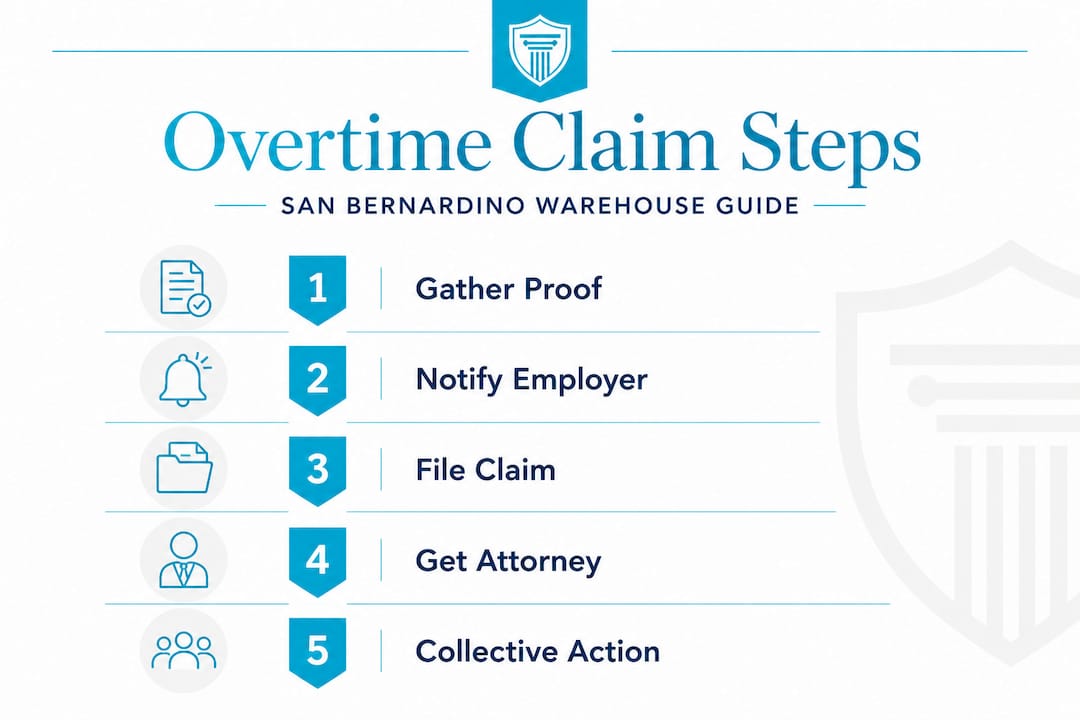
Step 2: Raise the issue internally (carefully)
You may choose to bring the issue to HR or your direct supervisor first. Do this in writing so you have a record. However, be aware that retaliation is a real risk. If you experience any negative consequences after raising the issue, document those too. Know that California law protects you from retaliation for reporting wage violations.
Step 3: File a wage claim with the California Labor Commissioner
The California Labor Commissioner's Office handles wage theft complaints at no cost to you. You can file a Bonta Wage Claim online or in person. The Labor Commissioner can investigate and order your employer to pay back wages, penalties, and interest. This is a practical option for workers who do not want to hire an attorney but still want formal enforcement.
Step 4: Consult an employment attorney
For serious or repeated violations, consulting an employment attorney is the most powerful step. An attorney can evaluate whether you have a claim, explain your options, and help you recover not just back wages but also penalties and legal fees. Many employment attorneys work on a contingency basis, meaning you pay nothing unless you win.
Step 5: Consider collective action
As the Amazon settlement shows, collective complaints filed through a union or alongside coworkers often produce larger results faster. If multiple workers have experienced the same violations, a group claim can carry significantly more weight than individual action.
Key evidence items to preserve at every stage:
- All printed or digital pay stubs going back at least three years
- Personal time logs you have kept independently
- Any schedules or shift assignments from supervisors
- Written communications about your hours, breaks, or any disciplinary actions
If you were fired or penalized after raising concerns, you may also have rights under retaliation law. Understanding wrongful termination rights and the process for filing retaliation claims with the California Labor Commissioner can help you respond effectively.
Pro Tip: California has a three-year statute of limitations for most wage claims, and four years for claims under the Unfair Competition Law. Do not wait. The sooner you act, the more wages you can recover.
The uncomfortable truth: Why most warehouse wage violations remain hidden
Legal victories like the Amazon settlement are meaningful. But they represent only a fraction of the violations actually taking place in San Bernardino County warehouses every day. The uncomfortable reality is that most wage theft never gets reported, let alone resolved.
Fear drives much of the silence. Warehouse workers, particularly those in immigrant communities or in non-union facilities, often worry that speaking up will cost them their jobs. Employers sometimes make this fear explicit, directly or indirectly warning workers that complaints will have consequences. That kind of pressure works. It keeps wages stolen and workers quiet.
The Teamsters credited their union pressure for the Amazon settlement, while Amazon disputed any union involvement in the resolution. That disagreement itself tells a story. Employers rarely acknowledge external pressure even when it clearly worked, because admitting it would invite more of it.
Collective action breaks through the fear barrier in ways individual complaints often cannot. When workers act together, the risk to any one individual is lower, and the pressure on the employer is higher. Legal settlements and back pay awards, while valuable, rarely change the underlying workplace culture on their own. Sustained pressure, whether through unions, legal filings, or organized worker complaints, is what drives lasting change.
Understanding how retaliation claims work is essential knowledge for any worker who is afraid to speak up. California's retaliation protections are among the strongest in the country. Using them is not just your right. It is one of the few tools that creates real accountability for employers who choose to steal from their workers.
Protect your rights with local legal support
If you are a warehouse worker in San Bernardino County and you believe your employer has violated your overtime rights, you do not have to navigate this alone. At Justice Shield Law, our employment law attorneys represent employees exclusively. We never represent employers. Our team understands the specific challenges facing warehouse workers in the region, from altered time records to denied meal breaks and retaliatory firings. Whether you need guidance on a single paycheck discrepancy or representation for a pattern of ongoing violations, our San Bernardino County lawyer team is ready to help. Contact us today for a free consultation, and find out how much you may be owed.
Frequently asked questions
What counts as unpaid overtime in a San Bernardino warehouse?
Unpaid overtime means your employer is not paying you time-and-a-half after 8 hours in a single day or 40 hours in a week, including situations where they alter time records or deny required meal breaks to hide the extra time worked.
How much back pay have local warehouse workers won for overtime violations?
Amazon warehouse workers in San Bernardino recently won $100,000 in back wages for missed second meal breaks, with individual payouts reaching as high as $8,700 per worker.
Can I be fired for complaining about unpaid overtime?
Firing or punishing a worker for reporting wage violations is illegal under California law, and you have the right to file a retaliation claim if your employer retaliates against you for speaking up.
What evidence should I save to support an overtime claim?
Save all pay stubs, personal time logs, posted work schedules, and any written communications from supervisors about your hours or breaks, as these form the foundation of a strong wage claim.
Is collective action more effective than acting alone?
Cases like the Amazon settlement show that worker complaints combined with union pressure are often the critical factor in winning larger settlements, though individual claims can also succeed with proper documentation and legal support.