
TL;DR:
- Many Fresno agricultural workers face persistent safety violations, often unreported due to fear and systemic gaps.
- Enforcement largely relies on complaints, but low inspection rates and retaliation fears hinder proper oversight.
Working in Fresno's agricultural fields means facing daily risks that most people never see. In February 2024, a crash killed seven agricultural workers connected to Lion Farms LLC, and a federal court later entered a consent judgment ordering the company to comply with federal farmworker safety and transportation requirements. That tragedy is not an isolated event. Many farmworkers in Fresno face unsafe conditions every day and do not know which agency to call, how to file a complaint, or whether they are protected by law. This guide will clarify your rights, identify the most common violations, and show you the legal recourse available to you.
Table of Contents
- Common workplace safety violations in Fresno agriculture
- Who enforces your workplace safety rights?
- How frequent are inspections and enforcement actions in Fresno?
- Legal remedies and financial penalties for safety violations
- The uncomfortable truth about workplace safety enforcement in Fresno agriculture
- Get legal help and protect your rights in Fresno agriculture
- Frequently asked questions
Key Takeaways
| Point | Details |
|---|---|
| Frequent violations | Unsafe transportation, pesticides, and heat risk are commonly reported hazards in Fresno agriculture. |
| Multiple agencies | Federal (MSPA) and state (Cal/OSHA) law may overlap, but which agency helps depends on the violation type. |
| Enforcement gaps | Inspections are rare compared to violations, meaning many hazards go unchecked. |
| Legal remedies available | Workers can win back pay, penalties, and improved safety—even if undocumented. |
| Action is key | Document and report unsafe work conditions early; legal support increases your chances of protection. |
Common workplace safety violations in Fresno agriculture
After understanding why safety matters, it is important to know what specific hazards you are most likely to encounter when working in Fresno's fields and packing operations.
Agricultural work in Fresno carries a wide range of risks, but certain violations appear repeatedly in enforcement records and investigative reporting. Recognizing them is the first step toward protecting yourself.
Transportation safety failures
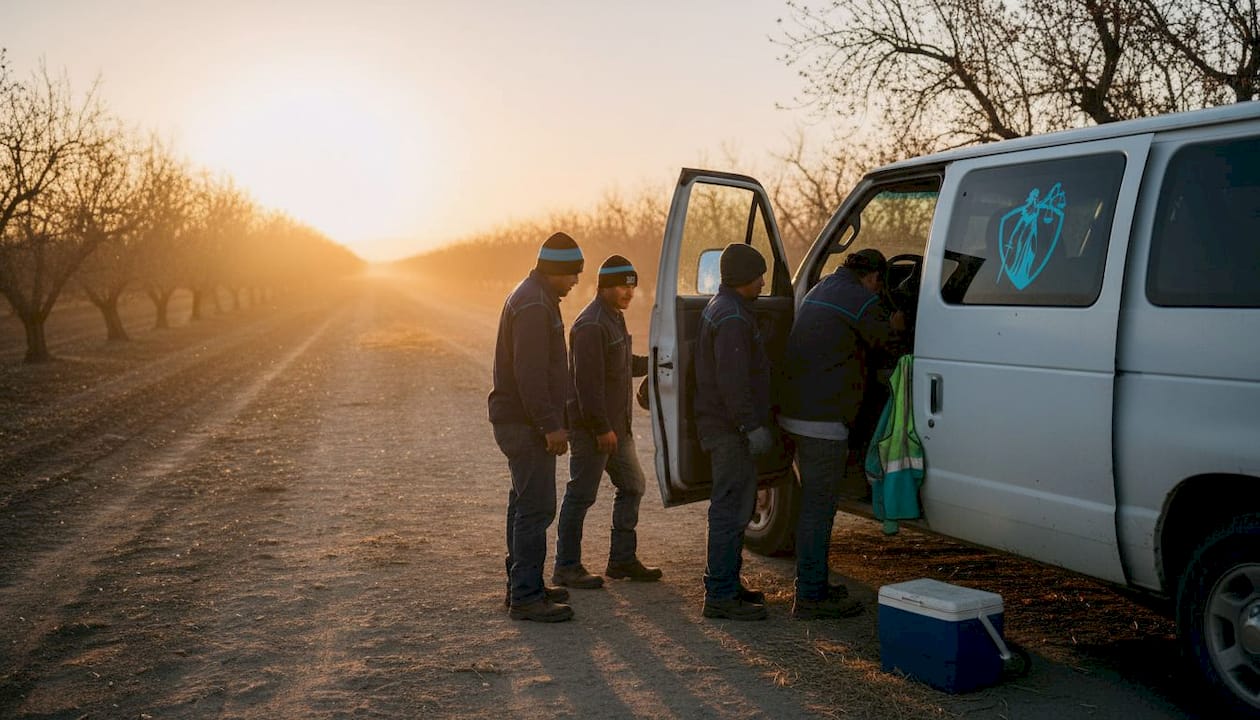
One of the most dangerous and documented hazards involves how workers are transported to and from job sites. The Department of Labor alleged that Lion Farms violated MSPA by using unsafe transportation practices, including unlicensed drivers and vehicles without adequate insurance coverage. The Migrant and Seasonal Agricultural Worker Protection Act, known as MSPA, specifically governs how farm labor contractors must transport workers. Overloaded vans, unqualified drivers, and vehicles that fail safety inspections are all violations that can and do cost lives.
Pesticide exposure and reporting failures
Pesticide exposure is another widespread risk. Workers in Fresno county fields are frequently near active chemical applications, yet reporting of related illnesses is often incomplete. Investigations have found low inspection rates and documented undercounting of pesticide-related illnesses, in part due to fear of retaliation and incomplete employer documentation. This means the actual scale of harm is likely larger than official numbers suggest.
Heat illness and inadequate protections
California's Central Valley routinely records extreme summer temperatures. Despite Cal/OSHA's heat illness prevention standard, many employers fail to provide adequate shade, water, or rest breaks. Heat illness can progress from cramps and exhaustion to heat stroke and death within hours.
Common violations at a glance
| Violation type | Primary risk | Governing law |
|---|---|---|
| Unsafe transportation | Crashes, fatalities | MSPA (federal) |
| Pesticide exposure | Illness, chemical injury | Cal/OSHA, DPR |
| Heat illness | Exhaustion, death | Cal/OSHA |
| Lack of sanitation | Infection, illness | Cal/OSHA |
| Retaliation for complaints | Job loss, intimidation | MSPA, California Labor Code |
Many violations go unreported because workers fear losing their jobs or facing immigration consequences. That fear is understandable, but it is important to know that the law prohibits employers from retaliating against workers who report unsafe conditions. You can also look into Cal-OSHA workplace investigations to understand how the process works in Fresno specifically.
"Fear of retaliation and incomplete documentation contribute to significant undercounting of pesticide-related illnesses among California farmworkers." — Capital & Main investigative reporting
Who enforces your workplace safety rights?
Now that you know what hazards to look for, it is important to understand who is responsible for protecting your safety and how enforcement actually works.
Two primary systems protect Fresno agricultural workers: federal law under MSPA and California state law enforced by Cal/OSHA. Knowing which agency handles your type of complaint can save you time and significantly improve your outcome.
Federal protections under MSPA
MSPA applies specifically to migrant and seasonal agricultural workers. It governs farm labor contractor licensing, transportation safety, housing, and wage disclosure. When a contractor violates transportation rules, as Lion Farms allegedly did, federal agencies like the Department of Labor's Wage and Hour Division are the ones who investigate and pursue penalties. Federal enforcement can result in court orders, back wage payments, and civil money penalties.
California state protections under Cal/OSHA
For heat illness, pesticide exposure, general equipment safety, and sanitation, Cal/OSHA is your primary agency. Cal/OSHA operates under California's state OSHA plan, which means federal MSPA and Cal/OSHA protections work in parallel. You do not have to choose one or the other. In many situations, both may apply to your complaint.
Which agency covers your situation?
| Issue type | Federal agency (MSPA) | State agency (Cal/OSHA) |
|---|---|---|
| Unsafe van or bus transport | Yes | Limited |
| Heat illness prevention | No | Yes |
| Pesticide safety | No | Yes (with DPR) |
| Contractor licensing violations | Yes | No |
| Wage and hour violations | Yes (WHD) | Yes (Labor Commissioner) |
Workers may file complaints directly with the Cal/OSHA district office in Fresno, or they can contact the Department of Labor's Wage and Hour Division for MSPA-related issues. If you have experienced retaliation for reporting unsafe conditions, there are also specific protections available. You can learn more about filing retaliation claims to understand your protections under California law.
Pro Tip: Start documenting unsafe conditions before you file any complaint. Photograph hazards, save any text messages or notes from supervisors, and write down dates and details. This documentation becomes critical if your case goes to investigation or litigation.
How frequent are inspections and enforcement actions in Fresno?
Understanding who enforces the law is only part of the picture. Let's look at how often enforcement actually happens in your area.
The gap between what the law requires and what actually gets inspected in Fresno is significant. Enforcement data and investigative reporting both reveal that inspection frequency is far lower than most workers assume.
The numbers tell a troubling story
In 2023, there was one inspection for every 146 times pesticides were applied across eight top-producing California counties. That ratio means the overwhelming majority of pesticide applications happen with no state oversight at all. For a worker exposed to chemicals during any one of those uninspected applications, the harm can be real while the official record shows nothing.
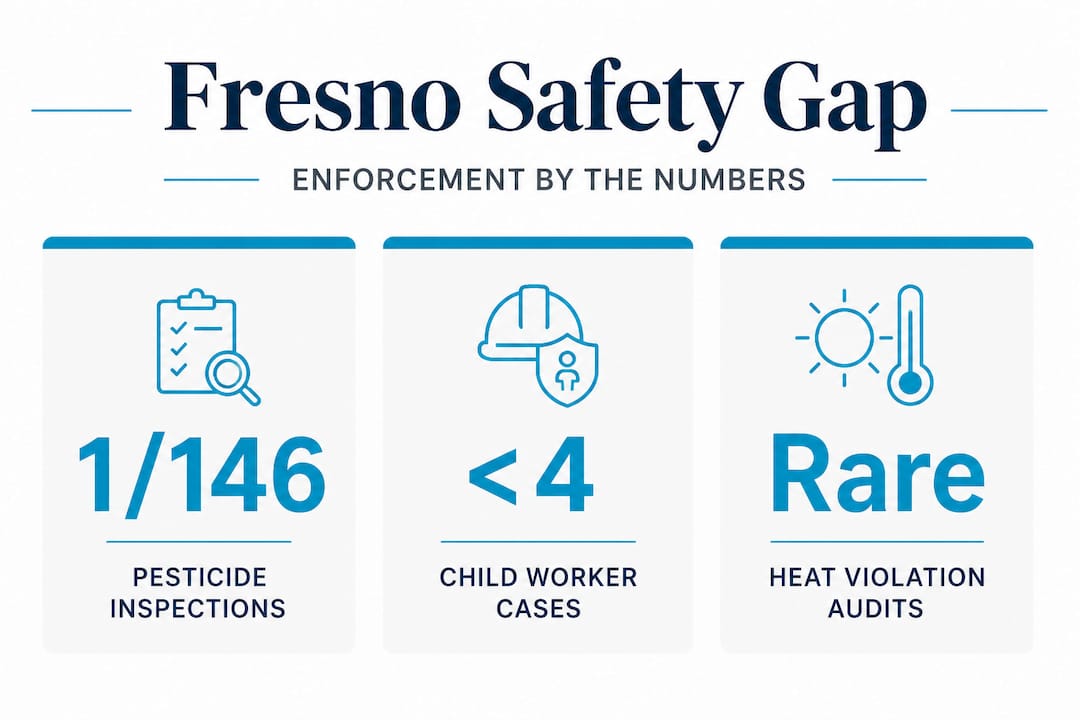
Fresno's Cal/OSHA field office averages fewer than four inspections per year specifically targeting child farmworker safety, according to records and enforcement reporting covering California's agricultural regions. Even when inspectors do visit, documentation problems and worker reluctance to speak up mean that findings often undercount the actual scope of violations.
Why underreporting distorts the data
Workers frequently do not report injuries or illnesses because they fear employer retaliation, worry about immigration consequences, or simply do not know they have the right to file a complaint. Some employers discourage reporting by making workers feel they could lose pay or their position. These barriers result in official databases that fail to capture what is actually happening in Fresno fields.
Enforcement frequency snapshot
| Inspection category | Estimated frequency (Fresno area) | Gap concern |
|---|---|---|
| Pesticide safety | 1 per 146 applications | Extremely high |
| Heat illness compliance | Infrequent, complaint-driven | High |
| Child farmworker safety | Fewer than 4 per year | Very high |
| Transportation compliance | Varies by complaint volume | High |
The low inspection rate does not mean violations are rare. It means they are rarely caught before someone gets hurt. You should not wait for an inspector to notice a hazard. If you see something unsafe, you have the right to report it. Understanding trends in safety enforcement across California can give you a broader sense of how state agencies prioritize complaints.
Legal remedies and financial penalties for safety violations
If a violation is investigated and proven, real consequences follow. Let's look at exactly what remedies are available and how they can benefit you directly.
The enforcement system is not just about punishing employers. It is also designed to put money back in workers' pockets and create safer conditions going forward. The Lion Farms case provides a concrete example of what successful enforcement can produce.
What happened in the Lion Farms case
After investigating the February 2024 crash and subsequent violations, the Department of Labor calculated $39,013 in back wages owed to 12 employees and ordered $89,886 in civil money penalties in addition to those back wages. The employer was also required under a consent judgment to correct transportation practices and comply with MSPA going forward. That is a meaningful financial and operational consequence.
The five stages of a typical enforcement action
- Filing your complaint. You submit a complaint to Cal/OSHA, the Department of Labor, or another relevant agency. Your complaint can be anonymous in many cases.
- Investigation. The agency reviews your complaint, may conduct an inspection, and interviews workers and supervisors.
- Findings and citations. If violations are confirmed, the agency issues citations and calculates penalties owed.
- Court action or settlement. Serious cases may result in a consent judgment, court order, or negotiated settlement.
- Wage recovery and safer practices. Workers receive back wages, and employers are required to make operational changes.
Pro Tip: Workers can receive financial compensation even if they are undocumented. Workplace safety laws and wage protections apply to all employees regardless of immigration status. Do not let fear of your status stop you from seeking what you are owed.
"In the Lion Farms matter, DOL calculated $39,013 in back wages owed to 12 employees and ordered $89,886 in civil money penalties." — U.S. Department of Labor, January 2026
Your evidence plays a central role in every stage of this process. Photographs, medical records, witness names, and pay stubs all support your claim. If you are thinking about recovering unpaid wages, documentation makes a substantial difference in how much you can recover. The Fresno employment lawyers at Justice Shield Law can help you understand what evidence you need and how to use it.
The uncomfortable truth about workplace safety enforcement in Fresno agriculture
Legal pathways exist. The laws are written clearly. Agencies have authority to act. So why do so many Fresno agricultural workers still get hurt?
Here is what the data and real-world experience reveal: enforcement systems in agricultural regions like Fresno are structurally underpowered relative to the number of workers and worksites they are supposed to cover. Record-based reporting shows that inspection frequency and citation issuance in California's agricultural regions may not match exposure volume at all. That is not a minor administrative gap. It means that even a dangerous employer with a history of violations may face no inspection for years.
The deeper issue is that enforcement is largely reactive, not proactive. Agencies typically respond to complaints rather than systematically auditing high-risk worksites. When workers are afraid to complain, the system essentially pauses. Cultural and economic pressures compound this. Many workers depend on the same employer for housing, transportation, and income, which makes reporting feel impossible.
What actually moves the needle? Worker knowledge and collective action. When multiple workers report the same hazard, agencies respond faster. When workers document conditions and connect with legal advocates before something catastrophic happens, they have much more power. Waiting until after a serious injury to gather evidence is one of the most common and costly mistakes we see.
Our experience tells us this clearly: the workers who fare best are those who understand their rights ahead of time, document consistently, and reach out for legal guidance early. Agencies have limits. A skilled attorney does not carry those same limits. Take a deeper look at safety enforcement in Fresno so you can understand the full picture before you need to act.
Get legal help and protect your rights in Fresno agriculture
If you suspect your workplace safety rights have been violated, here is how to get personalized help navigating your next steps.
At Justice Shield Law, our employment law attorneys represent workers exclusively. We do not represent employers. Our Fresno team understands the specific hazards facing agricultural workers, the agencies involved, and the legal strategies that produce real results. We offer free consultations so you can understand your eligibility for compensation before committing to anything. Acting promptly matters because evidence disappears, statutes of limitations apply, and conditions can change quickly. Our Fresno employment lawyers are ready to review your situation and advise you on the strongest path forward. You do not have to face this alone.

Frequently asked questions
What should I do if I see unsafe conditions in a Fresno agricultural job?
Document what you observe with photos or written notes, report the condition to your supervisor or directly to the Cal/OSHA district office, and contact a legal representative if the danger is not addressed promptly.
Can I file a safety complaint if I am undocumented?
Yes. Federal MSPA and Cal/OSHA protections apply to all agricultural workers regardless of immigration status, and agencies are generally prohibited from using complaints as a basis to report workers to immigration authorities.
Who investigates heat illness and pesticide safety complaints in Fresno agriculture?
Cal/OSHA is the primary agency for heat illness and pesticide safety violations under California's state OSHA plan, and it handles complaints for all agricultural employees in Fresno.
What penalties can employers face for workplace safety violations?
Employers can face fines, court orders requiring operational changes, and back wage obligations. In the Lion Farms case, DOL ordered $39,013 in back wages and $89,886 in civil money penalties, showing that financial consequences can be substantial.