
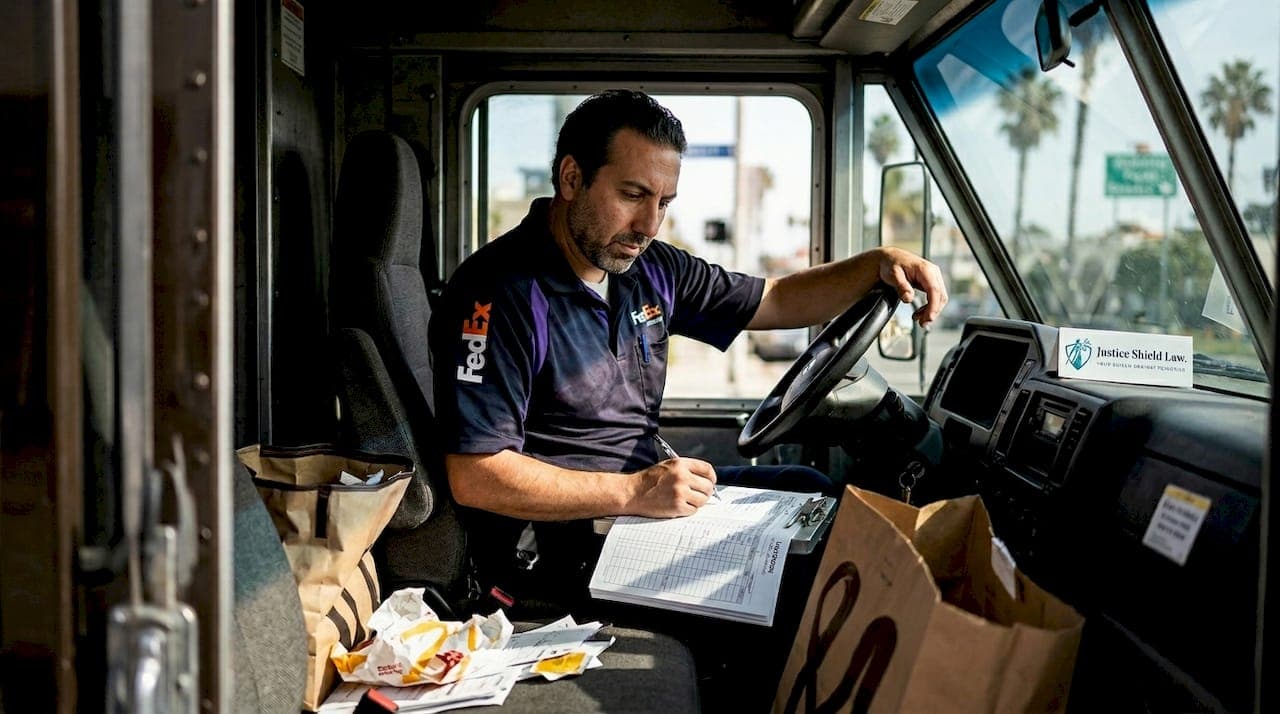
TL;DR:
- FedEx drivers face ongoing wage and hour violations including unpaid overtime and missed breaks.
- Courts often find FedEx exercises sufficient control to classify drivers as employees, entitling them to benefits.
- Proper documentation and early legal action improve chances of recovering owed wages.
FedEx has paid nearly $500M in settlements related to driver misclassification and wage violations, yet the lawsuits keep coming. If you drive for FedEx in Long Beach, you may be owed back pay, overtime, or both, and you might not even realize it. This guide breaks down the most common wage and hour violations FedEx drivers face, explains how the company's business model affects your legal status, and gives you a clear, practical path to understanding and enforcing your rights. Whether you are a current driver or recently left the job, what you learn here could directly affect your paycheck.
Table of Contents
- What counts as a wage and hour violation for FedEx drivers?
- Inside the FedEx Independent Service Provider (ISP) model
- Recent legal cases and settlements in Long Beach and California
- How to document and report wage and hour violations
- What most drivers and lawyers miss about FedEx wage cases
- Legal support for FedEx drivers in Long Beach
- Frequently asked questions
Key Takeaways
| Point | Details |
|---|---|
| Wage violations are common | FedEx drivers in Long Beach often face unpaid overtime and misclassification issues that are the subject of major lawsuits. |
| ISP status is debated | FedEx’s Independent Service Provider model remains controversial, with courts weighing actual control over job titles. |
| Take action early | Drivers benefit from keeping careful records and seeking legal advice before major settlements or class actions. |
| Documentation is key | Collecting evidence is crucial for drivers who need to prove wage and hour violations. |
What counts as a wage and hour violation for FedEx drivers?
Wage and hour violations happen when an employer fails to pay workers what the law requires. For FedEx drivers in Long Beach, these violations take several forms, and many go unreported simply because drivers do not know what to look for.
The most common violations include:
- Unpaid overtime: California law requires overtime pay for any time worked beyond 8 hours in a single day or 40 hours in a week. If you regularly work long routes but your pay stub does not reflect overtime rates, that is a red flag.
- Missed meal and rest breaks: California workers are entitled to a 30-minute unpaid meal break for shifts over 5 hours and a paid 10-minute rest break for every 4 hours worked. Skipping or cutting these short is a violation.
- Misclassification as an independent contractor: When a company labels you a contractor to avoid paying benefits and overtime, but still controls how, when, and where you work, that is misclassification. It is one of the most costly and widespread violations in the delivery industry.
- Expense reimbursement failures: If you pay out of pocket for fuel, vehicle maintenance, or uniforms that are required for the job, California law may entitle you to reimbursement.
Important: Ongoing lawsuits allege that FedEx continues to exercise significant control over drivers even after restructuring its workforce model, which courts have found relevant in determining employee status.
A critical point many drivers miss: not all truck drivers are exempt from overtime rules. Drivers operating vehicles that weigh under 10,001 pounds are not exempt from California overtime protections. This matters because many FedEx Ground drivers use smaller delivery vans and trucks that fall below this threshold.
Understanding your rights under California workers' rights law is the first step to knowing whether you have a valid claim.
Pro Tip: Start keeping a daily log of your actual start time, end time, break times, and total miles driven. Even a simple notes app on your phone can create a record that becomes critical evidence later.
Inside the FedEx Independent Service Provider (ISP) model
After facing significant legal pressure before 2014, FedEx restructured how it classifies its delivery workforce. Instead of contracting directly with individual drivers, FedEx began requiring drivers to work through what it calls Independent Service Providers, or ISPs. These are small businesses that contract with FedEx and then hire drivers.
On paper, this sounds like a clean separation. In practice, plaintiffs in multiple lawsuits argue the ISP model is a sham to avoid liability while maintaining the same level of operational control over drivers.
Here is how the three main worker classifications compare:
| Status | Who controls work? | Entitled to overtime? | Entitled to benefits? |
|---|---|---|---|
| Employee | Employer | Yes | Yes |
| ISP Contractor | Disputed (FedEx or ISP?) | Depends on control test | Typically no |
| Owner-Operator | Self | No (federal exemption may apply) | No |
The key legal question courts ask is not what title appears on a contract. Courts focus on functional control over workers, meaning who actually dictates the daily work. If FedEx tells you which routes to run, what uniform to wear, what vehicle standards to meet, and when to show up, a court may find that FedEx is your true employer regardless of what any contract says.

This matters enormously for your pay. If you are legally an employee, you are entitled to overtime, meal and rest breaks, and expense reimbursements under California law. The ISP label alone does not take those rights away.
Factors courts examine include:
- Whether FedEx sets your schedule and routes
- Whether you can work for other companies freely
- Whether FedEx provides training or equipment standards
- Whether your work is central to FedEx's core business
Understanding how courts evaluate these factors is also relevant for warehouse labor rights cases, where similar control-based arguments arise in the gig and logistics economy.
Recent legal cases and settlements in Long Beach and California
The legal history of FedEx wage cases in California is extensive, and the dollar amounts involved are significant. These are not small disputes. They represent systemic failures that affected thousands of workers.
| Settlement/Case | Year | Amount | Violation Type | Drivers Affected |
|---|---|---|---|---|
| California class action | 2015 | $228M | Misclassification, unpaid OT | ~2,600 drivers |
| Multi-state settlements | Various | ~$500M total | Wage theft, misclassification | Thousands |
| Ongoing 2026 lawsuits | Active | TBD | Continued control, unpaid OT | California drivers |
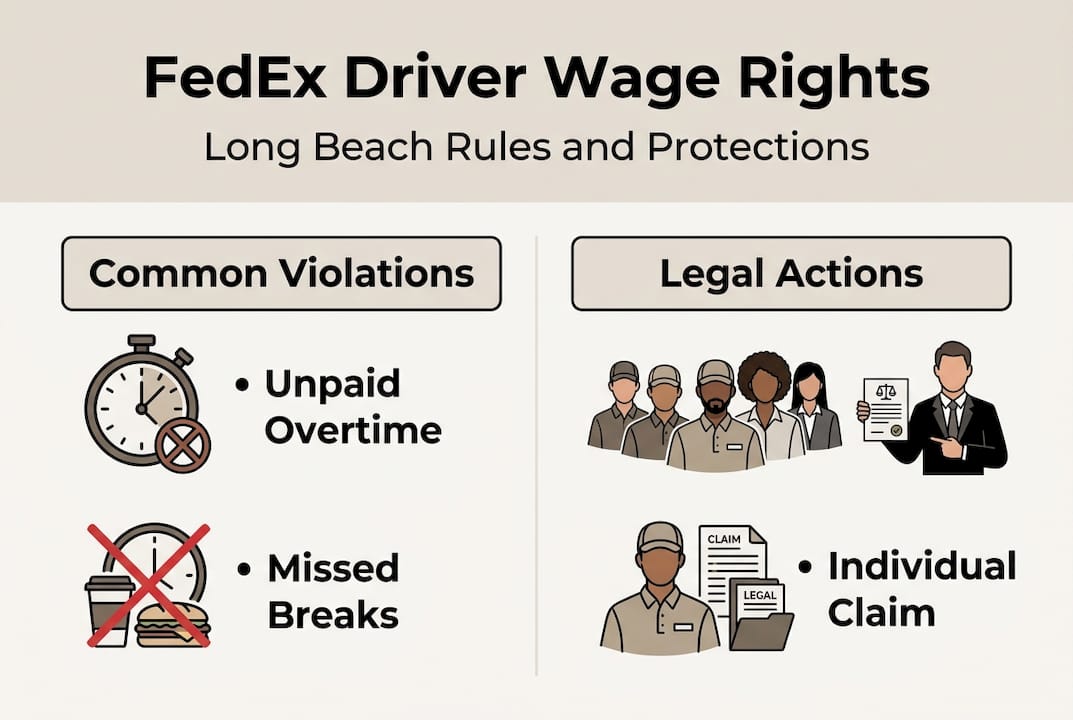
The California class action alone resulted in a $228 million settlement covering approximately 2,600 drivers, one of the largest driver misclassification settlements in U.S. history.
What can you learn from these past cases? Here are the key takeaways:
- Classification disputes are winnable. Courts have repeatedly sided with drivers when the evidence shows FedEx controlled their work.
- California law is stronger than federal law. State protections often go further, especially on overtime and break requirements.
- Class actions take time. Individual claims can sometimes move faster and recover more for specific drivers.
- Settlements do not always mean the problem is fixed. New lawsuits filed in 2026 show the violations are ongoing.
- You may already be owed money. If you drove for FedEx in recent years, you could be part of an active or future class action.
Pro Tip: Search your name and employer information through the California Labor Commissioner's website or ask an attorney to check whether you are a class member in any pending or settled FedEx case.
Reviewing the California employment law guide can help you understand the specific protections that apply to your situation. If you believe you faced retaliation for raising concerns, there are also clear steps for reporting workplace discrimination that protect you from further harm.
How to document and report wage and hour violations
Knowing your rights is only half the battle. Acting on them requires evidence. The good news is that you can start building a strong record right now, even before you contact a lawyer.
Here is what to collect:
- Time records: Daily logs showing your actual start, end, and break times
- Pay stubs: Every pay period, saved digitally or as paper copies
- Route sheets and delivery records: Any documents showing the hours and volume of work assigned
- Text messages and emails: Communications from supervisors, dispatchers, or ISP managers about schedules, expectations, or discipline
- Expense records: Receipts for fuel, vehicle maintenance, or any job-related costs you paid out of pocket
Once you have your documentation, here are the steps to report violations:
- Do not confront your employer alone. Raising concerns without legal guidance can expose you to retaliation.
- Contact the California Labor Commissioner's Office. You can file a wage claim without a lawyer, though an attorney can strengthen your case.
- File with the Equal Employment Opportunity Commission (EEOC) if your wage issues are connected to discrimination.
- Consult an employment attorney. Many work on contingency, meaning you pay nothing unless you win.
- Keep copies of everything you submit to any agency or employer.
Tips for keeping your evidence safe:
- Store copies in a personal email account or cloud storage, not on a work device
- Do not share your records with coworkers until you have spoken to a lawyer
- Avoid signing any documents your employer presents without legal review
Courts in recent FedEx overtime lawsuits have focused heavily on functional control and missed overtime payments, which means your daily records directly support the legal arguments that win these cases.
Pro Tip: Never sign a settlement offer, arbitration agreement, or release of claims from your employer without first having an attorney review it. Signing too early can permanently waive your right to recover wages you are owed.
If you are unsure where to start, reviewing resources on reporting workplace problems can give you a clearer picture of the process.
What most drivers and lawyers miss about FedEx wage cases
Here is something the legal industry rarely says out loud: winning a wage case against FedEx is not primarily about proving the contract is wrong. It is about proving that the daily reality of your job does not match what the contract claims.
FedEx has invested significant resources in structuring its ISP model to look legally sound on paper. But courts have consistently looked past those labels and examined what actually happens on the ground. Who tells you where to go? Who disciplines you? Who sets the rules? Those answers matter far more than any signed agreement.
What many drivers also miss is the risk of waiting for a class action to do the work for them. Class actions are powerful, but they can take years to resolve, and individual recoveries are sometimes smaller than what a direct claim could produce. Drivers who act early, with solid documentation, are often in a stronger position.
We have seen this pattern play out in other warehouse settlements across Los Angeles, where workers who documented their experience early recovered more than those who waited. The lesson is consistent: proactive evidence beats passive hope.
Legal support for FedEx drivers in Long Beach
If you are a FedEx driver in Long Beach and you believe your wages, overtime, or breaks have been shorted, you do not have to figure this out alone. At Justice Shield Law, we represent employees exclusively. We do not work for employers, and we do not take cases on both sides. Our focus is entirely on protecting workers like you.
We offer a free legal consultation to review your situation confidentially, with no obligation. Our team understands the specific California employment protections that apply to delivery drivers, and we have experience pursuing real recoveries for workers who were misclassified or denied overtime. Reach out today to find out what you may be owed.

Frequently asked questions
Are FedEx Ground drivers in Long Beach employees or independent contractors?
Most FedEx Ground drivers are classified as employees of Independent Service Providers, but courts have questioned this structure and may determine that drivers are actual FedEx employees based on how much control FedEx exercises over their daily work. The ISP model has been called a sham by plaintiffs in multiple lawsuits.
What is the biggest wage violation FedEx drivers should watch for?
Unpaid overtime is the most cited violation in FedEx cases, particularly when drivers are misclassified as contractors and required to work beyond 8 hours a day or 40 hours a week without additional pay. Ongoing lawsuits allege this practice continues despite prior settlements.
Do small delivery trucks have to pay overtime?
Yes. Drivers operating vehicles under 10,001 pounds are not exempt from California overtime laws and may be entitled to back pay for hours worked beyond the daily or weekly threshold. This applies to many FedEx Ground drivers using standard delivery vans. Smaller trucks are not exempt from state overtime rules.
What should I do if I suspect wage and hour violations at FedEx?
Document all your hours, pay stubs, and work communications immediately, then contact an employment attorney before taking any other steps. Lawsuits in this area consistently show that strong documentation of functional control and missed overtime is what drives successful claims.