

TL;DR:
- California's FEHA offers broad protections for physical and mental disabilities that limit major life activities.
- Employers must engage in a good-faith interactive process to consider reasonable accommodations, or risk legal violations.
- Documenting incidents, requests, and responses promptly is crucial for building a strong disability discrimination case.
Many Orange County employees face confusing situations at work after disclosing a medical condition or requesting an accommodation. Some are quietly sidelined. Others receive unexplained write-ups that seemed to start the moment they asked for help. The real problem? Most workers do not know whether what is happening to them legally qualifies as disability discrimination. Not every difficult situation is a legal violation, and not every uncomfortable workplace condition meets the legal standard for a protected disability. This guide explains what actually qualifies, what your rights look like in practice, and exactly what steps you should take if you believe your employer is treating you unlawfully.
Table of Contents
- What qualifies as disability discrimination in Orange County offices?
- Common examples and warning signs of discrimination
- Your rights and the accommodation process
- How to build your case and take action
- What most Orange County employees miss about disability discrimination cases
- Get expert support for your disability rights
- Frequently asked questions
Key Takeaways
| Point | Details |
|---|---|
| Know your rights | California law protects employees with substantial disabilities, but not every condition qualifies. |
| Follow the process | Request accommodations in writing and participate in the interactive process. |
| Document everything | Detailed records of all workplace interactions and decisions are critical if you need to take legal action. |
| Act promptly | Seek advice or file a claim quickly before deadlines pass or evidence is lost. |
| Legal help can make a difference | Expert support maximizes your chances of success in disability discrimination cases. |
What qualifies as disability discrimination in Orange County offices?
Disability discrimination in the workplace means an employer treats an employee unfavorably because of a physical or mental impairment that limits one or more major life activities. In California, employees benefit from both federal protections under the Americans with Disabilities Act (ADA) and stronger state protections under the Fair Employment and Housing Act (FEHA). California's FEHA is notably broader, covering conditions that merely "limit" a major life activity rather than "substantially limit" one, which is the higher federal standard.
Your employment rights in California under FEHA are among the most protective in the country. California law covers a wide range of physical conditions such as cancer, diabetes, epilepsy, HIV, and musculoskeletal injuries. It also covers mental health conditions including depression, PTSD, and anxiety disorders, but only when those conditions meaningfully impair your ability to perform essential job functions or major life activities.
Here is where many employees get confused. Not every health issue triggers legal protection.
Common misconceptions about protected disabilities:
- Temporary conditions like a broken leg or flu usually do not qualify unless recovery is prolonged
- Mild anxiety or stress responses that do not limit work functions are not automatically covered
- Personal preferences about working from home are not accommodations unless tied to a documented medical need
- Discomfort with certain tasks, without any underlying medical diagnosis, does not create a legal obligation for your employer
A critical point: EEOC guidance requires individualized assessment of each situation, meaning employers may deny requests that involve undue hardship or that fall outside essential job functions, but they cannot skip the interactive process entirely.
The interactive process is a legally required, good-faith conversation between you and your employer. Once you request an accommodation or your employer becomes aware of a possible disability, both parties have a legal obligation to communicate and explore options. An employer who ignores your request or refuses to engage in this dialogue may be violating the law regardless of whether they ultimately grant the accommodation.
Understanding this framework is the first step. The next is recognizing what discrimination actually looks like when it shows up in an Orange County office.
Common examples and warning signs of discrimination
Understanding the definition is important, but seeing how it looks in real office life brings it into focus. Disability discrimination rarely shows up as an obvious, single event. More often, it builds gradually through a pattern of small decisions that individually seem explainable but collectively tell a different story.
The most common illegal actions employers take include:
- Denying a reasonable accommodation without engaging in the interactive process or providing a legitimate justification
- Creating a hostile work environment by making derogatory remarks about an employee's condition or using a disability as the basis for ridicule
- Retaliating against an employee for requesting an accommodation or filing a complaint by reducing hours, reassigning duties, or initiating disciplinary action
- Terminating employment shortly after a disability disclosure or accommodation request, which courts often view as suspicious timing
- Excluding employees with disabilities from meetings, communications, or projects in ways that limit advancement opportunities
Real scenarios happen every day in Orange County offices. An employee with a documented back condition asks for an ergonomic chair and is told the company does not provide equipment for individual preferences. A worker managing PTSD asks to attend team meetings by video call rather than in person and is denied without explanation. A sales representative discloses a recent cancer diagnosis and is suddenly left off client assignments without being told why.

These are not edge cases. They are the situations we see when employees come to us for help.
Pro Tip: Start documenting the moment something feels wrong. Write down the date, time, what was said or done, who was present, and how it affected your work. Waiting until things escalate often means losing critical early evidence.
Early warning signs that discrimination may be occurring include sudden changes in performance reviews after a disability disclosure, unexplained exclusion from team communications, reduction in job responsibilities without clear business justification, and an unusually close level of scrutiny applied to your work compared to colleagues.
It is also important to understand that retaliation and legal options exist for employees who face pushback after making a protected request. If your employer takes any negative action against you after you request an accommodation or raise a concern about disability discrimination, that retaliation may be a separate and additional legal violation. According to EEOC guidance, employers can reevaluate prior accommodations if circumstances change, but this cannot be used as cover to quietly remove accommodations and erode a disabled employee's working conditions over time.
Your rights and the accommodation process
Once potential discrimination is identified, it is crucial to understand exactly what rights and procedures you have as an employee. The law does not require your employer to give you exactly what you ask for. It requires them to provide a reasonable accommodation, meaning one that does not impose an undue hardship on the business and that allows you to perform the essential functions of your role.
How to request an accommodation correctly:
- Submit your request in writing, even if you have already spoken verbally with your manager or HR
- Include a clear statement of your medical condition and how it affects your ability to perform specific job duties
- Reference any supporting documentation from your healthcare provider
- Keep a copy of everything you submit and note when and to whom it was delivered
Your medical leave rights may also come into play here, particularly if your condition requires time away from work as part of an accommodation. Under California law, protected medical leave can sometimes work alongside reasonable accommodation obligations.
The table below clarifies what types of adjustments are generally considered reasonable and what falls outside an employer's legal obligation.
| Typically considered reasonable | Generally not required |
|---|---|
| Modified work schedule or shift changes | Eliminating essential job duties entirely |
| Ergonomic furniture or adaptive equipment | Creating a new position that does not exist |
| Remote or hybrid work (when medically necessary) | Permitting indefinite leave with no return date |
| Reassignment to a vacant equivalent position | Displacing another employee to create a vacancy |
| Adjustments to non-essential job functions | Lowering production or performance standards |
| Quiet workspace or reduced noise environment | Restructuring the core nature of the role |
The EEOC's individualized assessment standard means your employer cannot apply a blanket policy to deny requests. Each situation must be evaluated on its specific facts. If your accommodation request is denied, ask for the denial in writing and request a specific explanation. This documentation is critical if you later decide to escalate your complaint.
Pro Tip: If your employer denies an accommodation, do not simply accept the decision. Ask to continue the interactive process and propose alternative solutions. Courts look negatively on employers who shut down this conversation prematurely.
How to build your case and take action
Knowing your rights is only part of the solution. Taking effective action requires smart documentation and making informed decisions about when and how to escalate. Many employees wait too long, hoping the situation resolves on its own. That delay often makes legal action harder to pursue.
The foundation of any strong disability discrimination case is a clear, consistent record. The EEOC is direct on this point: document everything meticulously. This means more than just saving emails. It means keeping a dated incident log that captures every relevant interaction, tracking the names of witnesses, and preserving any written communications related to your disability, your accommodation request, or your performance.
Key documentation steps:
- Save all emails, messages, and letters related to your accommodation request and any employer responses
- Write detailed notes after every relevant conversation, including verbal denials or dismissive comments
- Record instances where colleagues without disabilities were treated differently in similar situations
- Identify coworkers who witnessed discriminatory behavior and document their contact information
- Retain copies of performance reviews, especially any that changed after your disability disclosure
When it comes to documenting workplace rights violations, consistency is more important than volume. A clear, organized record showing a pattern of behavior is far more persuasive than a pile of disconnected screenshots.
The table below compares your two main paths for taking action.
| Option | Process | Timeline | Outcome |
|---|---|---|---|
| Internal HR complaint | File complaint with HR or designated EEO officer | Varies by employer | Policy review, internal investigation, or dismissal |
| External government complaint | File with DFEH (CRD) or EEOC | Strict deadlines apply | Right-to-sue letter, investigation, or mediation |
| Legal representation | Consult an employment attorney for case evaluation | Immediate | Demand letter, negotiation, litigation, or settlement |
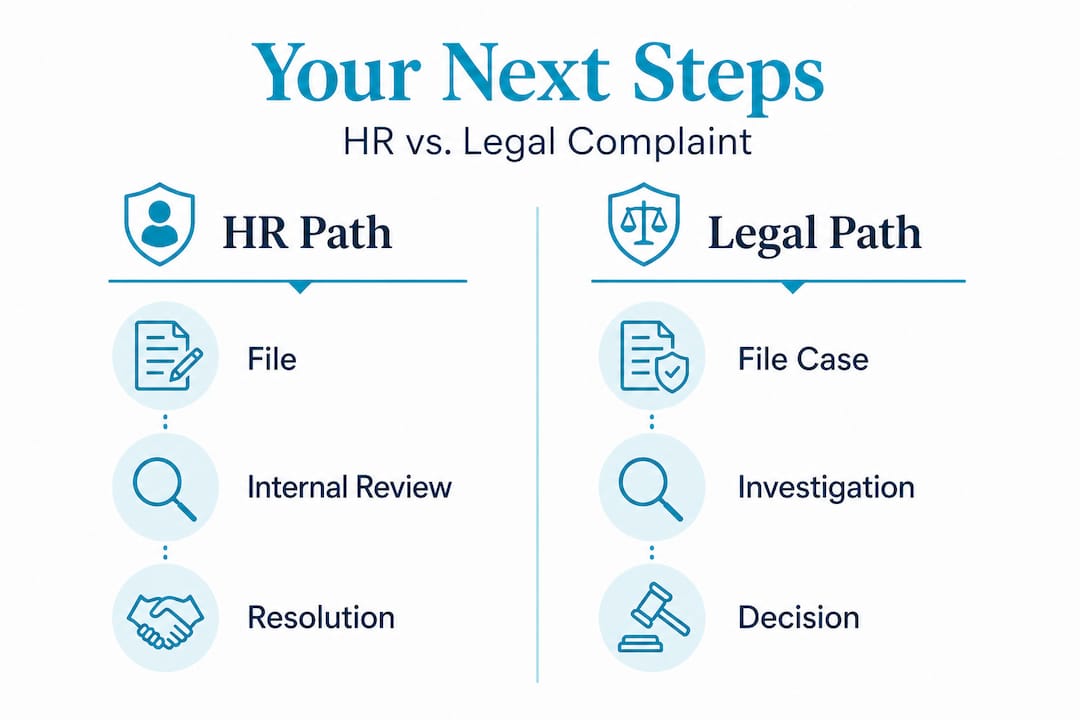
You can file a workplace complaint with California's Civil Rights Department (formerly the Department of Fair Employment and Housing) or with the federal EEOC. Both paths have specific deadlines, and missing them can permanently affect your ability to pursue a claim. In California, you typically have one year from the date of the discriminatory act to file with the CRD, though some exceptions apply.
Summary action steps:
- Document all incidents in real time with specific dates, names, and details
- Submit any accommodation request in writing and retain confirmation
- Request a written explanation if your request is denied
- Compare how similarly situated employees without disabilities are treated
- Consult an employment attorney before filing any formal complaint to understand your options
- File with the CRD or EEOC before the applicable deadline
What most Orange County employees miss about disability discrimination cases
From our experience working with employees throughout Southern California, one pattern shows up repeatedly: employees wait too long because they believe HR will fix the problem. This is one of the most consequential decisions a worker can make, and it rarely leads to the outcome they hope for.
HR departments exist to protect the company. That is not cynical—it is structural. When you bring a complaint to HR without first understanding your legal rights or consulting an attorney, you may inadvertently give the employer time to build a counter-narrative. The company begins creating documentation of its own, often focusing on performance issues that were never mentioned before your disability came to light.
The second major mistake we see involves the records themselves. Employees often have a general sense that something is wrong but cannot point to specific incidents with specific dates. Courts and administrative agencies do not operate on impressions. They look for patterns supported by facts. Vague claims, no matter how genuine, are difficult to sustain without concrete details.
As the EEOC emphasizes, not all discomfort qualifies as actionable discrimination, and the obligation to document everything meticulously falls on the employee just as much as it does on legal teams. Many employees who have legitimate claims lose ground because their records are inconsistent, incomplete, or were started too late in the process.
The third overlooked issue is failing to escalate internally before going external. Skipping internal channels entirely can sometimes undercut a claim. Courts often expect employees to give employers a reasonable opportunity to correct the situation before litigation. That said, going internal without legal guidance can also backfire. The best approach is to consult an attorney first so you understand the landscape before making any formal moves.
Your California employee protections are real and they are strong, but they require proactive engagement. Waiting is the single biggest factor that weakens otherwise valid claims. We encourage employees to reach out for a legal consultation even before they are sure discrimination is occurring. Early guidance can shape your documentation strategy and preserve options that disappear over time.
Get expert support for your disability rights
If anything in this article resonates with your situation, do not wait to see if things improve on their own. Justice Shield Law works exclusively on the employee side of employment disputes, representing Orange County workers who are facing disability discrimination, retaliation, and accommodation denials. We offer free consultations so you can understand your rights before committing to any course of action. Whether you are still in the documentation phase or already facing termination, we can help you evaluate your case clearly and honestly. Take the time to learn more about your employment rights and reach out to our team today. You deserve an advocate who is entirely in your corner.
Frequently asked questions
What types of disabilities are protected under California law?
Physical, mental, and medical conditions that limit major life activities are protected under California's FEHA, which is broader than federal law. Minor or temporary issues that do not affect your ability to work or carry out daily functions generally do not qualify for legal protection.
Can my employer deny my accommodation request?
Yes, your employer can legally deny a request if it creates an undue hardship for the business or involves a non-essential job function, but they must first engage in the interactive process and consider all alternatives before issuing a denial.
What records should I keep if I suspect discrimination?
Keep emails, written accommodation requests, HR responses, and dated incident notes with witness names. The EEOC advises employees to document everything meticulously, and consistency in record-keeping is what separates strong claims from weak ones.
How long do I have to file a complaint for disability discrimination?
In California, you generally have one year from the date of the discriminatory act to file a complaint with the Civil Rights Department. Federal deadlines may differ, so consult a legal professional as soon as you suspect a violation to avoid missing a critical cutoff.
Are mental health conditions like anxiety always covered?
No. Anxiety is only protected when it substantially limits major life activities or essential job functions. General anxiety without documented functional impairment does not automatically entitle an employee to a specific accommodation such as permanent remote work.