

TL;DR:
- California law protects employees fired for reporting safety, discrimination, or exercising legal rights.
- Building a strong case requires timely documentation, witness support, and legal guidance.
- Early legal consultation improves chances of fair resolution and often leads to compensation.
Losing your job at UPS can feel like the end of the road, especially when the termination seems unfair or retaliatory. Many Riverside UPS employees assume they have no legal options, believing that employers can fire anyone at any time without consequence. That assumption is wrong. California has some of the strongest employee protection laws in the country, and wrongful termination is a recognized legal claim that courts take seriously. If you were fired after raising a safety concern, reporting discrimination, or exercising a protected right, you may have a strong case. This guide walks you through your rights, the legal framework, and the steps you can take right now.
Table of Contents
- Recognizing wrongful termination at UPS in Riverside
- Legal framework for wrongful termination claims in Riverside
- How Riverside UPS employees can build their case
- What to expect: resolution and outcomes for UPS termination claims
- Our perspective: what Riverside UPS employees often miss when facing wrongful termination
- Connect with Justice Shield Law for trusted support
- Frequently asked questions
Key Takeaways
| Point | Details |
|---|---|
| Know your rights | California law offers protections for Riverside UPS employees facing unfair dismissal. |
| Act promptly | Quick action and thorough documentation can strengthen your claim. |
| Legal help matters | Expert guidance increases your chances for a fair outcome. |
| Expect resolution | Most wrongful termination claims settle within a year, often with compensation. |
Recognizing wrongful termination at UPS in Riverside
Wrongful termination does not simply mean being fired unfairly in a general sense. Under California law, it means being dismissed for an illegal reason. California is an at-will employment state, which means employers can usually let employees go without cause. However, there are important exceptions that protect workers from being fired for the wrong reasons.
Common illegal reasons for termination at UPS include firing an employee for reporting a workplace safety violation, complaining about wage theft, requesting medical leave, or reporting discrimination. Retaliation is a common basis for wrongful termination claims, and it covers situations where an employer punishes a worker for engaging in a legally protected activity.
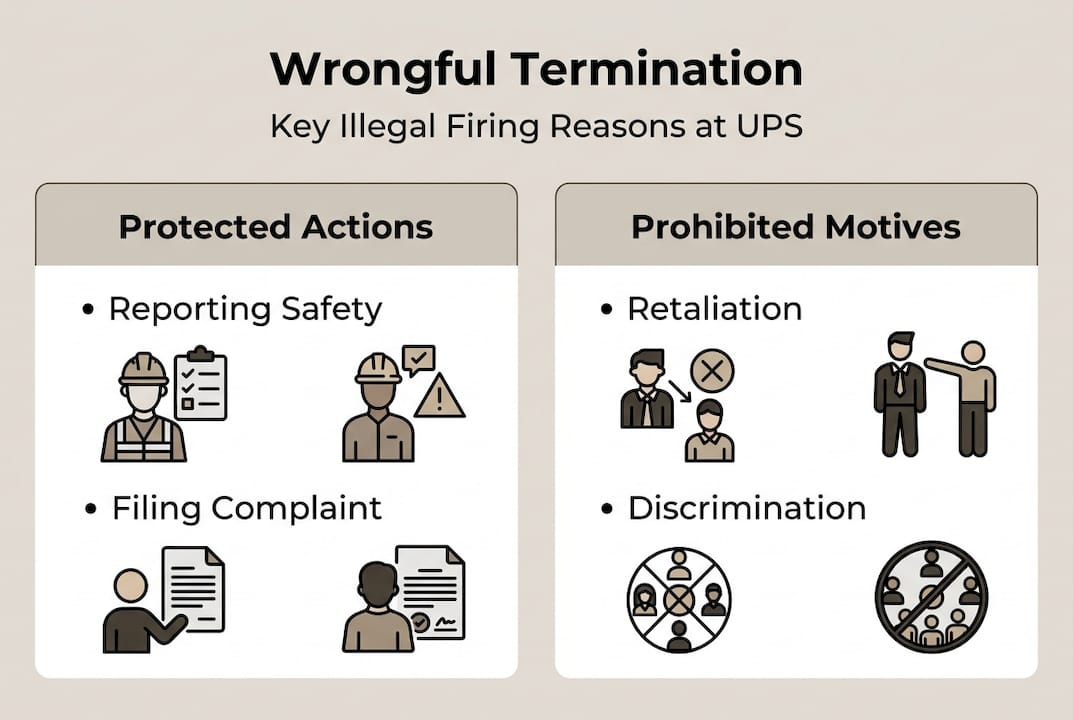
You should also be aware of workplace discrimination reporting rights, which protect employees who speak up about race, gender, age, disability, or other protected characteristics. UPS employees in Riverside have the right to raise these concerns without fear of losing their jobs.
Here is a quick comparison to help you understand the difference:
| Legal termination reason | Illegal termination reason |
|---|---|
| Poor performance with documentation | Firing after a safety complaint |
| Company-wide layoff | Retaliation for reporting discrimination |
| Violation of company policy | Termination tied to medical leave request |
| Restructuring or budget cuts | Firing based on race, gender, or disability |
Signs you may have been wrongfully terminated include:
- You were fired shortly after making a complaint to HR or a supervisor
- Your termination followed a request for protected leave
- You were the only employee disciplined despite others doing the same thing
- Your performance reviews were positive before you raised a concern
- You were asked to sign documents under pressure immediately after termination
"California law protects workers who speak up about unlawful practices."
Pro Tip: Start saving every email, text message, and written notice from your supervisors right now. Even casual messages can become critical evidence later.
Understanding California worker protection laws is the first step toward recognizing whether what happened to you was illegal, not just unfair.
Legal framework for wrongful termination claims in Riverside
Once you recognize that your termination may have been illegal, understanding the legal tools available to you is essential. California offers multiple layers of protection for employees like you.
The Fair Employment and Housing Act (FEHA) prohibits employers from terminating employees based on protected characteristics such as race, sex, age, disability, religion, or national origin. The California Labor Code adds further protections, covering retaliation for whistleblowing, wage complaints, and workplace safety reporting. Public policy exceptions also protect workers who are fired for refusing to break the law or for exercising a legal right.
Over 60% of wrongful termination claims in California involve retaliation or discrimination, which means these are not rare edge cases. They are the most common reasons employees are pushed out illegally.
Here is a general look at how claim outcomes can vary:
| Claim type | Common outcome | Average timeline |
|---|---|---|
| Retaliation after complaint | Settlement or damages | 6 to 12 months |
| Discrimination-based firing | FEHA complaint resolution | 12 to 18 months |
| Breach of contract | Arbitration or court ruling | 9 to 15 months |
| Public policy violation | Reinstatement or compensation | 6 to 12 months |
If you believe your termination was illegal, here are the steps for filing a claim:
- File a complaint with the California Civil Rights Department (CRD) for discrimination or retaliation claims
- File with the California Labor Commissioner's Office for wage or retaliation claims under the Labor Code
- Submit an EEOC charge if federal law applies, such as Title VII or the ADA
- Consult an employment attorney before filing to identify the strongest legal avenue
Timelines matter enormously. For FEHA claims, you generally have three years from the date of the adverse action to file with the CRD. Missing this deadline can eliminate your right to pursue the claim entirely. Understanding family medical leave laws and sexual harassment claims can also reveal overlapping protections you may not have considered. If your termination involved wage issues, reviewing your wage and hour rights is equally important.
Act promptly. Every day you wait is a day closer to a missed deadline.
How Riverside UPS employees can build their case
A strong wrongful termination claim is built on evidence. The quality and completeness of your documentation can determine whether your case succeeds or falls short. Most employees underestimate how much detail matters.
Here is a step-by-step approach to gathering evidence:
- Collect all written communications. Save emails, text messages, performance reviews, disciplinary notices, and any written policies from your employee handbook.
- Document the timeline. Write down exactly what happened and when, including dates of complaints, meetings, and your termination notice.
- Identify witnesses. Think about coworkers who saw or heard relevant events. Their statements can significantly support your claim.
- Preserve your performance records. If your reviews were positive before the complaint, that contrast is powerful evidence.
- Request your personnel file. California law gives you the right to access it, and it may contain notes or records you were not aware of.
- Avoid signing anything new. Do not sign severance agreements or releases without consulting an attorney first.
"Solid documentation often tips the balance in favor of the employee."
What most people overlook is the value of co-worker testimony. A colleague who witnessed your complaint being dismissed or your supervisor making a biased comment can make a significant difference. Proper documentation is key to successful claims, and that includes both written records and witness accounts.
Pro Tip: Never make recorded statements to UPS HR or legal representatives without first speaking to your own attorney. What you say can be used against your claim.
Working with legal counsel early also shapes your strategy. An attorney can identify which legal theories apply, which agency to file with first, and how to frame your case for maximum impact. Reviewing worker protection strategies and labor rights tips can further prepare you for what lies ahead.

What to expect: resolution and outcomes for UPS termination claims
Knowing what the process looks like from start to finish helps you stay focused and realistic. Wrongful termination claims do not resolve overnight, but they do resolve, and often in the employee's favor when the case is well-prepared.
The process typically begins with filing a complaint with the appropriate agency, such as the CRD or the EEOC. After investigation, the agency may issue a right-to-sue letter, which allows you to pursue the matter in civil court. Many cases settle before reaching trial.
Settlements are common in employment law disputes, and they often offer faster resolution than a full trial. Most wrongful termination claims resolve within 12 months, though complex cases can take longer.
Typical resolution options include:
- Settlement: A negotiated agreement where the employer pays compensation without admitting wrongdoing
- Arbitration: A private dispute resolution process, sometimes required by employment contracts
- Reinstatement: Being returned to your position, though this is less common in practice
- Damages: Financial compensation for lost wages, emotional distress, and sometimes punitive damages
- Negotiated exit: A structured departure with agreed terms, often including a severance package
The outcome depends heavily on the strength of your evidence, the legal theories involved, and the quality of your legal representation. Employees who act quickly and document thoroughly consistently see better results. If you have faced other employment challenges alongside your termination, understanding how to challenge workers' comp denials can also be relevant to your overall situation.
Do not assume a settlement means you lost. Many settlements result in meaningful compensation and accountability.
Our perspective: what Riverside UPS employees often miss when facing wrongful termination
After working with employees across California, we have seen one pattern repeat itself: people wait too long to get help. They spend weeks hoping the situation will resolve on its own, or they assume they need more proof before speaking to an attorney. Both instincts cost them.
The reality is that evidence disappears quickly. Emails get deleted. Witnesses move on. Memories fade. The employees who build the strongest cases are the ones who start documenting and seeking counsel within days of their termination, not months later.
Another thing people miss is the value of early, informal legal advice. You do not need to commit to filing a lawsuit to speak with an attorney. A single conversation can clarify whether your situation qualifies, what your options are, and what your next move should be. Understanding how to report workplace discrimination early can also reveal protections you did not know existed.
"Seeking help quickly is the single best move you can make."
Most outcomes are shaped by preparation, not luck. The employees who fare best are those who treat their situation seriously from day one.
Pro Tip: Even a free 30-minute consultation with an employment attorney can give you a clearer picture of your rights and realistic options.
Connect with Justice Shield Law for trusted support
If you are a Riverside UPS employee who believes you were wrongfully terminated, you do not have to figure this out alone. Justice Shield Law specializes exclusively in employment law for workers across California, including those in Riverside facing large employers like UPS. We represent employees only, which means our focus is entirely on protecting your rights and holding employers accountable.
We offer free consultations where we review the details of your situation, explain your legal options clearly, and help you understand whether you have a viable claim. There is no obligation and no cost to speak with us. The sooner you reach out, the stronger your position will be.
Contact Justice Shield Law today and take the first step toward getting the outcome you deserve.
Frequently asked questions
How can I tell if my UPS termination in Riverside was wrongful?
If you were fired after complaining about safety violations, reporting discrimination, or exercising a protected right, your termination may be illegal under California law. Retaliation is a common basis for wrongful termination claims, and timing often matters significantly.
What steps should I take after wrongful termination from UPS?
Gather all relevant documents, identify witnesses, and consult an employment attorney as soon as possible. Proper documentation is key to successful claims, so start collecting evidence immediately.
How long does a wrongful termination claim against UPS take to resolve?
Most cases reach resolution within 12 months, though complex matters can take longer depending on the legal theories involved and whether the case goes to court or settles. Acting quickly gives you more control over the timeline.
Can I get my job back after a wrongful termination claim?
Reinstatement is a possible outcome, but settlements are more common in employment law disputes. Many employees receive financial compensation and other negotiated terms instead of returning to their former position.
Recommended
- Justice Shield Law | California Employment Lawyers — Free Consultation
- Justice Shield Law | California Employment Lawyers — Free Consultation
- Justice Shield Law | California Employment Lawyers — Free Consultation
- Justice Shield Law | California Employment Lawyers — Free Consultation
- Top La Verne California Wrongful Termination Lawyer