

TL;DR:
- Workplace retaliation in Anaheim’s hospitality industry occurs frequently and can be subtle but unlawful.
- California law offers strong protections for workers who report violations or oppose discrimination.
- Proper documentation and timely filing are crucial for building a successful retaliation claim.
Workplace retaliation is not rare in Anaheim's hospitality industry. It happens at hotels, theme parks, restaurants, and resorts every day, and workers who speak up often face serious consequences. Many employees assume that reporting a violation means their employer will do the right thing. That assumption can be costly. The truth is that even large, well-known employers have faced retaliation claims, including a recent case at Disneyland Resort in Anaheim. California law gives you strong, actionable protections. This guide explains what retaliation looks like, how to document your experience, how to file a claim, and how to connect with legal support.
Table of Contents
- Understanding retaliation and your protections
- How to recognize retaliation in Anaheim hospitality jobs
- Building a strong retaliation claim: Evidence and documentation
- How to file a retaliation claim in Anaheim
- The truth about Anaheim hospitality retaliation claims
- Get legal help for Anaheim hospitality retaliation claims
- Frequently asked questions
Key Takeaways
| Point | Details |
|---|---|
| Legal protections | California law shields hospitality workers in Anaheim from retaliation after reporting workplace violations. |
| Action steps | Workers must document everything and follow a clear claims process to safeguard their rights and pursue remedies. |
| Case evidence | Strong retaliation claims rely on timely evidence, persuasive documentation, and often witness statements. |
| Timely filing | Claims must be filed with the California Civil Rights Department within three years of the retaliatory event. |
Understanding retaliation and your protections
Retaliation happens when an employer punishes a worker for asserting legal rights or reporting workplace violations. The punishment does not have to be obvious. It can be subtle, like being passed over for a promotion, receiving suddenly negative performance reviews, or having your schedule cut without explanation. What matters legally is whether the negative treatment followed a protected activity.
California's California worker protections are among the strongest in the country. The California Fair Employment and Housing Act, commonly referred to as FEHA, is one of the primary laws that shields hospitality workers in Anaheim. Under FEHA, FEHA protections for hospitality workers cover workers who oppose discrimination, file complaints, request accommodations, or participate in workplace investigations.
This protection extends to a wide range of situations you may encounter in a hospitality role:
- Reporting unsafe working conditions to a supervisor or to Cal/OSHA
- Filing a complaint about wage theft or unpaid overtime
- Requesting accommodation for a disability or medical condition
- Opposing harassment or discrimination based on race, gender, religion, or national origin
- Participating as a witness in a coworker's complaint or investigation
- Reporting violations of health codes or food safety standards
- Refusing to participate in illegal activity at work
Your employer cannot legally punish you for speaking up about violations, filing a complaint, or cooperating in an investigation. California law treats these actions as protected activities, and any negative response from your employer may constitute unlawful retaliation.
This protection matters most in hospitality settings because workers in this industry are frequently vulnerable. Many are paid hourly, work variable schedules, and depend on tips or shift assignments that management controls directly. That creates significant opportunity for retaliatory behavior that can feel like routine business decisions. Knowing your rights is the first step toward protecting them. You can also review discrimination lawsuit examples to understand how these cases play out in California.

How to recognize retaliation in Anaheim hospitality jobs
With your protections established, let's look at how retaliation actually appears in Anaheim's hospitality sector. Employers rarely announce that they are retaliating. Instead, the punishment is framed as a business decision, a performance issue, or a scheduling necessity. Your job is to recognize the pattern.
The most common forms of retaliation in hospitality include:
- Termination shortly after a complaint or investigation, often framed as downsizing or policy violations
- Demotion or reduction in responsibilities, such as being removed from a preferred shift or department
- Hour reduction, especially for tipped workers who rely on busy shifts for income
- Excessive discipline, including written warnings for minor infractions that were previously overlooked
- Hostile or hostile work environment, where management suddenly treats you differently from peers
- Reassignment to undesirable roles, such as moving a front-desk worker to back-of-house cleaning duties after a complaint
One of the clearest indicators of retaliation is timing. Courts and investigators look at what is called temporal proximity, meaning how close in time the adverse action was to your protected activity. If your hours were cut two weeks after you reported wage theft, that timing is significant.
This principle was directly demonstrated in a real Anaheim case. A NLRB Anaheim case filed in 2025 against Disneyland Resort alleges retaliation, discharge, and discipline in response to concerted activities under Section 8(a)(1) of the National Labor Relations Act. This case illustrates that even powerful, globally recognized employers are not immune from retaliation claims. The Disney retaliation case is a reminder that workers at any level have the right to stand up for themselves.
| Retaliation tactic | Common framing by employer | Red flag timing |
|---|---|---|
| Termination | Policy violation, downsizing | Within 30 to 90 days of complaint |
| Hour reduction | Business slowdown | Immediately following a report |
| Demotion | Performance concerns | After requesting accommodation |
| Written warnings | Minor infractions | After participating in investigation |
| Schedule changes | Operational needs | Following complaint filing |
| Hostile treatment | Management style | Begins after protected activity |
Recognizing these patterns early is critical. If you notice a sudden shift in how management treats you after you report something, document it immediately. The connection between your protected activity and the employer's response is the foundation of any retaliation claim. If you have concerns about safety-related retaliation, reviewing information about a workplace safety investigation can also help you understand what agencies expect during that process.
Building a strong retaliation claim: Evidence and documentation
Spotting retaliation is crucial, but knowing how to build a solid claim is your next key step. California courts look for three core elements when evaluating a retaliation case: you engaged in a protected activity, your employer took an adverse action against you, and there is a causal connection between the two. Without solid evidence connecting those three elements, a claim becomes harder to pursue.
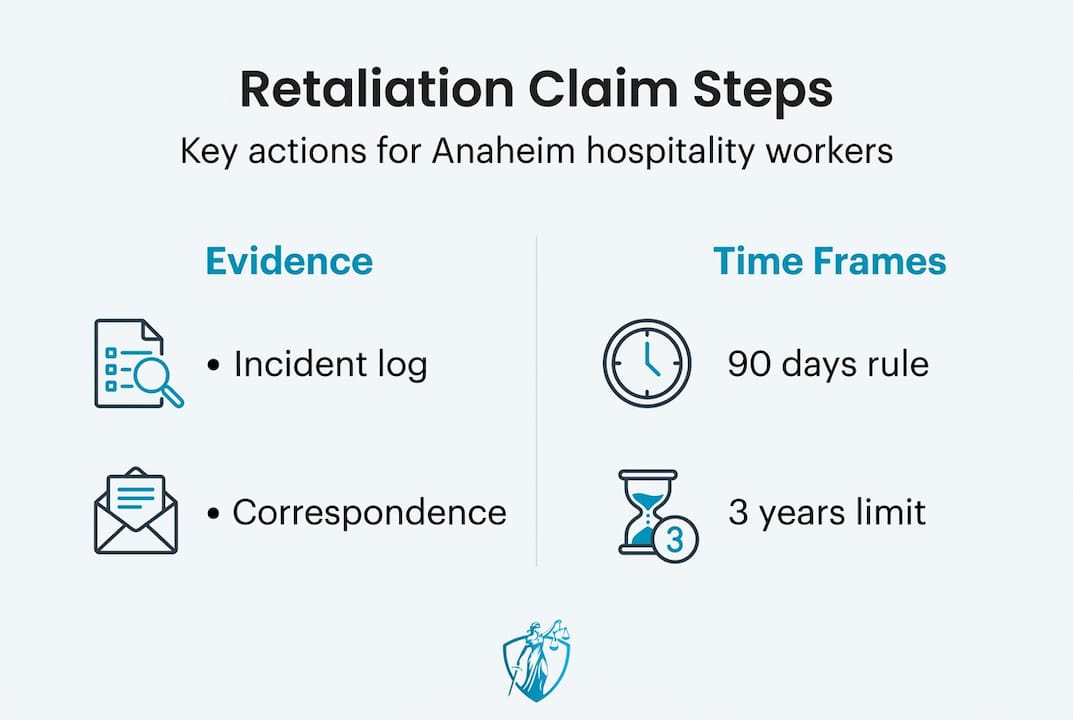
Timing is one of your most powerful tools. Under California Senate Bill 497, adverse action within 90 days of protected activity is presumed to be retaliatory. This shifts the burden to your employer to prove that the negative treatment was not connected to your complaint. Witness statements and thorough documentation further strengthen this presumption.
Here is a side-by-side look at what separates a weak case from a strong one:
| Evidence type | Weak case example | Strong case example |
|---|---|---|
| Protected activity | Vague verbal complaint | Written complaint with date and specific violation cited |
| Adverse action | General feeling of mistreatment | Documented demotion with written notice |
| Causal connection | Timeline is unclear | Adverse action occurs 3 weeks after complaint |
| Witness support | No witnesses available | Coworker observed manager's hostile response |
| Employer response | No explanation given | Employer offers changing or pretextual reasons |
| Pattern of behavior | Single incident | Multiple incidents following different complaints |
To build the strongest possible record, follow these steps:
- Document your protected activity immediately. After filing a complaint or participating in an investigation, write down the date, what you reported, who you reported it to, and any responses you received. Send a follow-up email to HR if possible, creating a written record.
- Record every adverse action in writing. Keep a personal log that includes dates, what happened, who was present, and any explanation your employer gave. Keep this log outside of work systems.
- Save all written communications. Emails, texts, performance reviews, schedule changes, and disciplinary notices should all be saved somewhere your employer cannot access.
- Gather witness information. Note the names of coworkers who observed the treatment or who may have heard relevant conversations. Ask if they are willing to provide statements.
- Request your personnel file. California law gives you the right to review and copy your personnel file. This can reveal whether new documentation appeared after your complaint.
- Consult an employment attorney early. Legal guidance at the documentation stage can prevent costly mistakes later, particularly around missed deadlines or incomplete records.
Pro Tip: When documenting incidents, always reference the specific violation you originally reported. For example, note that the schedule change occurred on a specific date following your complaint about unpaid overtime on an earlier date. This precise connection strengthens the causal link and makes your timeline easier to follow. Cases involving medical leave retaliation and wage and hour rights show how important this level of detail can be.
How to file a retaliation claim in Anaheim
Once you have your documentation, here is how to move forward with a claim. The process involves several steps, each with its own requirements. Following the correct order matters because missing a step or deadline can affect your ability to recover compensation.
Here is how the process works for most FEHA retaliation claims in California:
- Report internally if possible. Before filing with an agency, consider reporting the retaliation to your HR department in writing. This creates a paper trail and gives your employer an opportunity to respond. However, if you fear further retaliation, you can proceed directly to a government agency.
- File with the California Civil Rights Department (CRD). The CRD is the state agency that enforces FEHA. You must file a CRD complaint within 3 years of the retaliatory action. This deadline is firm and missing it typically bars your ability to sue in court.
- Request a right-to-sue notice. After filing with the CRD, you can request an immediate right-to-sue notice. This gives you permission to file a civil lawsuit in California Superior Court without waiting for the CRD to complete its investigation.
- File your civil lawsuit. Once you have the right-to-sue notice, you generally have one year to file your lawsuit in court. Working with an employment attorney during this stage is strongly advisable.
- Pursue available remedies. Successful retaliation claims can result in back pay for wages lost after termination or demotion, compensation for emotional distress, attorney fees, and in some cases, reinstatement to your position.
Pro Tip: Keep a dedicated folder, either physical or digital, for every piece of correspondence related to your claim. Label each item with the date and a brief description. When you work with an attorney or file with an agency, this organized record saves time and demonstrates that you took your claim seriously from the beginning.
It is also worth noting that NLRB claims, like the Disneyland Resort case, follow a separate process from FEHA claims. If your retaliation involves concerted activity or union organizing, an NLRB charge may be the more appropriate route. An employment attorney can help you determine which avenue applies to your situation. For workers who have faced harassment-related retaliation, reviewing guidance on harassment claim filing may clarify additional options available to you.
The truth about Anaheim hospitality retaliation claims
Many hospitality workers in Anaheim know something is wrong but convince themselves they cannot win against a large employer. They worry about legal costs, losing their jobs permanently, or being labeled as troublemakers. These fears are understandable. They are also largely unfounded.
California's retaliation laws are specifically designed to protect workers against employers with far more resources. The causal link and temporal proximity standards under California law mean that a well-documented timeline can carry substantial legal weight, even without a confession from management. The NLRB action at Disneyland Resort in Anaheim is direct evidence that even a company with thousands of attorneys on retainer can face government-level accountability for retaliation.
The most common mistakes we see workers make are waiting too long to document and missing the filing deadline. Both are preventable. The second most common mistake is assuming that because an employer has a plausible-sounding explanation for the adverse action, there is no case. Courts regularly look past surface explanations when the timing and pattern point to retaliation. You can also find encouragement in wrongful termination rights cases where workers successfully challenged large employers. Act early, document thoroughly, and do not assume you are powerless.
Get legal help for Anaheim hospitality retaliation claims
If you need expert guidance or want to explore your options, professional support is available. At Justice Shield Law, we represent employees exclusively, which means our entire focus is on protecting your rights, not your employer's interests. We offer free, confidential consultations for Anaheim hospitality workers who believe they have experienced retaliation. Whether you are facing termination, reduced hours, or workplace intimidation after speaking up, we can help you understand your legal options and build the strongest possible case. Do not let fear or uncertainty stop you from acting. Contact us today to take the first step.

Frequently asked questions
What counts as retaliation in hospitality jobs?
Retaliation includes any adverse action, such as firing, demotion, hour reduction, or intimidation, that occurs after you have reported or opposed workplace violations. Under FEHA protections, opposing discrimination, requesting accommodations, or participating in investigations all qualify as protected activities that trigger this protection.
How soon after reporting can an employer retaliate?
There is no minimum waiting period, and employers sometimes act within days. However, under SB 497, adverse action within 90 days of a protected activity is presumed retaliatory, which significantly strengthens your position when building a claim.
Do I need witnesses for a retaliation claim?
Witness statements are valuable and can significantly strengthen your case, but they are not required. Thorough documentation of dates, actions, and written communications can support a strong claim even when witnesses are unavailable, according to strong retaliation case criteria.
How long do I have to file a retaliation claim?
You must file your complaint with the California Civil Rights Department within three years of the retaliatory action. Missing this deadline typically eliminates your right to sue. The full FEHA claim process also requires a right-to-sue notice before proceeding to court.
Will filing a claim guarantee compensation?
Filing does not guarantee compensation, but successful claims can result in back pay, emotional distress damages, and attorney fees. The outcome depends on the strength of your evidence and whether filing procedures were followed correctly, as outlined in the FEHA retaliation process.