

TL;DR:
- California law offers strong protections against pregnancy discrimination for employees at companies with five or more staff.
- Reasonable accommodations include extra breaks, modified schedules, remote work, and private lactation spaces, which employers must consider.
- Early documentation and legal consultation are crucial when facing discrimination or denial of pregnancy-related accommodations.
Imagine this: you are a senior project manager at a well-known Irvine tech firm, you have consistently strong performance reviews, and you have just shared the news that you are expecting. Within weeks, you are suddenly passed over for a promotion you were told was "all but guaranteed," your manager stops including you in key meetings, and your request for a standing desk and additional rest breaks is denied without explanation. This scenario is not rare. Despite overlapping federal and California state laws designed to protect pregnant employees, confusion, delay, and outright violations persist across Irvine's corporate landscape. This guide will walk you through exactly what the law says, what you can demand from your employer, and what to do when your rights are ignored.
Table of Contents
- What is considered pregnancy discrimination at work?
- Key laws protecting pregnant employees in Irvine
- Reasonable accommodations: What you can ask for
- What to do if you experience pregnancy discrimination in Irvine
- Why ongoing enforcement matters: Lessons from recent cases
- Connect with trusted legal support
- Frequently asked questions
Key Takeaways
| Point | Details |
|---|---|
| Legal protection is strong | Federal and California laws offer robust rights for pregnant employees in Irvine workplaces. |
| Document everything | Keeping written records of requests and employer responses strengthens your case. |
| Accommodations are mandatory | Employers must provide reasonable accommodations unless it creates an undue hardship. |
| Take action early | Act promptly if you feel your rights are being violated by following both internal and external complaint processes. |
| Expert legal help matters | Consulting with employment law professionals increases your chance of a successful outcome. |
What is considered pregnancy discrimination at work?
Pregnancy discrimination happens when an employer treats you unfavorably because of your pregnancy, childbirth, or a related medical condition. The treatment can be obvious or subtle, and both forms are illegal under state and federal law.
In a corporate environment, discrimination often looks like this:
- Being fired or laid off shortly after announcing your pregnancy
- Being passed over for a raise, promotion, or high-profile assignment
- Receiving sudden, unexplained negative performance reviews after disclosure
- Having your job duties reduced or your role restructured without a business reason
- Being denied reasonable accommodations that non-pregnant employees with similar limitations would receive
- Being pressured to resign or take leave earlier than necessary
Under California workplace protections, the protections are strong. California's FEHA prohibits adverse actions like termination, demotion, denial of promotions, and failure to provide reasonable accommodations for any employer with five or more employees. This is notably broader than federal law.
At the federal level, the Pregnancy Discrimination Act requires employers with 15 or more employees to treat pregnant workers the same as other employees who are temporarily unable to perform certain tasks. If you have a back injury and your employer gives you light duty, they cannot refuse to give a pregnant employee the same option.
"Pregnancy discrimination can be as subtle as a shift in tone during meetings or as overt as being escorted out after sharing pregnancy news. Both are equally actionable under the law."
Subtle discrimination is particularly common in corporate settings. A manager might start copying you out of email threads, assign less challenging work without asking, or stop sponsoring your professional development. These changes may not feel dramatic in isolation, but when they consistently follow your pregnancy disclosure, they form a legally recognizable pattern.
Reasonable accommodations are a central part of pregnancy protection. In a corporate office environment, an accommodation might mean a closer parking spot, a modified schedule for prenatal appointments, permission to work remotely during a difficult trimester, or access to a private space for lactation. Denying accommodations without a documented, legitimate reason is a violation of your rights, full stop.
Key laws protecting pregnant employees in Irvine
Three major laws form the foundation of protection for pregnant employees in Irvine. Understanding each one gives you a clearer picture of what your employer is actually required to do.
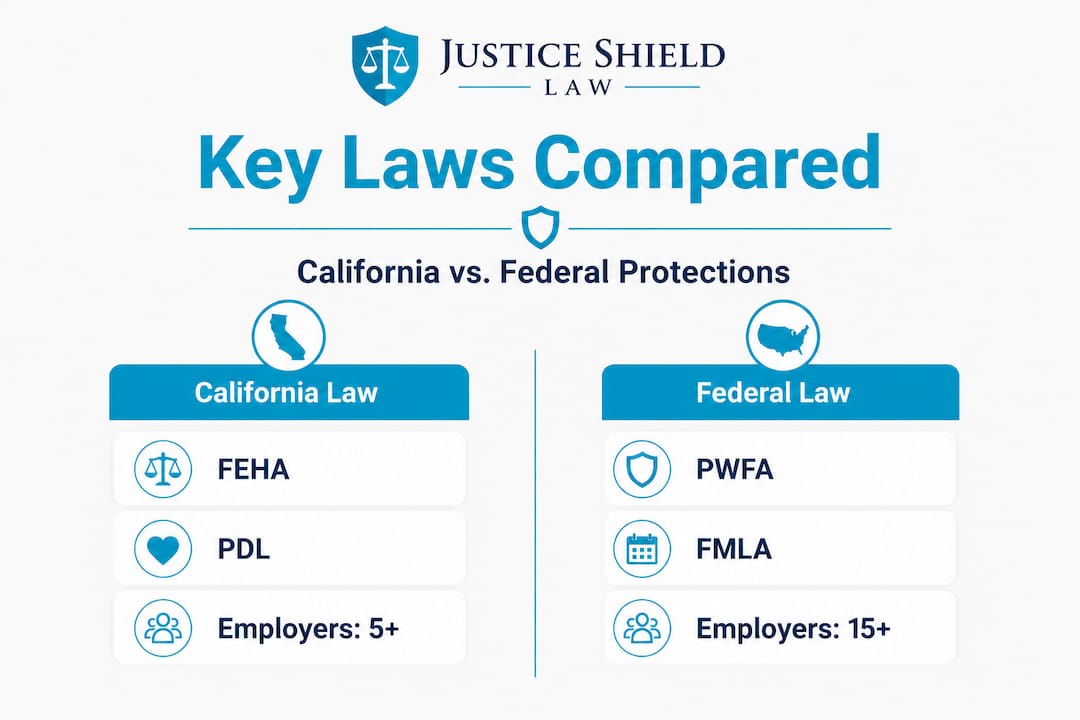
California's Fair Employment and Housing Act (FEHA) is the strongest of the three. FEHA covers employers with 5+ employees and prohibits discrimination on the basis of pregnancy, childbirth, and related medical conditions. It also requires employers to engage in a good-faith interactive process to find reasonable accommodations. FEHA applies to a much wider range of employers than federal law, which means that even small Irvine startups or boutique corporate offices must comply.

California's Pregnancy Disability Leave (PDL) allows eligible employees to take up to 4 months of job-protected, unpaid leave for any disability caused by pregnancy, childbirth, or a related condition. Critically, there is no minimum service requirement. This means you can take PDL even if you have worked for your company for only a few weeks.
The federal Pregnant Workers Fairness Act (PWFA), which went into effect in 2023, fills in gaps that the older Pregnancy Discrimination Act left open. The PWFA mandates reasonable accommodations for known limitations related to pregnancy unless the employer can demonstrate undue hardship. It applies to employers with 15 or more employees.
The table below summarizes how these laws compare:
| Law | Employer size | Covers accommodations | Leave entitlement | Who enforces it |
|---|---|---|---|---|
| FEHA (California) | 5+ employees | Yes | PDL: up to 4 months | California Civil Rights Dept. |
| PDA (Federal) | 15+ employees | Partially | No specific leave | EEOC |
| PWFA (Federal) | 15+ employees | Yes, explicitly | No specific leave | EEOC |
For most Irvine employees at mid-size to large corporations, all three laws apply simultaneously. California law often provides greater protection, so when state and federal rights conflict, you typically benefit from the stronger rule.
Pro Tip: Every time you submit an accommodation request or discuss your pregnancy with HR, follow up in writing. Send a brief email summarizing what was discussed and what you were told. This creates a timestamp and a paper trail that is invaluable if you ever need to escalate.
You should also understand the process for reporting workplace discrimination so you are prepared before any problem escalates.
Reasonable accommodations: What you can ask for
The phrase "reasonable accommodation" can feel vague, but the law is actually quite specific about what qualifies. In a corporate setting, you have the right to request adjustments that allow you to keep doing your job safely while managing the physical demands of pregnancy.
Common examples of reasonable accommodations include:
- Additional rest breaks, such as a 10-minute break every two hours rather than the standard schedule
- Seating or an ergonomic chair, particularly if your role normally involves extended standing or walking
- Modified work schedule, allowing you to attend prenatal appointments without using vacation time
- Remote work or hybrid arrangements, when your job functions can be performed off-site
- Temporary reassignment to lighter duties if heavy lifting or strenuous tasks are part of your normal role
- Access to a private lactation room with appropriate facilities, which is legally required for most employers
- Closer parking or reduced walking distances within the office
Accommodations like extra breaks and seating are among the most commonly requested, and also among the most commonly denied without valid justification. The law requires employers to engage in a good-faith interactive process with you. This means they cannot simply say "no." They must consider your request, consult with you, and explore alternatives before claiming undue hardship.
"Undue hardship is a high bar. For large corporations, basic accommodations like a chair or modified schedule almost never qualify. Employers who use this defense without basis risk legal exposure."
The concept of undue hardship means an accommodation that would require significant difficulty or expense given the employer's size and resources. For a company with hundreds of employees and millions in annual revenue, claiming that providing a stool at a reception desk is "too costly" simply does not hold up. Predictable assessments like water access or rest breaks are rarely, if ever, considered an undue hardship for any sizable employer.
When you make a request, do it in writing. Describe your limitation and what you are asking for. Give HR a reasonable timeframe to respond. If they delay, document that too. These steps directly support the process for family medical leave protections and other related claims if you ever need to take the matter further.
Pro Tip: If HR denies an accommodation verbally, ask them to confirm the decision in writing with a reason. Many employers will reconsider when they realize the denial is being documented.
What to do if you experience pregnancy discrimination in Irvine
If you believe your employer has discriminated against you or failed to accommodate you, acting quickly and strategically makes a real difference. Here is a clear, step-by-step approach:
- Document everything immediately. Write down dates, times, what was said, and who was present. Save all emails, texts, and meeting notes. If your job responsibilities suddenly change, document that in writing.
- Review your company's internal complaint policy. Most corporate employers have an HR grievance process. Filing an internal complaint establishes a formal record and puts your employer on notice.
- Consult an employment attorney early. Many pregnant employees wait too long. Getting legal advice early helps you preserve evidence, understand deadlines, and avoid common mistakes.
- File a charge with the EEOC or the California Civil Rights Department (CRD). These government agencies investigate discrimination complaints. Filing is often a required step before you can sue in federal court.
- Preserve your evidence independently. Keep copies of all documents outside of your work systems. Use a personal email or drive to store records you may need later.
Recent enforcement data shows why persistence matters. EEOC received 765 calls from pregnant workers denied accommodations following the PWFA's enactment, and settlements including payments of $30,000 or more for unlawful terminations after pregnancy disclosure reflect that these claims are being taken seriously and resolved in employees' favor.
The table below outlines the key reporting routes:
| Route | Agency | Timeframe to file | Outcome |
|---|---|---|---|
| Internal HR complaint | Your employer | As soon as possible | Formal company record |
| EEOC charge | Federal agency | 180 or 300 days from violation | Investigation, mediation, right to sue |
| CRD complaint | State agency | 3 years from violation (California) | Investigation, potential litigation |
| Civil lawsuit | Court (federal or state) | After administrative process | Damages, reinstatement, attorney fees |
California's three-year statute of limitations for CRD complaints gives Irvine employees more time than most states. But waiting too long still damages your case. Witnesses' memories fade, documents get deleted, and patterns become harder to prove. The process for reporting discrimination is your roadmap once you decide to act.
Why ongoing enforcement matters: Lessons from recent cases
There is a gap between what the law requires and what actually happens in corporate offices. We see it consistently. Employers, even large, well-resourced companies, still deny basic accommodations. Managers still make comments about "not knowing if someone will come back after leave." HR departments still handle pregnancy disclosures with skepticism rather than support.
What EEOC enforcement data reveals is that simple, inexpensive accommodations such as chairs or additional breaks are among the most frequently denied, often without any real assessment of hardship. This is not a gray area. These are clear-cut violations. Yet they keep happening because many employees do not know their rights well enough to push back, and some employers assume silence means consent.
The lesson here is direct: do not assume your employer understands the law better than you do. Some HR professionals in corporate settings genuinely lack training on PWFA requirements, particularly given how recently the law took effect. Others know the rules but count on you not knowing them.
The EEOC's active pursuit of settlements, some reaching six figures, sends a signal that this enforcement environment is real and consequences are tangible. At the same time, settlements only happen when employees step forward. You cannot benefit from enforcement if you stay silent.
Another persistent issue involves so-called workplace safety violations that disproportionately affect pregnant workers, particularly those in environments requiring physical activity. These situations are legally actionable and reinforce that the protections described in this guide are broad and meaningful.
The practical lesson is this: document early, advocate clearly, and access legal resources before your situation becomes more complicated. Irvine has a dense corporate sector with many sophisticated employers who are aware of the law. But awareness does not always translate into compliance, and you deserve more than awareness. You deserve full protection.
Connect with trusted legal support
Facing pregnancy discrimination at work is a stressful and disorienting experience, and navigating the legal process alone adds an unnecessary burden. At Justice Shield Law, we represent employees exclusively, which means our only focus is protecting your rights. Our attorneys understand both California and federal employment law and are experienced in handling pregnancy discrimination claims in Irvine and throughout Southern California. If you are dealing with a denied accommodation, a suspicious demotion, or a wrongful termination, we can help you evaluate your options. We offer confidential consultations so you can get a clear picture of your situation and your next best step, without pressure and without obligation. Reach out to us today.
Frequently asked questions
How do I prove pregnancy discrimination at my workplace?
Gather written records of all communications, keep copies of performance reviews, and document any adverse changes after your pregnancy is disclosed. A clear timeline connecting your disclosure to negative employer actions is your strongest evidence.
What accommodations must my Irvine employer provide under California law?
Employers must provide reasonable accommodations like breaks, seating, modified duties, and schedule changes unless it causes genuine undue hardship, which is a high bar for most corporate employers.
What's the difference between FEHA and the PWFA?
FEHA is a California law applying to employers with 5+ employees; the PWFA requires accommodations under federal law for employers with 15+ employees. Both require accommodations, and California's FEHA often provides broader coverage.
How long can I take leave during my pregnancy in California corporate jobs?
You may take up to 4 months of job-protected, unpaid leave for pregnancy-related disabilities under California's PDL, with no minimum service requirement.
What's the first step if my company refuses my accommodation request?
Document the refusal in writing and attempt to resolve it through HR. If unresolved, contact the EEOC or an experienced employment attorney to understand your options and protect your rights before any legal deadlines pass.