
TL;DR:
- Nearly 90% of workers' compensation medical treatment denials in California are upheld after appeal.
- Common reasons for denials include delayed reporting, insufficient documentation, and disputed injury causation.
- Timely filing and strong medical support are crucial for improving chances in the complex appeals process.
Appealing a denied workers' compensation claim sounds straightforward, but the numbers tell a different story. California's 12.7% overturn rate for medical treatment denials through Independent Medical Review (IMR) means that roughly 9 out of 10 denials are upheld after appeal. For hospital employees in Oakland, whether you work at Highland Hospital, Kaiser Oakland, or another Alameda County facility, this reality makes understanding the process before you file absolutely critical. This guide breaks down why denials happen, how to navigate each appeals channel, and what practical steps give you the best chance of protecting your rights.
Table of Contents
- Why are workers' compensation claims denied in Oakland hospitals?
- Understanding the appeals process: UR, IMR, and WCAB
- Oakland WCAB District Office and regional specifics
- What to do if your compensation is denied: Practical steps
- A hard truth about workers' comp denials: What most hospital employees aren't told
- Connect with legal help for your Oakland hospital workers' compensation denial
- Frequently asked questions
Key Takeaways
| Point | Details |
|---|---|
| Low denial overturn rates | Most California hospital workers’ comp denials are rarely overturned on appeal. |
| Strict appeal deadlines | You must act within 30 days or 1 year to preserve your claim rights. |
| Local WCAB office | Oakland hospital workers resolve disputes at the local WCAB District Office. |
| Documentation matters | Strong medical records and prompt action greatly improve your odds. |
Why are workers' compensation claims denied in Oakland hospitals?
With the surprisingly high uphold rate for denials in mind, let's look at what causes so many claims by Oakland hospital workers to be turned down in the first place.
The workers' compensation process for California hospital employees begins when you report a workplace injury to your employer and receive a DWC-1 claim form. Your employer's insurer then investigates the claim and decides whether to accept or deny it. From there, if your claim is accepted but specific medical treatments are denied, a separate review process called Utilization Review (UR) applies.
The most common reasons Oakland hospital employees face denials include:
- Delayed reporting: California law requires you to report an injury promptly. Late reporting gives insurers grounds to question whether the injury actually occurred at work.
- Insufficient medical documentation: Without clear medical records linking your condition to your job duties, a denial is likely.
- Disputed injury causation: Insurers often argue that an injury pre-existed employment or happened outside of work.
- Non-covered services: Certain treatments fall outside the Medical Treatment Utilization Schedule (MTUS), the official standard California uses to evaluate medical necessity.
- Procedural errors: Missing paperwork, incomplete forms, or filing with the wrong office can trigger administrative denials.
Understanding which medical services are most disputed helps you anticipate problems. Recent statewide data shows that IMR disputes most commonly involve prescription drugs (30 to 33%), physical therapy (13.6%), injections (12.9%), and durable medical equipment (9.7%). Evaluation and management services actually see the highest overturn rates, which is worth noting if your denial involves office visits or specialist consultations.
| Disputed service type | Share of IMR disputes |
|---|---|
| Prescription drugs | 30-33% |
| Physical therapy | 13.6% |
| Injections | 12.9% |
| Durable medical equipment | 9.7% |
| Evaluation and management | Lower volume, highest overturns |
These trends apply statewide and are directly relevant to hospital employees in Oakland. If you work in a physically demanding role, such as nursing, patient transport, or surgical support, the disputed service types above are especially common in your field. Learning about Kaiser claim denials can also help you recognize patterns specific to large hospital employers.
Understanding the appeals process: UR, IMR, and WCAB
Once you understand why denials happen, it's crucial to know your options for fighting them through the official appeals channels.
California has a layered appeals system. The path you take depends on whether your entire claim was denied or only specific medical treatments within an accepted claim.
For a full claim denial:
- Request a reconsideration from the insurer immediately after receiving the denial letter.
- If reconsideration fails, file the DWC-1 form (Application for Adjudication of Claim) with the Workers' Compensation Appeals Board (WCAB) within one year of your injury date.
- Attend a mandatory settlement conference, then a trial if no agreement is reached.
For a medical treatment denial within an accepted claim:
- Your treating physician must first request the treatment through UR.
- If UR denies it, request an Independent Medical Review (IMR) within 30 days of the UR decision. Missing this deadline nearly always ends your ability to challenge that specific denial.
- If IMR upholds the denial and you believe MTUS guidelines were violated, you may appeal to the WCAB on narrow legal grounds.
The IMR process favors insurers with roughly a 90% uphold rate, and has faced sustained criticism for limiting access to care even when treating physicians strongly recommend a treatment.
The WCAB remains your most powerful formal venue when IMR fails, but the legal standards are strict and professional guidance is often essential.
Pro Tip: Keep a dated log of every communication with your insurer, every form you submit, and every phone call. Insurers sometimes dispute receipt of documents, and your records can be the deciding factor in a WCAB proceeding.
If you want to understand your broader California workers' rights beyond workers' comp, that knowledge can also strengthen your position if your employer retaliates against you for filing. Retaliation is illegal, and knowing when to take additional action, such as filing formal complaints with state agencies, is part of protecting yourself fully.
Oakland WCAB District Office and regional specifics
Now that you know the steps and rules, let's zero in on where claims are actually processed when disputes aren't resolved internally.
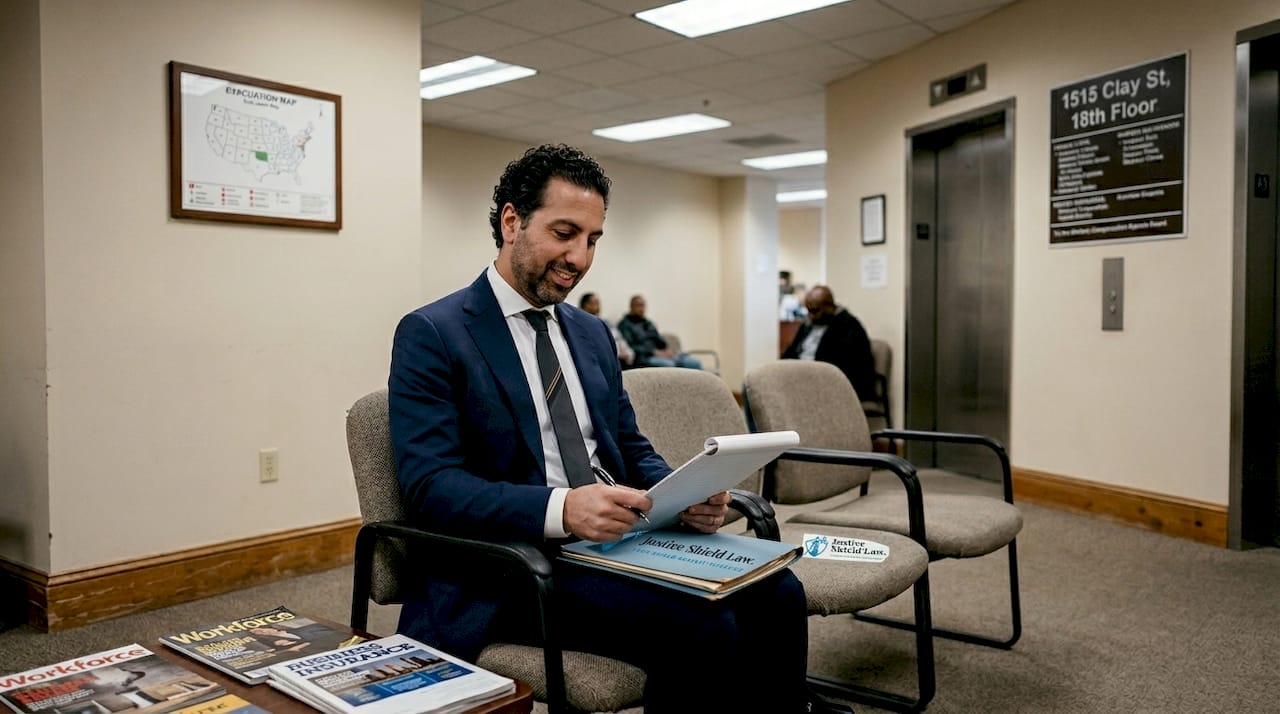
If your case moves to a formal hearing, you will work with the Oakland WCAB District Office. This is the primary venue for Alameda County hospital employees. The Oakland WCAB District Office is located at 1515 Clay St, 18th Floor, Oakland, CA 94612. This office handles disputes for employees at hospitals including Highland Hospital, Kaiser Oakland, and other Alameda County medical facilities.
Key facts about the Oakland WCAB office:
- Jurisdiction: Covers Alameda County workplace injury disputes.
- Services provided: Case filings, hearings, mandatory settlement conferences, and trial proceedings.
- Operating hours: Standard California DWC business hours; call ahead to confirm availability.
- Required forms: DWC-1, Declaration of Readiness to Proceed (if advancing to hearing).
| Oakland WCAB office detail | Information |
|---|---|
| Address | 1515 Clay St, 18th Floor, Oakland, CA 94612 |
| County served | Alameda County |
| Key hospitals covered | Highland Hospital, Kaiser Oakland, others |
| Primary role | Formal dispute hearings and adjudication |
One important note: there are no publicly available denial rate statistics specific to individual Oakland hospitals. Bay Area and statewide data are the closest benchmarks you can use. However, recent hospital layoffs at facilities like Alameda Health System may cause delays in claims processing as administrative staff numbers change. Those layoffs do not alter your legal rights or the denial rates themselves, but they may affect response times. If you are experiencing delays at Kaiser Oakland disputes or other facilities, document those delays carefully, as they can become relevant in a hearing.
What to do if your compensation is denied: Practical steps
If you've been denied or are facing delays, here is a practical, immediate action list to protect your rights and move your case forward.
- Get the denial in writing. Always request a written explanation of the denial. Verbal denials are not sufficient for appeals purposes.
- Review the denial reason carefully. Check whether it's a full claim denial or a treatment denial. The appeals path is different for each.
- File the DWC-1 with the WCAB within one year of your injury date if your full claim is denied. Do not wait, as the official filing timelines are strict and missing them can permanently close your case.
- Request IMR within 30 days if a specific treatment was denied through UR. This is a hard deadline.
- Gather all medical records related to your injury. Ask your treating physician to write a detailed report connecting your condition to your specific work duties.
- Document your work environment. Photos, incident reports, witness statements, and shift logs all support your claim.
- Check statewide denial patterns. The annual denial percentages published by the Commission on Health and Safety and Workers' Compensation (CHSWC) provide context on how common certain denials are in California, which can inform your strategy.
- Consult a workers' compensation attorney early. Many employees wait too long. Free consultations cost you nothing and can prevent costly procedural mistakes.
Pro Tip: Most employment attorneys who handle workers' comp cases offer free initial consultations. Use this opportunity to have your denial letter reviewed by a professional before making your next move. Understanding your California workers' legal protections takes less than an hour when you have qualified guidance.
A hard truth about workers' comp denials: What most hospital employees aren't told
Stepping back, here's the blunt reality most guides won't tell you about fighting workers' comp denials in hospital settings.
The system is not designed to make appeals easy. Insurers understand that a large portion of denied employees will not follow through with every procedural step. That's not cynicism. It's how the system works in practice.
Most denials are upheld not simply because the claim lacks merit, but because employees submit appeals without strong supporting medical evidence or miss a single critical deadline. The IMR process, while officially independent, operates under guidelines that systematically favor the insurer's position in borderline cases.
There is also a persistent myth that denials get overturned at higher rates on second or third appeal. The data does not support this. The approximately 88 to 89% uphold rate in recent quarters is consistent and applies across case types.
What does work is early, aggressive documentation combined with physician support. If your treating doctor strongly advocates for a specific treatment and clearly links it to your occupational injury, that gives an IMR reviewer less room to uphold a denial. Passive reliance on the process alone rarely produces different results.
For hospital employees specifically, working conditions, like lifting patients, exposure to infectious materials, and long shifts, create complex injury profiles that require detailed documentation. Starting that documentation at the time of injury, not after a denial, is the single most effective thing you can do. Reviewing resources about challenging hospital claim denials early in the process can help you understand what documentation matters most.
Connect with legal help for your Oakland hospital workers' compensation denial
Facing a denied workers' compensation claim is stressful, especially when the formal appeals system feels designed to confuse you. Justice Shield Law works exclusively on behalf of employees, never employers or insurers. We understand the specific challenges hospital workers in Oakland face, and we know what it takes to build a compelling case. Whether you are at the beginning of the appeal process or have already received an IMR decision, getting professional guidance now can protect your options. Visit our site for workers' compensation guidance or learn more about challenging a denial. Contact us today for a free, confidential consultation.
Frequently asked questions
What are the main reasons hospital workers' comp claims are denied in Oakland hospitals?
Most denials stem from insufficient medical documentation, delayed injury reporting, or insurer disputes over whether the injury is work-related. IMR disputes most often involve prescription drugs and physical therapy, which are common treatment types for hospital workers.
How long do I have to appeal a workers' comp denial?
You must request IMR within 30 days of a UR treatment denial or file your Application for Adjudication of Claim with the WCAB within one year of your injury date for a full claim denial.
What is the chance my medical treatment denial will be overturned in California?
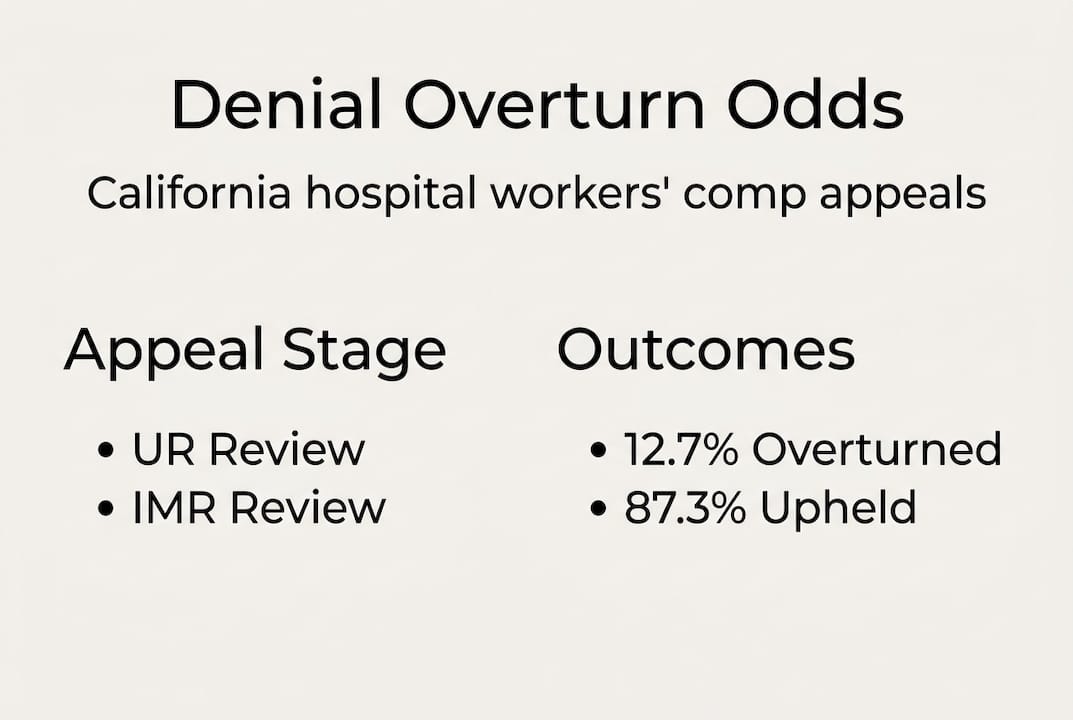
Statistically low: only a 12.7% overturn rate applies to IMR denials statewide, meaning roughly 88% of denials are upheld after review.
Where do I resolve my workers' comp dispute if I work at Kaiser or Highland in Oakland?
Your formal dispute will be handled at the Oakland WCAB District Office at 1515 Clay St, 18th Floor, which covers all Alameda County hospitals including Highland and Kaiser Oakland.
Do recent hospital layoffs change the denial process?
Recent Alameda Health System layoffs may slow claims processing times but do not legally change denial rates or your appeal rights. Document any processing delays, as they may become relevant to your case.
Recommended
- Justice Shield Law | California Employment Lawyers — Free Consultation
- Justice Shield Law | California Employment Lawyers — Free Consultation
- Justice Shield Law | California Employment Lawyers — Free Consultation
- Justice Shield Law | California Employment Lawyers — Free Consultation
- Wrongful Termination After Workers’ Compensation Claims | Serendib Law Firm