

TL;DR:
- California law grants eligible retail workers up to four months of Pregnancy Disability Leave with job and health benefits.
- Common violations include denial of leave, terminations, reduction of hours, and retaliation, often subtle and hard to detect.
- Document all requests and incidents, file complaints with the state, and seek legal support to enforce rights.
If you work retail in Mid-Wilshire and you're pregnant, you may already feel uncertain about what your employer is legally required to do. Many retail workers in this area don't realize that California law requires employers with five or more employees to provide up to four months of Pregnancy Disability Leave. Violations happen frequently, and employers often count on workers not knowing the rules. This article will walk you through your legal rights, the warning signs of a violation, the steps to protect yourself, and the remedies available when an employer breaks the law.
Table of Contents
- Understanding your pregnancy leave rights in Mid-Wilshire retail
- Common pregnancy leave violations in retail jobs
- What to do if your retail employer violates pregnancy leave laws
- Legal outcomes and remedies for pregnancy leave violations
- Why most retail pregnancy leave violations go unreported — and what really works
- How Justice Shield Law can help you protect your rights
- Frequently asked questions
Key Takeaways
| Point | Details |
|---|---|
| Know your rights | California law protects your right to up to four months of pregnancy leave in retail jobs. |
| Recognize violations | Common violations include denial, retaliation, or ignored requests for leave. |
| Document everything | Careful documentation can make or break your legal case if your rights are violated. |
| Report promptly | File a complaint with the California Civil Rights Department within 3 years if your leave is denied. |
| Get legal support | Consulting an employment lawyer can help you secure compensation and protection for your job. |
Understanding your pregnancy leave rights in Mid-Wilshire retail
With rights often misunderstood, let's clarify exactly what California law guarantees you as a retail employee.
Pregnancy Disability Leave (PDL) is a California state protection that gives eligible employees the right to take time off work when a pregnancy-related condition affects their ability to do their job. This is not the same as the federal Family and Medical Leave Act (FMLA), though both may apply at the same time depending on your situation. California's PDL is broader and covers more workers, making it especially relevant for retail employees in Los Angeles.
Who qualifies for PDL in retail?
To qualify for Pregnancy Disability Leave in California, you need to meet a few basic conditions:
- Your employer must have five or more employees (most Mid-Wilshire retail businesses meet this threshold)
- You must work for that employer at the time your disability begins
- You must be disabled by pregnancy, childbirth, or a related medical condition
- Your disability can be physical or mental, as confirmed by a healthcare provider
Notice that there is no minimum hours requirement for PDL in California, unlike the federal FMLA. Part-time retail workers are often surprised to learn they qualify. If you work 20 hours a week at a clothing store on Wilshire Boulevard, you may still be fully protected.
What does PDL actually cover?
The California PDL protection guarantees several specific rights that your employer cannot legally take away from you. Here is a summary:
| PDL right | What it means for you |
|---|---|
| Up to 4 months of leave | You can take this leave all at once or intermittently based on medical need |
| Job protection | Your employer must return you to the same or a comparable position |
| Health benefits continuation | Your employer must keep your health insurance active during leave |
| Reasonable accommodation | Employers must modify duties or schedules when medically necessary |
| Protection from retaliation | You cannot be disciplined, demoted, or fired for requesting or taking PDL |
The leave duration is calculated based on the number of hours you normally work. For a full-time retail worker, that can be up to 17.3 weeks. For part-time employees, the figure is prorated based on your standard schedule.
Reasonable accommodation is a key concept. Even before you reach the point of needing full leave, your employer may be required to reduce your hours, adjust your schedule, allow you to sit instead of stand, or limit heavy lifting. Many retail violations actually begin here, when employers refuse to adjust duties before a full leave request is ever made.
Pro Tip: Always submit your leave or accommodation request in writing, even if your manager first discusses it with you verbally. A written request creates a documented record that becomes critical evidence if a dispute arises later.
Common pregnancy leave violations in retail jobs
Now that you know what rights you have, it's crucial to spot how employers might violate them.
Retail employers in Mid-Wilshire violate pregnancy leave rights in several ways, some obvious and some surprisingly subtle. Knowing the difference helps you identify a problem before it escalates.
Overt violations
These are the clearest and most direct violations:
- Outright denial of leave — A manager tells you that your store is "too busy" to approve leave or that pregnancy is not a covered condition
- Termination upon announcement — You notify your employer about your pregnancy and are let go shortly after, often under the pretext of poor performance or a position elimination
- Failure to reinstate — You return from pregnancy leave and are told your position no longer exists or that someone else has been permanently placed in your role
- Cutting off health benefits — Your employer stops paying for your health coverage during your approved leave period
Subtle violations you might miss
These are harder to catch but just as serious:
- Being reassigned to worse shifts or fewer hours after returning from leave
- Pressure to resign "voluntarily" while on leave
- Sudden negative performance reviews that did not exist before your pregnancy
- Being excluded from training, promotions, or advancement opportunities after announcing your pregnancy
- A manager making comments about your capacity or reliability based on your pregnancy
"Denied pregnancy leave is one of the most frequent violations in retail employment rights cases, and many workers don't realize the behavior is illegal until long after the damage is done."
Retail worker rights cases across California show that documentation is the single most powerful tool an employee can have. When employers know they have a paper trail working against them, they are far more likely to settle or correct their behavior.
A concrete example: imagine a cashier at a Mid-Wilshire grocery store who tells her manager she is pregnant and needs modified duties because of back pain. The manager verbally agrees but never puts it in writing. Two weeks later, the cashier is assigned to a physically demanding stocking role. When she complains, she is told her position has been "restructured." This is a textbook violation, but it would be difficult to prove without written records.

Family medical leave violation examples show that this kind of incremental retaliation is common across industries. According to state guidance, employees facing violations should document each incident, request accommodations in writing, and engage HR formally rather than informally.
What to do if your retail employer violates pregnancy leave laws
If you suspect a violation, here's what to do to protect yourself and your rights.
Taking action may feel intimidating, especially when you depend on your job. But there are clear steps you can follow, and each one strengthens your legal position significantly.
Step-by-step action plan
-
Document everything immediately. Write down dates, times, locations, and what was said. Note who was present. Keep copies of any emails, texts, or written notices you receive from your employer.
-
Put all requests in writing. Submit your leave or accommodation request via email or a formal letter. Avoid relying on verbal conversations. If your manager speaks to you about your request, follow up that conversation with a written summary sent by email.
-
Notify HR formally. Send a written notice to your HR department stating your request and the legal basis (California PDL). Keep copies of everything you send and receive.
-
File a complaint with the California Civil Rights Department (CRD). If your employer fails to respond appropriately, you can file a complaint with the CRD. The deadline to file is within 3 years of the violation. This is a generous window, but acting sooner preserves evidence and witness memory.
-
Consult an employment attorney. A lawyer who focuses on employee rights can evaluate your situation, advise you on the strength of your claim, and help you navigate the process without mistakes that could hurt your case.
-
Request a right-to-sue notice if needed. In some situations, you may need a formal right-to-sue letter from the CRD before filing a civil lawsuit. An attorney can guide you through whether this step applies to your case.
A real-world example
Consider Jane, a retail associate at a boutique on Wilshire Boulevard in Mid-Wilshire. She informs her store manager by email that she is pregnant and needs intermittent leave for prenatal appointments. Her manager responds verbally but takes no formal action. Over the next month, Jane is moved to a demanding overnight shift she has never worked before. Her hours are also cut. When she escalates to HR, nothing changes.
Jane saves every email, takes notes after every conversation, and contacts an employment attorney. With that documentation, she files a CRD complaint and the matter moves to mediation. Her employer, facing clear evidence of retaliation, agrees to settle. Jane is reinstated to her original schedule and receives back pay for the wages she lost.
Pro Tip: Save all written communications in a personal email folder or cloud storage account that is separate from your work accounts. If your employer deactivates your work email, you will still have your records. Also take photos of any physical documents like posted schedules or written warnings.
Understanding how to file a workplace complaint is a critical skill for any employee in this situation. The process is not as complicated as many workers fear, especially with legal guidance.
Legal outcomes and remedies for pregnancy leave violations
Understanding legal processes, let's look at what results you can expect if you act.
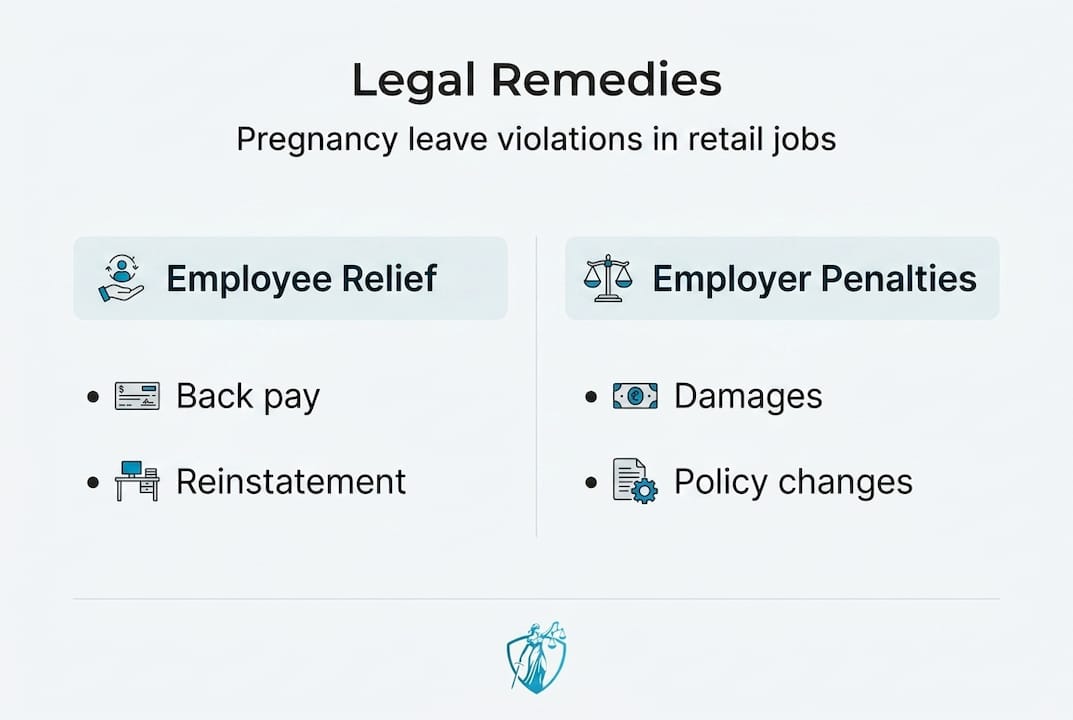
When a pregnancy leave violation is proven, the legal system provides several forms of relief. Knowing what is realistically available to you helps set expectations and motivates action.
What remedies are on the table?
| Remedy type | What it means | Employer common defense |
|---|---|---|
| Back pay | Wages you lost due to the violation | "Employee performance issues" |
| Reinstatement | Return to your original or comparable job | "Position was eliminated" |
| Compensatory damages | Compensation for emotional distress and out-of-pocket costs | "No harm was caused" |
| Policy changes | Employer required to update written policies | "Existing policies were sufficient" |
| Training mandates | Employer required to train management | "Managers were already trained" |
The "undue hardship" defense is worth addressing directly. Retail employers sometimes argue they cannot accommodate a pregnancy-related request because it places an unreasonable burden on the business. However, this defense is rarely valid in retail settings because the bar is extremely high. California courts require employers to show significant operational or financial difficulty, not just inconvenience. For most retail businesses, adjusting a schedule or modifying duties does not come close to meeting that standard.
What typically happens after a complaint?
- The CRD investigates the complaint and may offer mediation
- Many cases settle during mediation, with the employer agreeing to pay damages and implement policy changes
- If mediation fails, the CRD may issue a right-to-sue notice, allowing the employee to file a civil lawsuit
- Successful lawsuits can result in court-ordered reinstatement, back pay, and damages
The Whole Foods case in Berkeley is a well-known example of this process. After workers' pregnancy accommodation requests were allegedly ignored, the company agreed to training and policy changes through a CRD resolution. This outcome shows that formal complaints produce real, tangible results.
Retaliation claims in retail often accompany pregnancy leave violations, meaning that if you were punished for asserting your rights, that is a separate legal claim on top of the original violation.
What you can realistically expect from a well-documented, successful case:
- Recovery of lost wages from the period you were improperly denied leave or demoted
- Return to your job with legal protection against further retaliation
- Financial compensation for the stress and costs caused by the violation
- Your employer being required to change its practices so other workers are protected going forward
Why most retail pregnancy leave violations go unreported — and what really works
Here is the real-world truth from years of legal experience: most retail employees who face pregnancy leave violations never report them. Fear is the most common reason. Fear of losing their job, fear of not being believed, fear of making things awkward at work. HR departments sometimes reinforce this fear by discouraging formal complaints, framing the process as slow, complicated, or unlikely to succeed.
We have seen this pattern repeatedly. An employer denies a request, a worker feels powerless, and the violation goes unaddressed. The employer faces no consequence and often repeats the behavior with the next employee. This cycle only breaks when workers document what is happening and take formal action.
What actually leads to change is not a conversation in a break room. It is a written complaint backed by organized evidence. Wrongful termination case outcomes confirm this consistently. Employers change policies when they face legal accountability, not when employees quietly endure mistreatment.
You are more powerful than you think when you act with knowledge and support. The law is clearly on your side. Retail employers in Mid-Wilshire are not exempt from these requirements, no matter how small the store or how informal the workplace culture.
How Justice Shield Law can help you protect your rights
If you're ready to protect your rights, here's how to get direct support.
Justice Shield Law works exclusively on the employee side of employment disputes in Los Angeles. We represent retail workers in Mid-Wilshire and throughout LA who are facing pregnancy leave violations, retaliation, wrongful termination, and related employment law issues. If your employer has denied your leave, pressured you to resign, or retaliated against you for asserting your rights, we want to hear from you. We offer free, no-obligation consultations so you can understand your legal options without any financial risk. Our team handles the complexity so you can focus on your health and your family. Contact us today to speak with an experienced employment attorney.
Frequently asked questions
How long is pregnancy leave for retail jobs in California?
Pregnancy Disability Leave in California provides up to 4 months of job-protected leave if your employer has five or more employees, regardless of how long you have worked there.
What steps should I take if I am denied pregnancy leave?
Document every incident, make your requests in writing, notify HR formally, and file a CRD complaint within three years of the violation while also consulting an employment attorney as early as possible.
What legal remedies are available for pregnancy leave violations?
Remedies may include back pay, reinstatement to your job, financial damages for emotional distress, and employer-mandated policy and training changes negotiated through mediation or ordered by a court.
Does my employer have to keep my health benefits during pregnancy leave?
Yes, California law requires employers to maintain your health insurance benefits at the same level throughout your approved Pregnancy Disability Leave period.