

Facing workplace discrimination can be overwhelming and isolating. You may feel uncertain about your rights, hesitant to speak up, or unsure where to turn for help. California law provides robust protections and a clear process to report discrimination, empowering you to take action against unfair treatment. This guide walks you through every step of reporting workplace discrimination in California, from understanding your rights under state law to filing a formal complaint and avoiding common pitfalls that could delay justice.
Table of Contents
- Key takeaways
- Understanding workplace discrimination and your rights in California
- Preparing to report discrimination: what you need to know and gather
- How to file a workplace discrimination complaint in California: step-by-step process
- Common challenges when reporting discrimination and how to avoid them
- How Justice Shield Law can assist you in reporting workplace discrimination
- FAQ
Key Takeaways
| Point | Details |
|---|---|
| FEHA filing deadline | You have up to three years from the last discriminatory act to file with the California Civil Rights Department. |
| CRD online portal | Begin your complaint through the California Civil Rights Department online portal to start the process. |
| EEOC cross filing | Federal EEOC claims must be filed within 300 days and are cross filed with CRD in California. |
| Right to sue notice | After CRD processing, a right to sue notice allows you to file a state court lawsuit within one year. |
| FEHA advantages | FEHA offers broader protections and uncapped damages compared with federal law. |
Understanding workplace discrimination and your rights in California
Workplace discrimination occurs when you experience harassment or unfair treatment based on protected characteristics. Under California's Fair Employment and Housing Act, these protected categories include race, color, national origin, ancestry, religion, age, disability, sex, gender identity, sexual orientation, marital status, medical condition, genetic information, and military or veteran status. Understanding what qualifies as discrimination helps you recognize violations and take informed action.
FEHA applies to employers with 5 or more employees, casting a wider net than federal Title VII protections, which only cover employers with 15 or more workers. This broader scope means more California employees can seek legal remedies when discrimination occurs. FEHA also offers uncapped damages for emotional distress and punitive damages, potentially resulting in more substantial compensation than federal claims allow.
Knowing your rights empowers you to identify discrimination when it happens and prepares you to report it confidently. Common examples include:
- Being passed over for promotion due to your race or gender
- Experiencing hostile work environment comments about your religion or sexual orientation
- Receiving unequal pay compared to colleagues doing similar work
- Facing retaliation after requesting disability accommodations
- Being terminated shortly after disclosing a pregnancy or medical condition
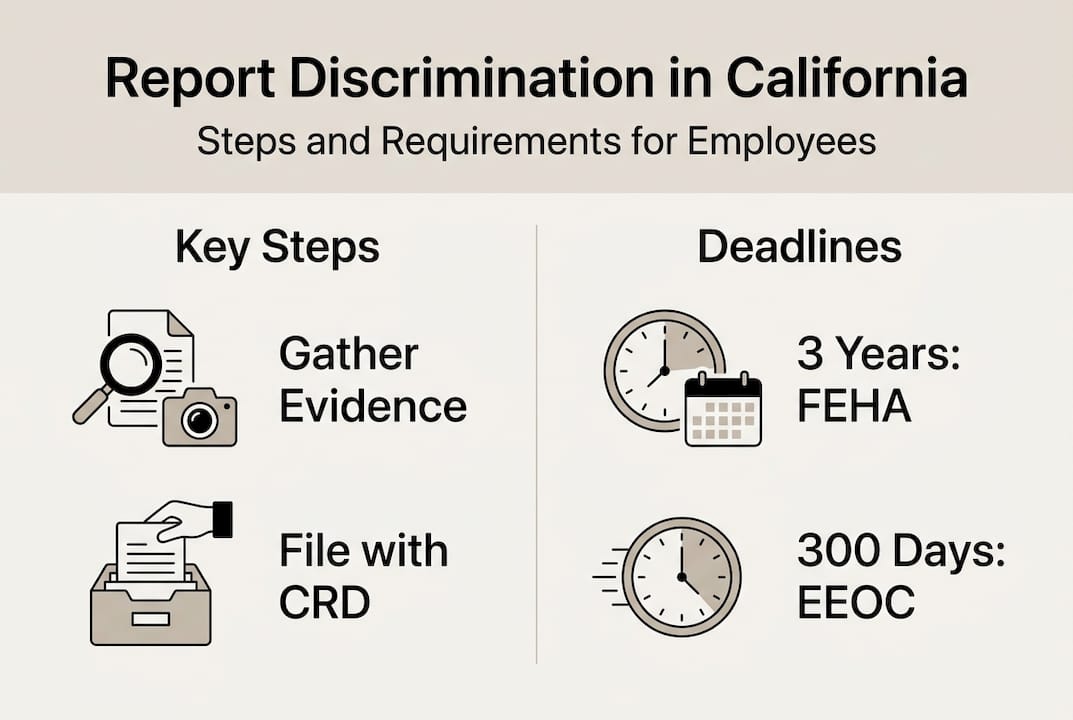
You have 3 years from the last discriminatory act to file a complaint with the California Civil Rights Department. This generous timeframe gives you space to gather evidence and seek legal counsel, but waiting too long can jeopardize your claim. Understanding this deadline from the start helps you plan your next steps strategically.
Pro Tip: Document every incident immediately after it occurs. Fresh details are more accurate and compelling than memories reconstructed months later.
Preparing to report discrimination: what you need to know and gather
Strong documentation forms the foundation of a successful discrimination complaint. Before filing, organize your evidence systematically to present a clear, compelling narrative. Start by creating a detailed timeline of each discriminatory incident, noting the date, time, location, people involved, and exactly what happened. Include how each event made you feel and any impact on your work performance or mental health.

Gather all relevant communications that support your claim. Emails, text messages, performance reviews, disciplinary notices, and witness statements can corroborate your account. If coworkers witnessed discriminatory behavior, ask if they would be willing to provide written statements or testify if needed. Save copies of company policies, employee handbooks, and any internal complaint procedures you followed before escalating to external agencies.
Understanding complaint deadlines is critical to protecting your rights. California's FEHA allows 3 years from the last discriminatory act to file with the CRD. Federal claims through the Equal Employment Opportunity Commission must be filed within 300 days. Missing these deadlines can permanently bar your claim, regardless of how strong your evidence is.
Keep a personal journal describing how discrimination affected you emotionally, physically, and financially. Note any medical treatment sought for stress, anxiety, or depression related to workplace mistreatment. Document lost wages if discrimination led to demotion, reduced hours, or termination. This information helps establish damages and demonstrates the real harm you suffered.
Consider these preparation steps:
- Create a chronological incident log with specific dates and details
- Collect all written communications related to the discrimination
- Identify potential witnesses and secure their contact information
- Review your employee file and save copies of all relevant documents
- Calculate financial losses including lost wages, benefits, and out-of-pocket expenses
Pro Tip: Consult an employment attorney at Justice Shield Law early in the process. Legal guidance ensures your documentation is comprehensive and your rights fully protected from the start.
How to file a workplace discrimination complaint in California: step-by-step process
Filing a discrimination complaint in California begins with the California Civil Rights Department's online portal. Navigate to the CCRS system and complete the intake form, providing basic information about yourself, your employer, and the nature of the discrimination you experienced. The form asks for details about protected characteristics involved, dates of incidents, and a brief description of what happened.
After submitting your intake form, the CRD schedules an intake interview. During this conversation, a CRD representative asks detailed questions about your complaint, gathers additional information, and explains your options. Be prepared to discuss your evidence, timeline, and desired outcomes. This interview helps the CRD determine whether your complaint falls under their jurisdiction and what next steps are appropriate.
Follow these steps to file your complaint:
- Access the CRD's CCRS portal and create an account
- Complete the online intake form with detailed information about the discrimination
- Submit supporting documents including your incident timeline and evidence
- Participate in the scheduled intake interview with a CRD representative
- Receive notification about whether your case proceeds to mediation, investigation, or closure
- If issued a right-to-sue notice, file a lawsuit within one year
The CRD may offer mediation as an early resolution option. Mediation brings you and your employer together with a neutral third party to negotiate a settlement. If mediation fails or is inappropriate, the CRD conducts an investigation, interviewing witnesses and reviewing evidence. After completing their review, the CRD either finds cause for discrimination or issues a right-to-sue notice allowing you to pursue a lawsuit in state court. You have one year from receiving this notice to file.
Alternatively, you can file with the federal EEOC within 300 days of the discriminatory act. The EEOC automatically cross-files your complaint with the CRD, allowing both agencies to review your case. However, FEHA often provides stronger protections and better outcomes than federal law.
| Filing Option | Deadline | Employer Size | Damage Caps |
|---|---|---|---|
| CRD under FEHA | 3 years | 5+ employees | Uncapped |
| EEOC under Title VII | 300 days | 15+ employees | Capped |
Pro Tip: File with the CRD first to take advantage of California's broader protections and longer filing window. Federal options remain available if needed.
Common challenges when reporting discrimination and how to avoid them
Missing filing deadlines remains the most common reason discrimination claims fail before ever being heard. The 3-year FEHA deadline and 300-day EEOC limit are strict. Courts rarely grant extensions, even for compelling reasons. Start your complaint process early, ideally within months of the discriminatory act, to ensure you meet all deadlines with room to spare.
Many employees mistakenly believe filing an internal company grievance satisfies their legal obligations. While reporting discrimination to human resources or management is often a good first step, it does not preserve your legal rights or stop the clock on filing deadlines. Always file with the CRD or EEOC to create an official record and trigger legal protections against retaliation.
Insufficient documentation derails many otherwise valid claims. Vague complaints without specific dates, witnesses, or corroborating evidence struggle to survive investigation or litigation. Maintain detailed records from the moment discrimination begins. The stronger your documentation, the harder it becomes for employers to dismiss or minimize your experience.
Understanding which law applies to your situation prevents strategic mistakes. FEHA covers employers with 5 or more employees and offers uncapped damages, making it more advantageous than federal Title VII in most cases. State courts also tend to be more plaintiff-friendly, increasing your chances of a favorable outcome. Choosing the right legal pathway from the start maximizes your potential recovery.
Avoid these common pitfalls:
- Waiting too long to file, risking deadline expiration
- Relying solely on internal company procedures without filing externally
- Failing to document incidents thoroughly with dates and details
- Assuming federal law provides the same protections as California law
- Not seeking legal advice early in the process
State courts tend to be more plaintiff-friendly, making timely and precise filings crucial for successful claims. Understanding FEHA's advantages over federal protections can significantly impact your case outcome and potential damages.
Pro Tip: Even if your employer promises to fix the problem internally, file with the CRD to preserve your rights. You can always withdraw the complaint if the company resolves the issue satisfactorily.
How Justice Shield Law can assist you in reporting workplace discrimination
Navigating workplace discrimination claims requires specialized legal knowledge and strategic planning. Justice Shield Law focuses exclusively on representing California employees in discrimination, harassment, and wrongful termination cases. Their experienced attorneys understand the complexities of FEHA and federal employment law, helping you build the strongest possible case from day one.

Their team guides you through compiling evidence, organizing your timeline, and preparing compelling witness statements. They ensure your CRD complaint is filed correctly and on time, avoiding procedural errors that could weaken your claim. Whether negotiating in mediation or litigating in court, Justice Shield Law advocates aggressively for your rights and maximum compensation. Contacting their office provides peace of mind and professional support during an emotionally difficult time, allowing you to focus on your wellbeing while they handle the legal complexities.
FAQ
What is the time limit for filing a workplace discrimination complaint in California?
Under FEHA, you must file a complaint with the California Civil Rights Department within 3 years of the last discriminatory act. Federal EEOC claims have a shorter 300-day deadline. Missing these deadlines typically bars your claim permanently, so act promptly to preserve your rights.
Can I file a discrimination complaint without an attorney?
Yes, you can file independently through the CRD's online system, and many employees do. However, consulting an employment attorney significantly improves your case strength, ensures proper documentation, and helps you navigate complex legal procedures. Legal representation often results in better settlements and outcomes.
What happens after I file a discrimination complaint with the CRD?
The CRD conducts an intake interview to gather detailed information about your complaint. They may offer mediation for early resolution or launch a formal investigation. After completing their review process, the CRD either finds cause for discrimination or issues a right-to-sue notice, giving you one year to file a lawsuit in state court.
Does FEHA provide better protections than federal discrimination laws?
Yes, FEHA covers smaller employers with just 5 employees compared to the federal 15-employee threshold. California law also offers uncapped damages for emotional distress and punitive awards, while federal Title VII caps damages. State courts in California tend to be more favorable to employee plaintiffs, making FEHA claims strategically advantageous.
Can my employer retaliate against me for filing a discrimination complaint?
No, both FEHA and federal law prohibit retaliation for filing discrimination complaints or participating in investigations. Retaliation includes termination, demotion, reduced hours, or creating a hostile work environment. If retaliation occurs, you have separate legal claims with additional damages available. Document any retaliatory actions immediately and report them to the CRD and your attorney.