

TL;DR:
- Healthcare workers often face FMLA that is denied, delayed, or retaliated against despite legal protections.
- Recognizing common violations and early warning signs can help employees protect their rights.
- Documentation and legal support are crucial when confronting FMLA violations in California healthcare settings.
Many healthcare workers in San Diego assume their employer will automatically honor their right to medical leave. That assumption can be costly. FMLA violations are far more common than most employees realize, and the healthcare industry is no exception. Nurses, clinic administrators, medical assistants, and support staff all face situations where leave is denied, delayed, or punished. Understanding your rights under both the federal Family and Medical Leave Act and California's own California Family Rights Act (CFRA) is the first step toward protecting your job and your health. This guide walks you through what the law requires, how violations happen, and what you can do about it.
Table of Contents
- Understanding FMLA and CFRA in California healthcare
- Types of FMLA violations common in San Diego healthcare
- Spotting the warning signs of FMLA retaliation or interference
- What to do if you suspect an FMLA violation
- Why most FMLA violations in healthcare go unreported—and how to change that
- Get support for your FMLA case in San Diego
- Frequently asked questions
Key Takeaways
| Point | Details |
|---|---|
| Know your rights | FMLA and CFRA protect leave for personal or family medical reasons in San Diego healthcare. |
| Spot violations early | Watch for denied leave, retaliation, or improper return-to-work conditions after leave. |
| Document everything | Conserve all written records, emails, and meeting notes if you suspect an FMLA issue. |
| Take immediate action | If a violation occurs, follow reporting procedures and seek legal guidance quickly. |
Understanding FMLA and CFRA in California healthcare
Now that you see how common confusion is, let's clarify the official rules. Federal FMLA and California's CFRA both provide job-protected leave, but they are not identical. Knowing the difference matters, especially in San Diego's busy hospital and clinic environments.
FMLA basics for healthcare employees:
- You must have worked for your employer for at least 12 months of employment, logged a minimum of 1,250 hours in the past year, and your employer must have 50 or more employees within 75 miles.
- FMLA provides up to 12 weeks of unpaid, job-protected leave per year.
- Leave can be used for your own serious health condition, to care for a spouse, child, or parent, or for the birth or adoption of a child.
How CFRA differs:
- CFRA covers employers with 5 or more employees, making it far broader in reach.
- CFRA also covers a wider definition of family, including domestic partners, grandparents, grandchildren, and siblings.
- CFRA and FMLA can run at the same time in many situations, but not always.
| Feature | FMLA | CFRA |
|---|---|---|
| Employer size | 50+ employees | 5+ employees |
| Family definition | Spouse, child, parent | Broader (includes domestic partners, grandparents) |
| Leave duration | Up to 12 weeks | Up to 12 weeks |
| Paid or unpaid | Unpaid | Unpaid (may coordinate with paid leave) |
A serious health condition under both laws includes inpatient care, ongoing treatment by a healthcare provider, and chronic conditions requiring periodic visits. For a hospital nurse, this could mean surgery recovery. For a clinic admin, it might cover a chronic illness requiring regular doctor appointments.
Pro Tip: Even if your employer has fewer than 50 employees, you may still qualify for CFRA protections in California. Always check both laws before assuming you are not covered.
Understanding these rules alongside California employment protections gives you a clearer picture of the full scope of your rights.
Types of FMLA violations common in San Diego healthcare
Once you understand your rights, it's crucial to recognize when they are being violated. FMLA violations in hospitals, clinics, and care facilities often fall into predictable patterns.
The most common FMLA violations include:
- Outright denial of leave. An employer refuses to grant leave even when the employee clearly qualifies.
- Failure to reinstate. After returning from leave, the employee is not restored to their original position or an equivalent role.
- Retaliation. The employer demotes, terminates, reduces hours, or changes the employee's schedule after they take or request leave. Employers cannot retaliate for protected leave under any circumstances.
- Improper communication. HR fails to inform the employee of their FMLA rights, delays approval without cause, or denies leave without a valid explanation.
- Interference. The employer discourages the employee from taking leave or creates obstacles that make it difficult to exercise their rights.
| Violation type | What the law requires |
|---|---|
| Denial of eligible leave | Approve leave when all criteria are met |
| Failure to reinstate | Restore to same or equivalent position |
| Retaliation | No adverse action for using protected leave |
| Improper communication | Notify employee of rights within 5 business days |
| Interference | Cannot discourage or obstruct leave use |
"Healthcare employers sometimes frame violations as performance issues or scheduling conflicts. Do not accept vague explanations at face value."
Pro Tip: If your manager discourages you from filing for FMLA leave verbally, write it down immediately. That note could become critical evidence later.
For more real-world context, reviewing other FMLA violation examples from similar workplace situations can help you recognize patterns before they escalate.
Spotting the warning signs of FMLA retaliation or interference
Recognizing the specific types of violation is only half the battle. The next step is spotting warning signs early. In healthcare organizations, retaliation often unfolds gradually and quietly, making it harder to identify.
Common warning signs of retaliation or interference:
- Sudden negative performance reviews after returning from leave
- Being reassigned to less desirable shifts or departments
- Exclusion from meetings, training, or advancement opportunities
- Increased scrutiny or micromanagement that did not exist before your leave
- Comments from supervisors suggesting your leave was a problem
- Being passed over for promotion in favor of less qualified colleagues
- Termination framed as a layoff or restructuring shortly after leave
Some violations are subtle. A supervisor who suddenly assigns you the worst shifts or excludes you from team communications may be retaliating without saying so directly. FMLA prohibits retaliation and any action that discourages you from using your leave rights.

San Diego's healthcare culture adds a layer of complexity. Large hospital systems often have multiple HR layers, which can create confusion about who is responsible for approving leave. Smaller clinics may lack formal HR departments entirely, leaving employees vulnerable to informal pressure from direct supervisors.
Statistic callout: Studies show that retaliation claims are among the fastest-growing categories of employment complaints filed with federal agencies, and healthcare is consistently one of the most affected industries.
Pro Tip: Trust your instincts. If your work environment changed noticeably after you took or requested leave, that shift is worth documenting, even if you are not sure it rises to the level of a legal violation.
Learning more about understanding retaliation rights can help you assess whether what you are experiencing crosses a legal line.
What to do if you suspect an FMLA violation
If you've noticed these red flags, swift and careful action is key. The steps you take in the days and weeks after a potential violation can significantly affect the strength of any future legal claim.
- Document everything. Write down dates, times, names, and what was said or done. Save emails, texts, and any written communications from HR or supervisors.
- Request written explanations. If your leave was denied or your position was not restored, ask HR to provide the reason in writing. This creates a paper trail.
- Review your employee handbook. Many healthcare employers have internal complaint procedures. Using them first can demonstrate good faith and create additional documentation.
- File an internal complaint if appropriate. Report the violation to HR or a compliance officer. Keep a copy of any complaint you submit.
- Contact the Department of Labor. Employees may file complaints with the Wage and Hour Division if their employer violates FMLA rights. There are strict deadlines, generally two years from the violation, or three years if the violation was willful.
- Consult an employment attorney. An attorney who focuses on employee rights can evaluate your situation, explain your options, and help you meet legal deadlines.
"The strength of an FMLA case often comes down to documentation. The more detailed your records, the stronger your position."
Pro Tip: Start a private log outside of work systems. Use a personal email or notebook to record events. Avoid using your work computer or work email for anything related to a potential legal claim.
For guidance on reporting workplace violations and documenting FMLA complaints effectively, these resources can walk you through the process step by step.
Why most FMLA violations in healthcare go unreported—and how to change that
Beyond the technical steps, there's an underlying reason these problems persist. Most healthcare workers who experience FMLA violations never report them. Fear is a major factor. In a field where professional reputation and scheduling favor can feel fragile, many employees worry that speaking up will make things worse.
There is also a knowledge gap. Many healthcare employees simply do not know that what happened to them was illegal. They accept a denial, absorb a demotion, or leave a job quietly because they assume the employer had the right to act that way.
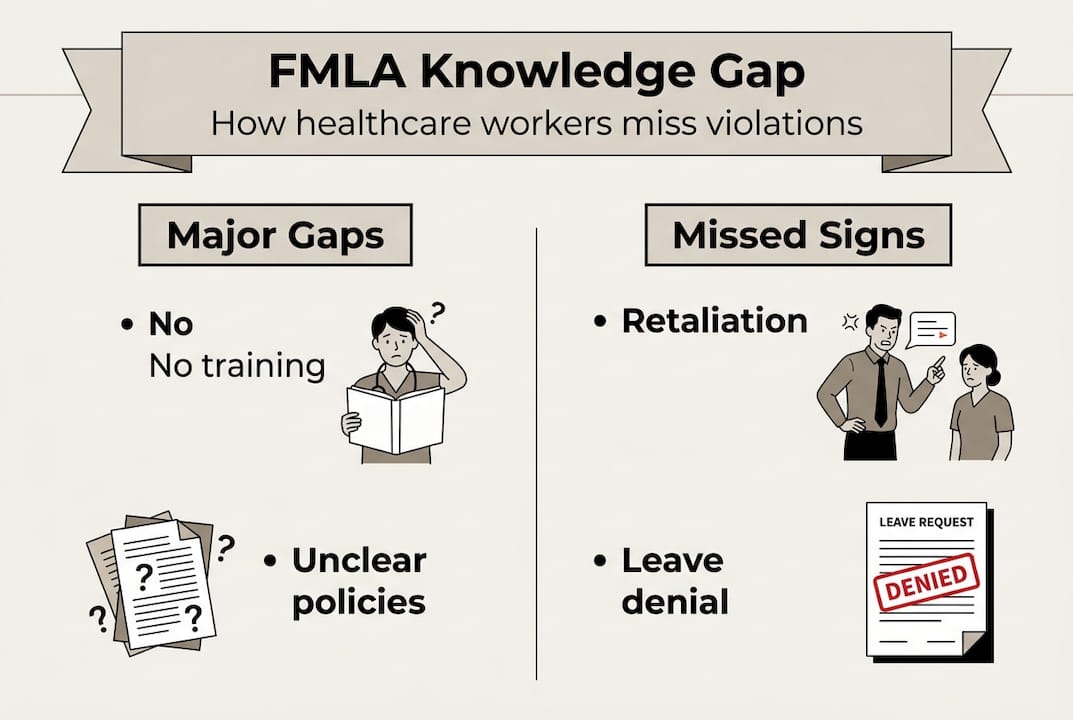
We believe this needs to change. The most effective defense against FMLA violations is consistent, early documentation combined with a clear understanding of your rights. You do not need to wait until you are terminated to take action. If interference or retaliation begins, documenting it immediately gives you options.
Building a culture of asserting employee rights in healthcare starts with individual workers who refuse to accept unlawful treatment silently. When you protect your workplace rights and report violations, you also make it harder for employers to repeat the same behavior with your colleagues.
Get support for your FMLA case in San Diego
If you're ready to protect your rights, help is available. Navigating FMLA violations in a healthcare workplace can feel overwhelming, especially when you are also managing a health condition or family care responsibility. You should not have to handle it alone.
Justice Shield Law represents employees exclusively. We do not represent employers. Our focus is entirely on helping workers like you understand their rights and hold employers accountable when those rights are violated. If you work in a San Diego hospital, clinic, or care facility and believe your FMLA rights have been ignored, we encourage you to reach out for a free consultation. Understanding the full scope of California worker protections available to you is the first step toward a real solution.
Frequently asked questions
Who qualifies for FMLA in a San Diego healthcare job?
You must work for a covered employer, complete at least 12 months of service, and have worked 1,250 hours in the past year. Your employer must also have at least 50 employees within 75 miles of your worksite.
What types of FMLA violations most often affect healthcare employees?
The most common violations are denial of leave, retaliation after taking leave, and failing to reinstate the worker to their position or an equivalent role. FMLA prohibits retaliation and guarantees job restoration after protected leave.
How do I document an FMLA violation properly?
Save all communications, request decisions in writing, and keep a detailed timeline of events. Employees should maintain records to support their case if a dispute arises.
Can I be fired for taking FMLA in California?
No. FMLA prohibits discharge or discrimination for taking protected leave. If you were fired after using FMLA, that termination may be unlawful and grounds for a legal claim.
Recommended
- Justice Shield Law | California Employment Lawyers — Free Consultation
- Justice Shield Law | California Employment Lawyers — Free Consultation
- Justice Shield Law | California Employment Lawyers — Free Consultation
- Justice Shield Law | California Employment Lawyers — Free Consultation
- Medical Leave Retaliation Impacting Fountain Valley Healthcare | Serendib Law Firm