

Many state government employees in California believe that reporting sexual harassment is a complicated, risky process that rarely leads to real results. That belief stops people from taking action when they have every right to do so. The truth is that California has structured complaint pathways, strict legal protections, and clear timelines designed specifically to support you. State employees report sexual harassment complaints internally through their agency's EEO Officer using the Discrimination Complaint Tracking System (DCTS) managed by CalHR. This article walks you through every step, from understanding what qualifies as harassment to filing your complaint and knowing what to expect afterward.
Table of Contents
- Understanding sexual harassment in California state government
- Your options for filing a sexual harassment complaint
- Step-by-step guide to filing a complaint
- What happens after you report: investigations and outcomes
- Sexual harassment prevention: training and your rights
- How legal guidance can help you assert your rights
- Frequently asked questions
Key Takeaways
| Point | Details |
|---|---|
| Prompt reporting is vital | You have strict deadlines—1 year internally or 3 years externally—to protect your rights. |
| Multiple complaint paths | State employees can use both internal (EEO/DCTS) and external (CRD, SPB) options. |
| Documentation strengthens cases | Keeping clear and detailed records greatly improves investigations and your legal position. |
| Mandatory training supports protection | California law requires regular harassment training for all state agency staff. |
| Legal help offers peace of mind | Consulting an attorney ensures you take the right steps and avoid retaliation risks. |
Understanding sexual harassment in California state government
Before you file anything, you need to know exactly what the law covers. California's Fair Employment and Housing Act (FEHA) prohibits sexual harassment in all workplaces, including state government agencies. FEHA applies to employers with five or more employees, which means virtually every state agency is covered.
Sexual harassment under FEHA falls into two main categories:
- Quid pro quo harassment: A supervisor or person in authority conditions your job, promotion, or benefits on accepting unwanted sexual advances or conduct.
- Hostile work environment: Unwelcome conduct of a sexual nature, whether verbal, physical, or visual, that is severe or pervasive enough to create an intimidating or offensive work environment.
Common examples include unwanted touching, sexual jokes or comments, displaying explicit images, sending inappropriate messages, and repeated unwanted requests for dates. Even a single severe incident can qualify as harassment under California law.
State agencies are held to a high standard. Employers must take "reasonable steps" to prevent and correct harassment under FEHA, and failure to do so creates liability even without a formal complaint. This means your agency cannot simply ignore a complaint or wait for things to resolve on their own.
"FEHA places an affirmative duty on employers to take all reasonable steps necessary to prevent discrimination and harassment from occurring." California Civil Rights Department, 2025 Harassment Prevention Guide.
Understanding worker protections under FEHA is the foundation for any complaint you file. Knowing the law is on your side makes the process far less intimidating. You also have the right to review your agency's harassment prevention training requirements to confirm your employer is meeting its obligations.
Your options for filing a sexual harassment complaint
You have more than one path available when reporting sexual harassment as a California state employee. Each option has different timelines, processes, and outcomes.
| Filing option | Where to file | Deadline | Key feature |
|---|---|---|---|
| Internal EEO/DCTS | Agency EEO Officer | 1 year from last act | Fastest resolution, documented in DCTS |
| State Personnel Board (SPB) | SPB directly | Varies by complaint type | Appeals certain discrimination decisions |
| California Civil Rights Department (CRD) | CRD online or in person | 3 years from last act | External investigation, broader remedies |
Here is how the process works for each option:
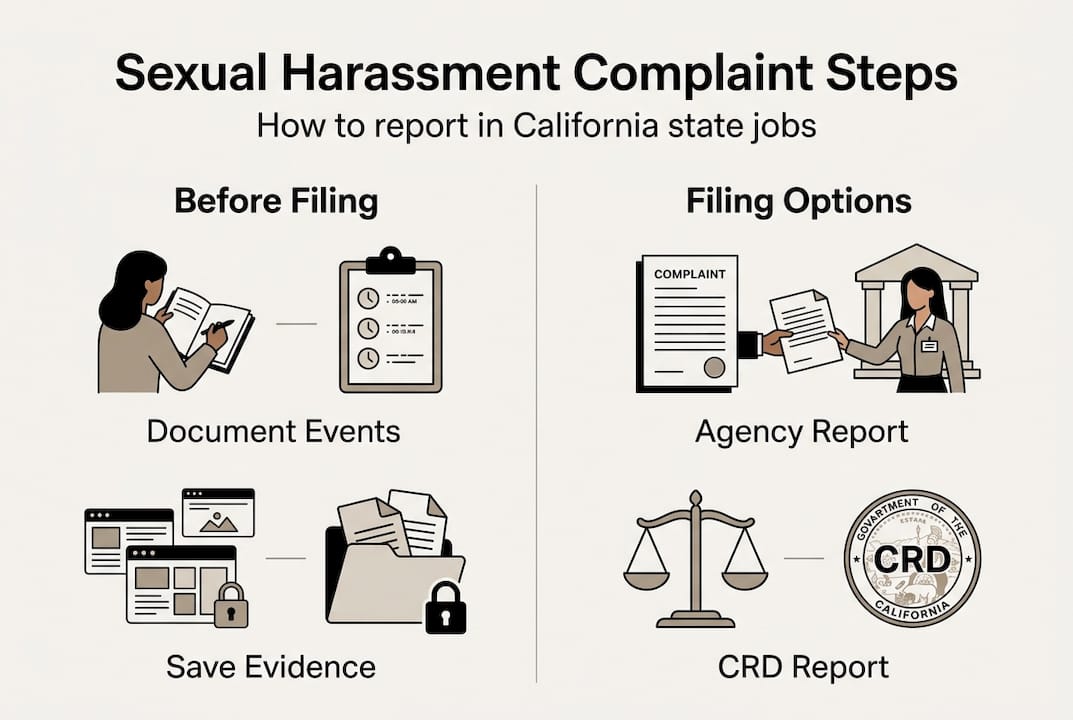
- Internal EEO complaint: File with your agency's EEO Officer. Complaints must be filed within one year of the last act of harassment. Investigations are documented in DCTS, and you can appeal certain outcomes to the State Personnel Board.
- State Personnel Board (SPB): The SPB handles appeals of certain discrimination complaints. This is typically used after an internal process has concluded.
- California Civil Rights Department (CRD): You may file directly with CRD within three years of the harm. CRD investigates employment discrimination including sexual harassment under FEHA and can pursue broader remedies.
You are allowed to file with both your agency and the CRD. Dual filing can strengthen your position and preserve your options. If you are unsure which path fits your situation, reviewing how to report workplace discrimination can help clarify your choices. You can also review the external reporting process overview for additional context.
Pro Tip: Do not wait to see if the harassment stops on its own. Deadlines are firm, and waiting can limit your legal options significantly.
Step-by-step guide to filing a complaint
Knowing your filing options makes it much easier to follow the correct steps. Here is how to take action confidently.
- Document everything immediately. Write down dates, times, locations, what was said or done, and who witnessed it. Save any emails, texts, or other written evidence. Strong documentation is the backbone of any successful complaint.
- Identify your agency's EEO Officer. Every California state agency has a designated EEO Officer. This person is your first point of contact for an internal complaint.
- Submit your complaint in writing. Verbal reports are a starting point, but a written complaint creates a formal record. Include all documented incidents and any supporting evidence.
- Cooperate with the investigation. Once filed, an investigator will be assigned. You may be interviewed, and witnesses may be contacted. Stay organized and responsive.
- Track your complaint in DCTS. The Discrimination Complaint Tracking System records your complaint and the agency's response. Ask your EEO Officer how to access updates.
- Escalate if needed. Internal reporting via EEO/DCTS protects you from retaliation. If you are unsatisfied with the outcome, escalate to the SPB or file with the CRD.
Pro Tip: Keep copies of everything you submit and every response you receive. Store them somewhere outside of your work email or work devices.
Documenting your experience thoroughly is one of the most important things you can do. Visit our guide on documenting workplace harassment for a detailed breakdown of what to record and how.
What happens after you report: investigations and outcomes
Once a complaint is filed, it is critical to understand what response and results you can expect from the investigation process.
Your agency is required to investigate promptly. The EEO Officer or a designated investigator will review your complaint, gather evidence, and interview relevant parties. CalHR tracks statewide discrimination and harassment complaints via DCTS for analysis and reporting, which means your complaint becomes part of a documented record that the state monitors.
Here is what you can expect during and after the investigation:
| Stage | What happens |
|---|---|
| Intake | EEO Officer reviews complaint for completeness |
| Investigation | Interviews, evidence review, witness statements |
| Findings | Written report with conclusions |
| Corrective action | Discipline, policy changes, or other remedies |
| Appeal | You may appeal to SPB or file with CRD |
Key protections you have throughout this process:
- Confidentiality: Your complaint is handled with discretion. Information is shared only as needed for the investigation.
- Retaliation protection: It is illegal for your employer to demote, discipline, or otherwise punish you for filing a complaint or participating in an investigation.
- Right to appeal: If you disagree with the outcome, you have options to escalate.
- Right to an attorney: You can have legal representation at any stage.
Understanding your legal protections after reporting is essential. Retaliation is one of the most common concerns employees have, and the law takes it seriously.
Sexual harassment prevention: training and your rights
Understanding your agency's obligations to prevent harassment goes hand-in-hand with your rights during and after a complaint.
California law requires mandatory harassment prevention training for all state employees. Specifically, state agencies must provide two hours of training biennially for supervisors and one hour for non-supervisory employees. This is not optional. It is a legal requirement.
What this training must cover:
- The definition of sexual harassment and examples of prohibited conduct
- How to report harassment and the complaint process
- Retaliation protections for employees who report
- Bystander intervention strategies
- Resources available to employees
"Employers who fail to provide required harassment prevention training may face increased liability in harassment claims, as courts view training failures as evidence of a non-compliant workplace culture."
If your agency has not provided this training within the required timeframe, that is a compliance failure you can document and report. It also strengthens any harassment complaint you file, because it shows the agency did not take its prevention obligations seriously.
You have the right to ask your HR department or EEO Officer when training was last conducted and when the next session is scheduled. Do not hesitate to raise this question. An agency that skips required training is one that may also mishandle complaints.
How legal guidance can help you assert your rights
Filing a sexual harassment complaint in California state government is a structured process, but it is not always simple. Deadlines, documentation requirements, and the possibility of retaliation can make the experience stressful. That is where experienced legal support makes a real difference.
At Justice Shield Law, we work exclusively on behalf of employees. We understand the specific rules that apply to California state government workers, and we can help you evaluate your situation, organize your evidence, and determine the strongest path forward. Whether you are deciding between an internal complaint and a CRD filing, or you have already filed and are facing retaliation, we are here to help.
You can get tailored legal help through a free consultation with our team. We will listen to your experience, explain your options clearly, and give you an honest assessment of your case. For more on how to navigate the reporting process, our legal reporting guidance is a strong starting point. You do not have to face this alone.
Frequently asked questions
What is the deadline for filing a sexual harassment complaint within a California state agency?
You must file within one year of the last act of harassment with your agency's EEO Office, or within three years with CRD. Missing these deadlines can eliminate your legal options.
Are state employees protected from retaliation if they file a sexual harassment complaint?
Yes. Both state and federal law prohibit retaliation against employees who report harassment or participate in an investigation. Retaliation protections apply from the moment you file internally through EEO/DCTS.
Can I appeal an unsatisfactory outcome of my complaint?
Certain complaints can be appealed to the SPB within 30 days of the decision. You may also file a separate complaint with the California Civil Rights Department for an independent review.
What training on sexual harassment must my agency provide?
Agencies must give all employees harassment prevention training: one hour for non-supervisors and two hours for supervisors every two years. Failure to provide this training is a compliance violation.
Where can I find more guidance or legal help if I'm unsure how to proceed?
You can speak with a California employment attorney for a personalized case evaluation. Justice Shield Law offers free consultations for state employees navigating sexual harassment complaints.