

California's employment laws are among the strongest in the nation, yet many employees remain unaware of just how comprehensive their protections truly are. If you've experienced discrimination, wage theft, harassment, or wrongful termination, you likely have more legal recourse than you realize. Fear of retaliation keeps countless workers silent, even though robust laws exist specifically to shield you from employer reprisals. This guide clarifies the role of employment law in protecting California employees, explains your key rights under state statutes, and outlines actionable steps to defend yourself when workplace violations occur.
Table of Contents
- Key takeaways
- Overview of California employment law protections
- Nuances and edge cases in employment law
- How employment law addresses retaliation and enforcement
- Practical steps to protect your workplace rights under California employment law
- How Justice Shield Law can help protect your workplace rights
- Frequently asked questions about employment law protections in California
Key Takeaways
| Point | Details |
|---|---|
| FEHA and Labor Code | California law shields workers from discrimination harassment wage theft and wrongful termination under FEHA and the Labor Code with options to file complaints and pursue private lawsuits. |
| Single incident harassment | A single severe act such as a racial slur can be actionable as harassment under FEHA even without a pattern. |
| Protection from retaliation | Employees reporting violations in good faith or participating in investigations are protected from reprisals. |
| Documentation matters | Keeping records of incidents and communications strengthens legal claims and supports timely remedies. |
| Employer duties to act | Employers must take reasonable steps to prevent investigate and remedy violations as laws evolve. |
Overview of California employment law protections
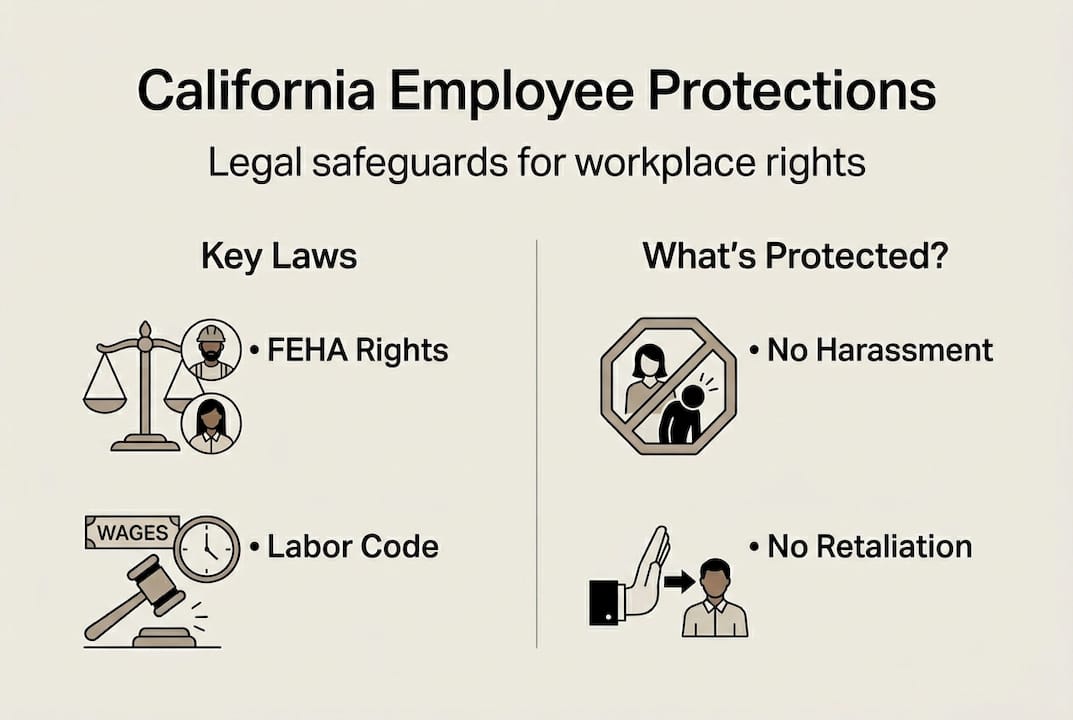
California's legal framework for workplace rights centers on two foundational statutes that provide extensive protections for employees. Understanding these laws helps you recognize when your rights have been violated and what remedies you can pursue.
The Fair Employment and Housing Act prohibits discrimination and harassment based on protected characteristics including race, gender, religion, age, disability, sexual orientation, and numerous other traits. This comprehensive law applies to hiring, promotion, compensation, and termination decisions. FEHA also covers workplace harassment, creating a legal obligation for employers to maintain environments free from offensive conduct.
California's Labor Code addresses wage and hour issues, ensuring workers receive proper compensation for their time. This includes minimum wage requirements, overtime pay, meal and rest breaks, and timely payment of final wages upon termination. The Labor Code also establishes wrongful termination protections, preventing employers from firing workers for illegal reasons or in violation of public policy.
Key protections under these laws include:
- Protection from adverse employment actions based on protected characteristics
- Right to file complaints with the Civil Rights Department or Labor Commissioner
- Ability to pursue private lawsuits for violations with potential damages and attorney fees
- Safeguards against retaliation when reporting violations or participating in investigations
- Requirements for employers to prevent, investigate, and remedy workplace violations
Pro Tip: California employment law often provides stronger protections than federal statutes. Even if federal law doesn't cover your situation, state law might offer a viable legal claim.
These protections apply whether you work for a large corporation or a small business, though some exceptions exist based on employer size. Justice Shield Law specializes in helping employees understand which protections apply to their specific situations and how to enforce their rights effectively.
"California employment law creates a shield for workers, not just a set of rules. When employers violate these protections, employees have multiple pathways to seek justice and hold companies accountable."
Nuances and edge cases in employment law
While California's employment laws provide broad protections, several nuanced scenarios and recent legal developments affect how these rights apply in practice. Understanding these complexities helps you assess your situation more accurately.
Recent case law has clarified that harassment claims don't always require a pattern of conduct. In Bailey v. San Francisco DA, courts recognized that a single severe incident, such as a racial slur, can be actionable as harassment under FEHA. This represents a significant expansion of harassment protections, acknowledging that some acts are so egregious they create a hostile work environment immediately.

Political belief discrimination presents another evolving area. While California law protects political activities and affiliations in certain contexts, the scope of these protections remains subject to interpretation. Courts continue to refine when political expression receives legal protection versus when employers can regulate such conduct.
Small employer exceptions create important distinctions:
- FEHA's discrimination and harassment provisions generally apply to employers with five or more employees
- Employers with fewer than five workers may still face wrongful termination claims based on public policy violations
- Labor Code wage and hour protections apply regardless of employer size
- Retaliation protections extend even to very small businesses in most circumstances
| Protection Type | Large Employers (5+ employees) | Small Employers (under 5) |
|---|---|---|
| FEHA discrimination claims | Fully covered | Limited coverage |
| Harassment claims | Fully covered | Fully covered |
| Wrongful termination (public policy) | Covered | Covered |
| Wage and hour violations | Covered | Covered |
| Retaliation protections | Covered | Generally covered |
Pro Tip: Even if your employer has fewer than five employees, you may still have viable legal claims. Don't assume small company size eliminates your protections without consulting an attorney.
These nuances matter when evaluating whether you have a strong legal claim. What seems like a borderline situation might actually fall squarely within California's protective framework, especially as courts continue interpreting these laws in employee-friendly ways. Justice Shield Law stays current on these evolving legal standards to provide accurate guidance for your specific circumstances.
How employment law addresses retaliation and enforcement
Retaliation represents one of the most common violations California employees face, yet robust legal protections exist specifically to prevent employers from punishing workers who assert their rights. Understanding these safeguards and enforcement mechanisms empowers you to take action without fear.
California law prohibits retaliation when employees report violations, file complaints, participate in investigations, or refuse to engage in illegal activities. This protection applies whether you report internally to HR, file with a government agency, or participate in a coworker's complaint. Retaliation can take many forms including termination, demotion, pay cuts, schedule changes, or creating a hostile work environment.
Despite these strong legal protections, fear of retaliation remains widespread among California workers. Many employees hesitate to report violations because they worry about losing their jobs or facing workplace hostility. However, the law specifically anticipates this concern and provides powerful remedies when retaliation occurs.
Practical enforcement strategies include:
- Document the original violation you observed or experienced, including dates, witnesses, and specific details
- Report the violation through appropriate channels, keeping copies of all communications
- Note any adverse actions that occur after your report, particularly those within 90 days
- File complaints with relevant agencies such as the Civil Rights Department or Labor Commissioner
- Consult with an employment attorney to evaluate your legal options and build a strong case
- Preserve evidence including emails, text messages, performance reviews, and witness contact information
Pro Tip: California law creates a presumption of retaliation if adverse action occurs within 90 days of protected activity. This timing significantly strengthens your legal position by shifting the burden to your employer to prove legitimate reasons.
Recent reforms under the Private Attorneys General Act (PAGA) have increased employer compliance obligations. Companies must now demonstrate they've taken reasonable steps to prevent violations, including regular training, compliance audits, and prompt investigation of complaints. These requirements create additional accountability mechanisms that benefit employees seeking to enforce their rights.
"The law doesn't just prohibit retaliation; it actively encourages employees to come forward by creating strong legal remedies and procedural advantages when employers engage in reprisals."
Enforcement mechanisms provide multiple pathways for addressing violations. You can file administrative complaints with government agencies, pursue private lawsuits, or in some cases participate in class or representative actions. Justice Shield Law helps employees navigate these options to choose the most effective enforcement strategy for their situation.
Practical steps to protect your workplace rights under California employment law
Knowing your rights means little without understanding how to protect and enforce them effectively. Taking strategic action when violations occur significantly improves your legal position and increases the likelihood of a favorable outcome.
Documentation forms the foundation of any strong employment claim. Create detailed records of incidents as they occur, including the date, time, location, people involved, what was said or done, and any witnesses present. Keep these records in a personal file outside of work, not on company systems. Contemporaneous documentation carries far more weight than trying to reconstruct events months later.
Report violations promptly through appropriate channels. Most employers have internal complaint procedures outlined in employee handbooks or HR policies. Following these procedures demonstrates good faith and creates a record of your complaint. However, don't let internal processes delay you from filing with government agencies if the situation warrants immediate external action.
Understanding timing matters critically. California has specific deadlines for filing different types of claims. FEHA complaints must generally be filed with the Civil Rights Department within three years of the violation. Wage claims have different limitation periods depending on the specific violation. Missing these deadlines can permanently bar your claims, regardless of their merit.
Key protective actions include:
- Maintain chronological records of all workplace incidents and communications
- Report violations in writing when possible to create a paper trail
- Request copies of your personnel file and performance evaluations
- Preserve evidence before it disappears, including emails and documents
- Avoid signing severance agreements or releases without legal review
- Seek legal consultation early, before taking actions that might weaken your position
| Approach | Benefits | Limitations |
|---|---|---|
| Self-help documentation | Creates evidence, costs nothing, fully in your control | May miss legal nuances, no representation in disputes |
| Internal HR complaints | Required first step in many cases, may resolve issues quickly | HR represents employer interests, not yours |
| Government agency complaints | Free filing, agency investigation, potential systemic remedies | Slower process, limited control over outcome |
| Private legal representation | Expert guidance, strategic advocacy, maximizes potential recovery | Requires finding qualified attorney, may involve costs |
Pro Tip: Consult an employment attorney before filing internal complaints for serious violations. Strategic guidance on timing, documentation, and complaint language can significantly strengthen your legal position from the outset.
Understanding your retaliation protections becomes especially important after reporting violations. Be alert for any adverse actions following your complaint, as these may constitute illegal retaliation. Document these actions meticulously and report them immediately.
Legal representation provides significant advantages when enforcing workplace rights. Experienced employment attorneys understand how to build strong cases, navigate complex procedures, and negotiate favorable settlements. They can also identify claims you might not recognize and ensure you don't waive valuable rights unknowingly. Justice Shield Law offers consultations to help employees evaluate their situations and determine the best path forward.
How Justice Shield Law can help protect your workplace rights
Facing workplace violations can feel overwhelming, especially when you're uncertain about your legal options or worried about retaliation. That's where specialized legal representation makes a critical difference in protecting your rights and holding employers accountable.

Justice Shield Law focuses exclusively on representing California employees in workplace rights disputes. Our team understands the complexities of FEHA, the Labor Code, and evolving case law that shapes your protections. We've helped countless workers navigate discrimination claims, wage disputes, harassment cases, and wrongful termination matters.
When you work with our firm, you gain experienced advocates who know how to document violations effectively, file strategic complaints, and pursue maximum compensation for the harm you've suffered. We handle negotiations with employers and their attorneys, allowing you to focus on your career and wellbeing while we fight for your rights.
Whether you're facing ongoing violations or have already been terminated, Justice Shield Law provides the expert guidance you need. Contact us today to discuss your situation and learn how we can help you enforce your workplace protections.
Frequently asked questions about employment law protections in California
What protections does FEHA provide to California employees?
FEHA prohibits discrimination and harassment based on protected characteristics including race, gender, religion, age, disability, sexual orientation, and many other traits. It covers hiring, promotion, compensation, and termination decisions, while also requiring employers to prevent and remedy workplace harassment.
Can a single incident count as workplace harassment legally?
Yes, California courts have recognized that a single severe incident can constitute actionable harassment under FEHA. For example, one egregious act like a racial slur may create a hostile work environment without requiring a pattern of conduct, as established in recent case law.
How can I protect myself from retaliation if I report a violation?
Document everything thoroughly, report violations in writing, and preserve all evidence of both the original violation and any subsequent adverse actions. California law presumes retaliation if adverse action occurs within 90 days of protected activity, which strengthens your legal position significantly.
Are small employers required to comply with all employment laws?
Small employers with fewer than five employees have limited FEHA obligations for discrimination claims but remain fully subject to harassment prohibitions, Labor Code wage requirements, and wrongful termination protections based on public policy violations. Size doesn't eliminate all employer obligations.
When should I seek legal help for workplace rights violations?
Consult an employment attorney as soon as you suspect serious violations or before filing formal complaints. Early legal guidance helps you document effectively, avoid common mistakes, and develop the strongest possible case. Many attorneys offer free initial consultations to evaluate your situation.