

TL;DR:
- Many Disney employees assume retaliation claims are hard to prove, but recent cases show they are significant.
- Legal protections under California and federal law can help employees fight back against workplace retaliation.
- Prompt documentation and legal guidance are crucial for employees facing negative actions after reporting misconduct or exercising rights.
Many Disney employees in Anaheim assume that retaliation claims are rare or difficult to pursue against a company as large and well-resourced as Disney. That assumption can cost you. Recent litigation tells a different story. A 2025 wage theft settlement involving 51,478 Disney theme park employees for $233 million shows just how serious workplace rights violations can be at this company. If you believe you have experienced retaliation at Disneyland or another Disney Anaheim location, understanding your rights is the first step toward protecting your future. This article walks you through what retaliation means, what real cases look like, and what you can do right now.
Table of Contents
- What is workplace retaliation and how it impacts Disney employees
- Recent cases and real-world examples at Disney Anaheim
- How employees can document and support a retaliation claim
- Legal options and support for Disney Anaheim employees
- Our take: What most Disney Anaheim employees miss when filing retaliation claims
- Get support: Next steps for Disney Anaheim employees
- Frequently asked questions
Key Takeaways
| Point | Details |
|---|---|
| Retaliation is more common | Claims of workplace retaliation at Disney Anaheim occur more often than most employees expect. |
| Evidence is crucial | Employees should quickly document incidents, timing, and communications to build a strong case. |
| Several legal options | Disney employees have multiple avenues for addressing retaliation, from internal complaints to legal action. |
| Company disputes, settlements | Disney frequently disputes retaliation claims, making legal representation and evidence key for success. |
What is workplace retaliation and how it impacts Disney employees
Workplace retaliation occurs when an employer takes a negative action against an employee because that employee exercised a legally protected right. That right might be filing a complaint about discrimination, reporting a safety violation, requesting medical leave, or participating in a union activity. The negative action does not have to be termination. It can be a demotion, a schedule change, a write-up, a pay cut, or even a hostile shift in how a supervisor treats you.
Under California law, employees are protected from retaliation by several statutes, including the California Fair Employment and Housing Act (FEHA) and Labor Code Section 1102.5, which is one of the broadest whistleblower protection laws in the country. Federal law also provides protections through Title VII of the Civil Rights Act and the National Labor Relations Act (NLRA). Understanding California worker protections can help you identify which law applies to your specific situation.
At Disney Anaheim, retaliation can appear in ways that are not always obvious. Common examples include:
- Being disciplined shortly after filing a complaint with HR
- Receiving a sudden negative performance review after raising a concern
- Being removed from a preferred shift or role after engaging in union activity
- Facing termination following a request for accommodation or medical leave
- Experiencing increased scrutiny or micromanagement after speaking up
A 2025 NLRB case is particularly telling. NLRB Case 21-CA-362528, filed in March 2025 in Anaheim, alleges that Disney violated Section 8(a)(1) of the NLRA through interrogation and retaliation, including discharge and discipline, against employees for engaging in protected concerted activities.
Retaliation does not always look like a dramatic firing. Sometimes it is a slow, deliberate pattern of negative treatment designed to push an employee out or silence them.
The emotional toll of retaliation is real. Employees often experience anxiety, self-doubt, and financial stress. Recognizing the pattern early gives you the best chance of taking action before critical deadlines pass.
Recent cases and real-world examples at Disney Anaheim
Real cases reveal patterns that are important for any Disney employee to understand. They show how retaliation claims develop, what defenses employers use, and what outcomes are possible.
One notable 2025 case involves Jody Hunter-Deno, a former Disneyland Fantasyland cast member. She filed a wrongful termination lawsuit alleging discrimination, retaliation, and failure to accommodate after being terminated over cell phone use. Her case was transferred to Orange County, and it illustrates how what appears to be a policy enforcement action can actually mask retaliatory intent.

The broader wage theft settlement affecting over 51,000 Disney theme park employees further demonstrates the scale at which employee rights violations can occur at this company. While not a retaliation case, it signals that Disney has faced serious accountability for how it treats its workforce.
Here is a comparison of how Disney typically responds to claims versus what employees often experience:
| Factor | Disney's position | Employee experience |
|---|---|---|
| Termination reason | Policy violation | Retaliation for complaint |
| Performance review | Documented issues | Sudden negative shift after complaint |
| Discipline timing | Routine enforcement | Closely follows protected activity |
| Accommodation denial | Operational need | Failure to engage in interactive process |
Key lessons from these cases include:
- Document the timeline carefully. Courts and agencies look at the timing between your protected activity and the negative action.
- Understand that Disney will likely offer an alternative explanation. Your job is to show that explanation is a pretext.
- Engage with union resources if you are a union member. The NLRB context adds another layer of protection.
- Learn how to approach reporting discrimination formally and in writing to create a paper trail.
These cases are not outliers. They reflect a broader reality that large employers, including Disney, face retaliation claims regularly. Knowing this should empower you, not discourage you.
How employees can document and support a retaliation claim
Documentation is the foundation of any strong retaliation claim. Without it, your case depends heavily on your word against your employer's. With it, you create a factual record that is much harder to dismiss.
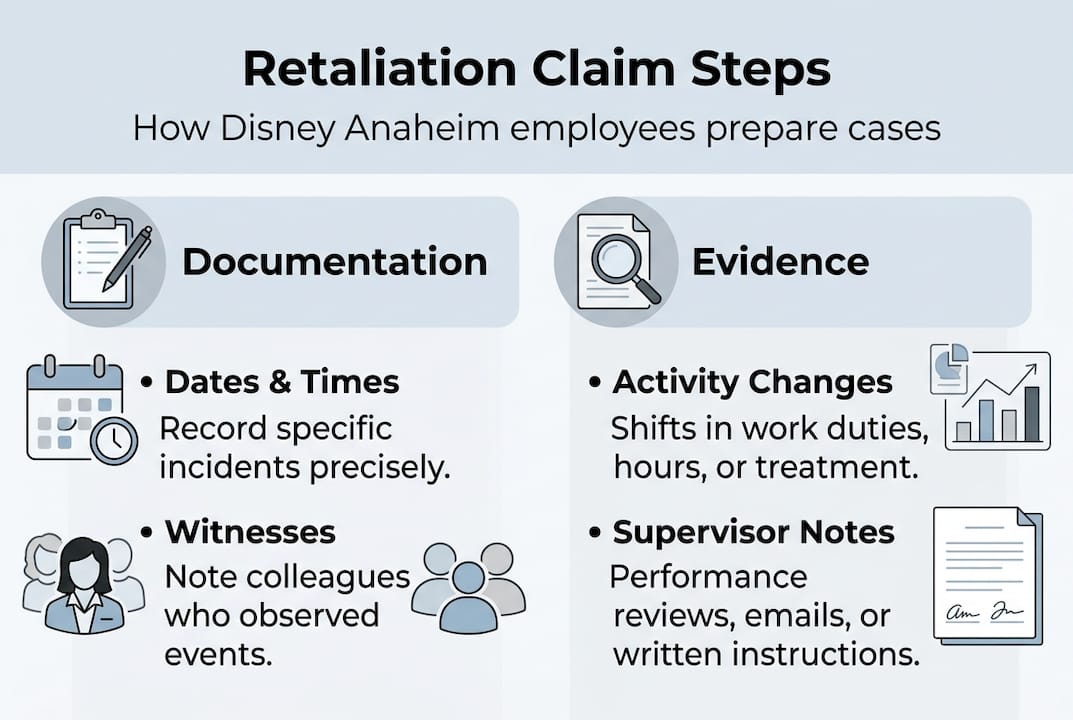
Start by recording specific dates, times, locations, and people involved in every incident you believe is retaliatory. Write down what was said, who was present, and how the interaction made you feel. Save all emails, texts, and written communications related to your complaint and any negative actions that followed. Keep copies of performance reviews, especially if they changed after you exercised a protected right.
One of the most important things to establish is causation, meaning the connection between your protected activity and the negative action. Courts and agencies look at proximity in time. If you filed a complaint on March 1 and received a write-up on March 10, that timing matters.
Disney disputes claims and does not admit wrongdoing in settlements. This means you should expect the company to argue that any negative action was based on legitimate policy enforcement. Your documentation should be specific enough to counter that narrative.
Here are the key items to gather:
- Written records of your original complaint or protected activity
- Emails or messages showing changes in treatment after your complaint
- Performance reviews from before and after the complaint
- Witness names and contact information
- Any HR communications or disciplinary notices
- Records of any medical leave or accommodation requests, especially if medical leave violations are part of your claim
Pro Tip: Start your documentation immediately after any incident you suspect is retaliatory. Memory fades fast, and courts value contemporaneous records, meaning notes written at or near the time of the event, far more than recollections written months later.
Organize everything in a secure folder, either digital or physical, that your employer cannot access. This record becomes the backbone of your legal case.
Legal options and support for Disney Anaheim employees
Once you have documented your experience, you have several legal paths available. Each option has different requirements, timelines, and potential outcomes. Choosing the right path, or combining paths, depends on your specific situation.
Here is an overview of the main options:
| Legal path | Who handles it | Key requirement | Timeline |
|---|---|---|---|
| Internal Disney complaint | HR or ethics hotline | Written complaint | Immediate |
| California DFEH/CRD filing | CA Civil Rights Dept. | File within 3 years | 3-year deadline |
| NLRB charge | Federal agency | Protected activity under NLRA | 6-month deadline |
| Civil lawsuit | Private attorney | Evidence of retaliation | Varies by claim |
The steps to pursue your claim effectively are:
- File an internal complaint with Disney HR or through their ethics reporting system. This creates a record and may trigger an internal investigation.
- Contact the California Civil Rights Department (formerly DFEH) to file a complaint if your claim involves discrimination or whistleblower retaliation.
- File an NLRB charge if your retaliation relates to union activity or concerted action with coworkers. The NLRB Anaheim retaliation case shows this is an active avenue.
- Consult a plaintiff-side employment attorney to evaluate whether a civil lawsuit is appropriate.
The scale of the $233 million Disney wage case shows that large-scale accountability is possible when employees take action collectively or individually. Understanding your retaliation rights in California is essential before deciding which path to take.
Union representation can also play a significant role. If you are a union member, your union rep can accompany you to disciplinary meetings and help you file grievances. Do not overlook this resource.
Our take: What most Disney Anaheim employees miss when filing retaliation claims
After reviewing these cases and working with employees facing retaliation, we see the same mistakes repeat. The most common one is waiting too long. Employees often hope the situation will improve on its own. It rarely does. And while you wait, critical deadlines, some as short as six months for NLRB charges, pass without action.
Another overlooked issue is incomplete evidence. Many employees document what happened but forget to document what changed. Before-and-after comparisons of performance reviews, scheduling, or supervisor behavior are often more persuasive than any single incident.
Employers like Disney are skilled at offering explanations that sound reasonable. A write-up for a minor policy violation. A shift change due to operational needs. These explanations can seem credible unless you can show a pattern or a suspicious timeline. That is why legal guidance early in the process matters so much.
We have seen employees in wrongful termination cases lose strong claims simply because they did not act quickly or did not understand what evidence to preserve. Retaliation cases require patience and strategy. Think of it as building a case brick by brick, not winning a single argument.
The employees who succeed are the ones who treat their claim seriously from day one, document everything, and get legal advice before making major decisions like resigning or signing severance agreements.
Get support: Next steps for Disney Anaheim employees
If you believe you are experiencing retaliation at Disney Anaheim, you do not have to navigate this alone. Justice Shield Law represents employees exclusively, and we understand the specific pressures that come with working for a large employer like Disney. We offer confidential consultations to help you evaluate your situation, understand your rights, and decide on the best course of action. Visit our site for Disney employee legal support and take the first step toward protecting your career and your livelihood. You can also explore our full guide to California employment law for a broader understanding of your workplace rights.
Frequently asked questions
What qualifies as retaliation at Disney Anaheim?
Retaliation includes any negative action taken against an employee for reporting workplace misconduct or exercising legal rights, such as demotion, suspension, or termination. NLRB Case 21-CA-362528, filed in Anaheim in 2025, is an active example of how these claims are pursued.
How do I prove retaliation if my supervisor claims it was policy enforcement?
You can strengthen a retaliation claim by documenting the timing between your complaint and the negative action, and by showing a pattern of changed treatment. Disney disputes claims in litigation, so detailed evidence of causation is critical.
What legal actions can I take if I believe I'm experiencing retaliation at Disney Anaheim?
You can file complaints internally, with the California Civil Rights Department, with the NLRB, or pursue a civil lawsuit with legal counsel. The scale of Disney settlements shows that formal legal action against Disney is a viable path.
Has Disney Anaheim faced large-scale retaliation lawsuits?
No major class action retaliation lawsuits have been identified, but the $233 million wage theft settlement covering 51,478 employees shows that Disney has faced significant legal accountability for how it treats its workforce.
Recommended
- Justice Shield Law | California Employment Lawyers — Free Consultation
- Justice Shield Law | California Employment Lawyers — Free Consultation
- Justice Shield Law | California Employment Lawyers — Free Consultation
- Justice Shield Law | California Employment Lawyers — Free Consultation
- California Employment Law Blog | Workplace Insights