

Kaiser Permanente is one of California's largest employers, and it handles its own workers' compensation claims internally rather than through a traditional insurance carrier. That means when you file a claim, Kaiser's own team reviews it, which creates a process that feels very different from what most employees expect. Self-insured in California, Kaiser manages these claims through dedicated internal staff based in Oakland. A denial from that team is not the end of the road. You have real legal options, and understanding how the system works is the first step toward protecting your rights.
Table of Contents
- Understanding Kaiser Permanente's workers' compensation process
- Common reasons for workers' compensation denials at Kaiser Permanente
- What to do if your claim is denied: first steps and legal options
- How Kaiser's denial process compares to other California self-insured employers
- Get support for your Kaiser workers' comp denial
- Frequently asked questions
Key Takeaways
| Point | Details |
|---|---|
| Kaiser handles its claims internally | Employees should understand Kaiser’s unique self-insured model and prepare for internal process differences when filing claims. |
| Typical denial reasons | Most denials result from lack of evidence or alleged pre-existing conditions, so thorough medical documentation is vital. |
| Appeal options are available | You can challenge Kaiser’s decision through WCAB and increase your odds by seeking legal counsel. |
| Kaiser’s rates reflect statewide trends | Denial and claim frequency at Kaiser follow the norm for California self-insured employers, so don’t assume systematic mistreatment. |
| Get expert help fast | Contact experienced attorneys in Oakland or the Bay Area for free consultations to maximize your chances against a denial. |
Understanding Kaiser Permanente's workers' compensation process
Kaiser operates as a self-insured employer, which means it does not purchase a standard workers' compensation insurance policy. Instead, it sets aside its own funds to cover claims and manages them internally through dedicated claims teams. This is legal in California, but it creates a dynamic that employees should understand before filing.
When you are injured at work, your claim goes directly to Kaiser's internal team rather than to an outside insurer. That team decides whether to accept, investigate, or deny your claim. Because Kaiser is both your employer and the entity paying your benefits, there is an inherent tension in that arrangement.
Here is how the self-insured process differs from a standard insurance company process:
| Factor | Self-insured employer (Kaiser) | Standard insurance carrier |
|---|---|---|
| Who reviews the claim | Internal Kaiser claims team | Third-party insurance adjuster |
| Financial incentive | Kaiser pays directly from its own funds | Insurer pays from pooled premiums |
| Medical evaluations | May use Kaiser-affiliated physicians | Independent medical examiners |
| Appeals body | Oakland WCAB District Office | Same WCAB process |
| Transparency | Internal process, less visible | Regulated insurer reporting |
Disputes that cannot be resolved internally go to the Oakland WCAB decisions process, where a workers' compensation judge reviews the evidence. Understanding California worker protections is essential before you reach that stage.
Pro Tip: From the moment you report your injury, keep a written log of every conversation, every document you receive, and every medical appointment. This record becomes critical if your claim is denied and you need to appeal.
Common reasons for workers' compensation denials at Kaiser Permanente
With Kaiser's process in mind, let's examine why denials often happen. Understanding the reason behind your denial is the most important factor in deciding how to respond.
Kaiser's internal teams frequently cite the following reasons when denying claims:
- Lack of medical evidence: The injury was not documented promptly or thoroughly enough to establish a clear work connection.
- Causation disputes: Kaiser argues the injury did not arise out of or in the course of employment.
- Pre-existing conditions: Internal physicians may attribute your symptoms to a condition you had before working at Kaiser.
- Late reporting: California requires injuries to be reported promptly, and delays can be used as grounds for denial.
- Disputed diagnosis: Kaiser-affiliated doctors may disagree with your personal physician's findings.
Kaiser may deny claims based on causation or pre-existing conditions, sometimes attributing injuries to non-work causes even when the evidence points otherwise. This is a pattern seen across self-insured employers, not just Kaiser.
"Insurers and self-insured employers cite medical evidence and legal standards when denying claims, but workers' compensation attorneys frequently argue that cost-driven decisions play a role in borderline cases."
It is important to distinguish between a legitimate denial and a disputable one. A legitimate denial might involve a claim filed months after an injury with no medical records. A disputable denial often involves a situation where your doctor supports your claim but Kaiser's physician does not. The latter is exactly the type of case where legal representation makes a measurable difference.
California workers' comp denial statistics show that self-insured claim frequency declined 7.4% in 2024 statewide. That means fewer claims are being filed, but the ones that are filed still face scrutiny. Knowing your workplace rights in California helps you push back effectively.
What to do if your claim is denied: first steps and legal options
If you've received a denial, here's your practical roadmap to fight back. Acting quickly matters because California imposes strict deadlines on appeals.
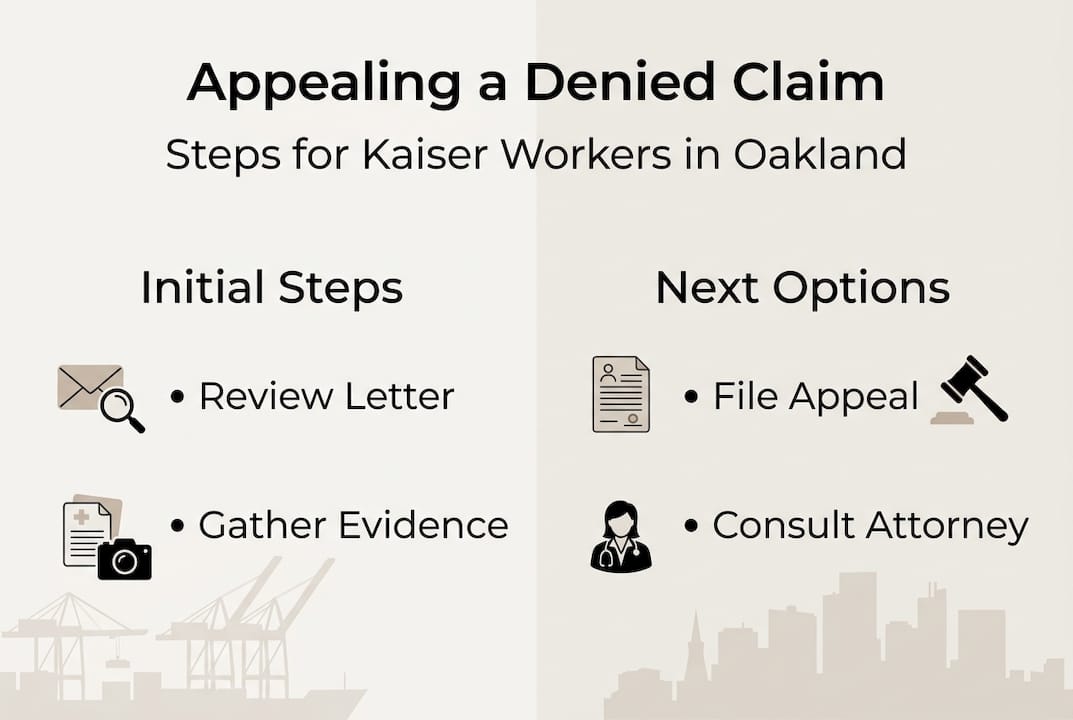
- Read the denial letter carefully. The letter must state the specific reason for denial. This tells you exactly what evidence or argument you need to counter.
- Gather all medical records. Collect every document related to your injury, including emergency room visits, doctor notes, and any treatment records from before and after the incident.
- Request reconsideration from Kaiser. You can ask Kaiser's claims team to review the decision again, especially if you have new medical evidence.
- File an Application for Adjudication of Claim with the WCAB. This formally opens your case with the state and preserves your legal rights.
- Attend a mandatory settlement conference. The WCAB process includes conferences where both sides present their positions before a judge.
- Seek legal counsel immediately. An experienced workers' compensation attorney can represent you at every stage and significantly improve your outcome.
The WCAB Oakland District Office handles disputes and appeals, with outcomes often favoring workers who present strong medical evidence. Having an attorney who knows this office and its judges is a real advantage.

| Key contact | Location | Purpose | Timeline |
|---|---|---|---|
| Kaiser Claims Team | Oakland, CA | Reconsideration request | Within 90 days of denial |
| WCAB Oakland District | 1515 Clay St, Oakland | File appeal application | As soon as possible |
| Qualified Medical Evaluator | Statewide panel | Independent medical review | Scheduled by WCAB |
| Workers' comp attorney | Bay Area | Legal representation | Consult immediately |
For workers dealing with related issues like extended recovery, understanding your medical leave rights can protect your job while your claim is pending. If your injury happened in a physically demanding role, reviewing industrial injury legal help resources can give you additional context.
Pro Tip: Many workers' compensation attorneys in the Bay Area offer free consultations and work on contingency, meaning you pay nothing unless you win. There is no financial reason to navigate this process alone. Reach out to a workers' comp attorney before your appeal deadline passes.
How Kaiser's denial process compares to other California self-insured employers
To put your experience in perspective, let's see how Kaiser compares to other employers. Some workers assume Kaiser denies claims at a higher rate than other large employers. The data tells a more nuanced story.
California self-insured employer data shows no evidence of a Kaiser-specific denial crisis versus statewide norms. Kaiser's claim frequency and denial patterns are broadly consistent with other large self-insured employers in California.
| Metric | Kaiser Permanente | Other large CA self-insured employers |
|---|---|---|
| Claim frequency trend | Declining, consistent with CA average | Down 7.4% statewide in 2024 |
| Paid losses trend | Increasing | Up 7.6% in 2024 to 2025 |
| Primary denial basis | Causation, pre-existing conditions | Same across most self-insured employers |
| Appeals body | WCAB Oakland | WCAB statewide |
| Resolution factor | Medical documentation quality | Same across all employers |
Paid losses across California's self-insured sector rose 7.6% in 2024 to 2025, which reflects rising medical costs and longer recovery periods rather than a surge in accepted claims. This context matters because it shows that the financial pressure on self-insured employers is real, and that pressure can influence how borderline claims are evaluated.
What this means for you is straightforward. Your denial is likely not the result of a Kaiser-specific policy targeting employees. It is more likely the result of a standard claims process that responds to strong medical evidence. The following factors consistently improve outcomes across all self-insured employers:
- Detailed, contemporaneous medical records from the date of injury
- A treating physician who clearly connects your condition to your work duties
- Consistent reporting of symptoms and treatment throughout your recovery
- Legal representation during the WCAB process
- A Qualified Medical Evaluator report that supports your claim
Understanding California employment protections gives you a broader foundation for asserting your rights, whether your dispute involves workers' compensation or related employment issues.
Get support for your Kaiser workers' comp denial
Having learned your options and how Kaiser's process compares to other employers, here's where expert help can make the real difference. A denial from Kaiser's internal team is not a final verdict. It is the beginning of a process that, with the right support, you can challenge effectively.
At Justice Shield Law, we work exclusively on behalf of employees. We offer free consultations for workers in Oakland and throughout California who are facing workers' compensation denials. Our attorneys understand the WCAB process, know how to build a strong medical record, and are committed to holding employers accountable when claims are wrongfully denied. Time is critical because appeal deadlines are strict. If you are unsure about your next step, reviewing our employment law resources is a good starting point, and reaching out for a free consultation costs you nothing. Do not let a denial go unchallenged.
Frequently asked questions
What is the first thing to do if Kaiser denies my workers' comp claim?
Read the denial letter carefully to identify the specific reason, then gather your medical records and consult a workers' compensation attorney before your appeal deadline. The WCAB Oakland office handles these disputes, and outcomes consistently favor workers with strong medical evidence and legal representation.
Are denial rates higher at Kaiser than at other California employers?
No. California statewide data shows Kaiser's denial patterns are consistent with other large self-insured employers, with no evidence of a unique or systematic denial crisis specific to Kaiser.
Why did Kaiser deny my claim for a workplace injury?
Kaiser often cites lack of medical evidence or pre-existing conditions as the basis for denial. Reviewing the specific reason in your denial letter and consulting an attorney gives you the clearest path to disputing the decision.
Can I appeal without an attorney if Kaiser denies my claim?
Yes, the WCAB allows self-representation, but legal counsel consistently produces better outcomes in contested workers' compensation cases. Most workers' comp attorneys work on contingency, so there is no upfront cost to getting professional help.