

Many Apple employees in San Jose assume that discussing wages, hours, or union activity at work puts their job at risk. That assumption is wrong, and it became even more outdated after Apple agreed to settle NLRB charges in 2025 over restrictive workplace policies affecting Bay Area and San Jose offices. The settlement forced real changes to company policy, and those changes directly affect what you can say, share, and organize around at work. This article breaks down exactly what your rights are, what challenges you may still face, and what steps you can take to protect yourself.
Table of Contents
- Understanding your labor rights at Apple in San Jose
- Common labor and union challenges at Apple's San Jose offices
- How to respond if your workplace rights are violated
- Recent enforcement trends and what they mean for Apple employees
- A fresh perspective: what Apple employees in San Jose should not overlook
- Get legal support for your workplace rights
- Frequently asked questions
Key Takeaways
| Point | Details |
|---|---|
| NLRA Section 7 clarified | Apple employees in San Jose can openly discuss workplace conditions, pay, and unionization after the 2025 settlement. |
| Action steps matter | Document everything and seek help early if you sense your labor rights were violated. |
| Enforcement landscape is shifting | Changes in NLRB action mean workers must be even more proactive in safeguarding rights. |
| Legal support is key | Consulting specialized employment lawyers gives employees a much stronger standing in disputes. |
Understanding your labor rights at Apple in San Jose
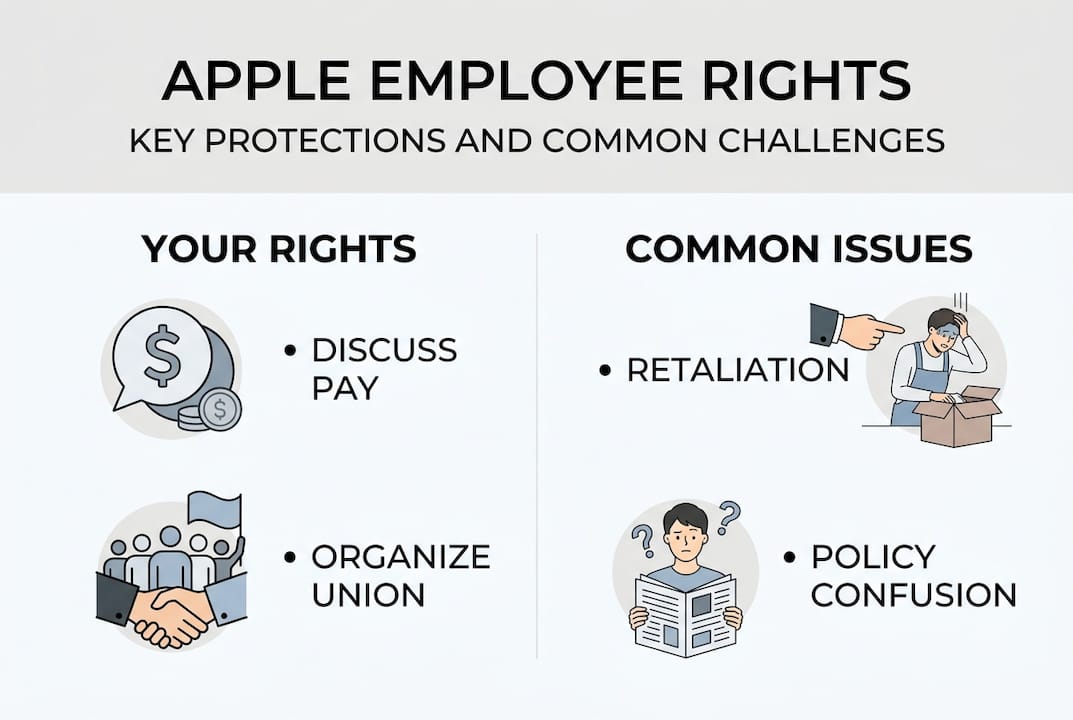
The foundation of your workplace rights as an Apple employee is Section 7 of the National Labor Relations Act (NLRA). Section 7 gives most private-sector employees the right to discuss wages, hours, and working conditions with coworkers. It also protects your right to organize, join a union, and take collective action. These rights exist whether or not your employer likes them.
For years, some Apple employees believed that confidentiality agreements prevented them from having these conversations. That belief was understandable, because certain policy language created real confusion. The 2025 NLRB settlement changed that. Apple's Confidentiality and IP Agreement now explicitly excludes restrictions on Section 7 rights. In plain terms, Apple cannot use confidentiality rules to stop you from talking about your pay or working conditions with colleagues.
Here is a quick look at what Section 7 protects and what it does not:
| Protected activity | Not protected |
|---|---|
| Discussing your wages with coworkers | Sharing trade secrets or proprietary code |
| Organizing or joining a union | Harassing or threatening colleagues |
| Talking about job conditions or safety | Disclosing confidential client data |
| Supporting collective bargaining | Making false statements about the company |
Key rights you hold as an Apple employee in San Jose:
- The right to talk about your salary, raises, and bonuses with coworkers
- The right to organize meetings or sign union authorization cards
- The right to discuss working hours, schedules, and job conditions
- The right to support or oppose union activity without retaliation
- Protection against discipline for exercising any of the above
You are also covered by California labor law protections, which in many cases go further than federal law. California adds extra layers of protection around retaliation and workplace organizing.
"Nothing in Apple's policies restricts your rights under Section 7 of the National Labor Relations Act." This language now appears in Apple's updated settlement notice posted in the workplace.
Pro Tip: When a manager or HR representative questions you about a workplace conversation, refer directly to the updated Confidentiality Agreement language. Knowing the exact policy wording gives you a clear, factual basis to stand on.
Understanding your rights is the first step. Now let's look at practical workplace issues Apple employees commonly face in San Jose.
Common labor and union challenges at Apple's San Jose offices
Knowing your rights on paper is one thing. Experiencing pushback at work is another. Apple employees in San Jose have faced a range of labor challenges, and many of them persist even after the 2025 settlement.

Before the settlement, Apple employees around the Bay Area experienced restrictions on discussing workplace conditions, with some reporting that managers discouraged open conversations about pay equity or union activity. Post-settlement, the official policy changed, but workplace culture does not always shift as quickly as legal documents do.
Here is how the landscape has changed:
| Issue | Pre-2025 | Post-2025 settlement |
|---|---|---|
| Discussing wages | Often discouraged or prohibited | Explicitly protected |
| Union organizing | Frequently met with resistance | Legally protected, though resistance may continue |
| Confidentiality agreements | Could be used to silence workers | Must exclude Section 7 rights |
| Retaliation risk | High, with limited recourse | Still possible, but stronger legal footing for complaints |
If you experience pushback, here are the steps to take:
- Stay calm and document the incident immediately. Write down what was said, who was present, the date, and the location.
- Review Apple's updated policies. Reference the official settlement document to confirm your rights.
- Talk to a trusted coworker or union representative if one is available in your workplace.
- Contact HR in writing to create a paper trail of your concern.
- Consult an employment attorney if the situation escalates or you face any form of discipline.
Retaliation is one of the most common fears employees report. It can take many forms, including sudden negative performance reviews, schedule changes, exclusion from meetings, or termination. If you believe you are being targeted for exercising your rights, you can report discrimination at work through official channels.
You also have workplace safety rights that connect to labor organizing. If unsafe conditions are part of what you want to address collectively, those concerns are protected too.
Pro Tip: Keep records of all communications, including emails, texts, and meeting notes. These records are critical if you need to file a complaint or pursue legal action later.
With these challenges in mind, it is important to know how to respond if you believe your rights are being violated.
How to respond if your workplace rights are violated
If you think Apple has crossed a legal line, acting quickly and methodically matters. The steps you take in the first days after an incident can significantly affect the outcome of any complaint or legal case.
Start with these immediate actions:
- Write everything down. Record dates, times, names, and the exact words used. Do this as soon as possible after the incident.
- Gather supporting documents. Save emails, policy documents, performance reviews, and any written communications related to the issue.
- Identify witnesses. Note any coworkers who observed the incident and may be willing to corroborate your account.
- Contact HR formally. Submit your concern in writing so there is an official record.
- Reach out to a union representative if your workplace has one, or connect with a labor organizer in your area.
If internal channels do not resolve the issue, your next step is to file a complaint with the National Labor Relations Board (NLRB) Region 20, which covers California. You can contact NLRB Region 20 in San Francisco to submit an unfair labor practice charge. There is no fee to file, and the process is designed to be accessible.
Protected activities that Apple cannot legally retaliate against include:
- Talking about your pay, benefits, or hours with coworkers
- Signing a union authorization card or attending organizing meetings
- Filing or supporting an NLRB complaint
- Refusing to sign an agreement that waives your Section 7 rights
- Discussing working conditions with coworkers, including safety concerns
The settlement confirms that Apple's policies must not restrict these activities. If you face discipline for any of them, that discipline may constitute an unfair labor practice.
For context on how recent NLRB enforcement news may affect your case, it helps to understand the broader enforcement environment, which we cover in the next section. You can also explore reporting workplace violations through California-specific channels for additional options.
Understanding the process is one thing. Let's look at what has changed in the labor enforcement landscape and how that may affect your situation.
Recent enforcement trends and what they mean for Apple employees
The NLRB's posture toward Apple cases shifted in 2025. The labor board withdrew claims against Apple's CEO in a high-profile case, signaling that federal enforcement priorities may be moving away from some tech-sector labor disputes. This is important context for any Apple employee in San Jose considering filing a complaint.
A reduced enforcement appetite at the federal level does not eliminate your rights. It does mean you may need to be more strategic about how you pursue them.
Over 70% of labor complaints in tech focus on retaliation or workplace discussions, making documentation and legal support more critical than ever.
Steps to strengthen your complaint in a shifting policy environment:
- File promptly. NLRB charges must generally be filed within six months of the violation. Do not wait.
- Use California state protections. California's labor laws are among the strongest in the country. State-level agencies may be more active than federal ones right now.
- Build a coalition. Complaints supported by multiple employees carry more weight than individual claims.
- Work with an attorney early. An employment lawyer can help you frame your complaint in the most legally sound way before you file.
- Reference the settlement. The 2025 agreement is a binding legal document. Citing it in your complaint strengthens your position.
The NLRB settlement itself remains enforceable even as broader enforcement priorities shift. Apple's updated policy commitments are on record, and violations of those commitments can still be challenged. Leaning on California worker protections alongside federal rights gives you two layers of defense.
Now that you understand these challenges and changes, let's take a fresh look at labor relations and union organizing in tech.
A fresh perspective: what Apple employees in San Jose should not overlook
Here is something most articles on this topic will not tell you: legal settlements are starting points, not finish lines. Apple's post-settlement policy changes now explicitly acknowledge Section 7 rights, but a policy update does not automatically change how managers behave, how HR responds, or how colleagues perceive union activity.
Real progress in workplace rights happens through consistent, everyday advocacy. That means exercising your rights regularly, not just when a crisis hits. Talk openly about your pay. Attend organizing meetings. Ask questions about your working conditions. Each of these small actions builds a culture where rights are normalized rather than feared.
We also see a pattern in our work with California tech employees: those who wait for a major incident before acting often find themselves with fewer options. The employees who fare best are those who document routinely, build relationships with coworkers, and know their rights before they need them.
Fear is still the biggest obstacle. Even with official protections in place, many Apple employees hesitate to speak up because they worry about career consequences. That fear is understandable, but it is also something you can address proactively by handling discrimination in tech through proper channels before situations escalate.
Pro Tip: Do not wait for something big to happen. Start protecting your daily rights now. Small, consistent actions build the momentum that leads to lasting workplace change.
Get legal support for your workplace rights
If you are an Apple employee in San Jose dealing with labor relations issues, union organizing challenges, or workplace retaliation, you do not have to figure this out alone. Justice Shield Law is a plaintiff-side employment law firm dedicated exclusively to representing employees in California. We work with tech workers who face exactly the kinds of issues covered in this article, from confidentiality agreement disputes to retaliation claims.
Our team offers free consultations so you can understand your options without any financial commitment. Whether you need help protecting your workplace rights or want to know if your situation warrants legal action, we are here to help you take the right next step.
Frequently asked questions
What labor rights do Apple employees in San Jose have after the 2025 NLRB settlement?
Apple employees can freely discuss wages, hours, working conditions, and union activity without violating company confidentiality agreements. Apple's updated Confidentiality Agreement no longer restricts Section 7 rights.
How can Apple workers in San Jose file a labor complaint or report retaliation?
File a complaint with NLRB Region 20 in San Francisco or consult a labor and employment attorney for personalized support. The settlement document outlines the specific protections you can reference when filing.
What should I do if I feel intimidated about supporting a union at Apple?
Document specific incidents, speak with trusted coworkers or a union representative, and seek legal guidance if the pressure continues. Retaliation and fear are among the most common obstacles to union organizing, and both are addressable with the right support.
Does the recent NLRB withdrawal from Apple cases affect my rights?
Your Section 7 protections remain fully intact, but federal enforcement may be slower or less aggressive than in prior years. Pairing your federal rights with California state protections gives you the strongest possible foundation for any complaint.