

TL;DR:
- Age discrimination in San Francisco tech often appears subtly through patterns like project exclusion and language in job postings.
- California laws like FEHA and ADEA protect employees aged 40 and over, offering remedies such as back pay and damages.
- Automated hiring systems can reinforce hidden age bias, making documentation and legal action crucial for affected workers.
Age discrimination is a persistent reality inside San Francisco's tech industry, even as companies publicly champion diversity and inclusion. If you are over 40 and work in tech, you may have already noticed subtle shifts: being passed over for promotions, receiving vague performance criticism, or watching layoffs land disproportionately on older staff. Many workers assume these industries are purely merit-based and age-blind, but recent lawsuits and AI hiring controversies prove otherwise. This article explains exactly what age discrimination looks like in tech workplaces, which laws protect you, how automated tools can target older workers, and what practical steps you can take right now to protect your career and your rights.
Table of Contents
- What does age discrimination look like in San Francisco tech?
- Key protections for employees aged 40 and over
- How AI and company policies create hidden bias
- Steps to take if you face age discrimination
- What most guides miss about age discrimination in tech
- How Justice Shield Law supports San Francisco tech employees
- Frequently asked questions
Key Takeaways
| Point | Details |
|---|---|
| California and federal protections | Workers over 40 in San Francisco tech are protected against age discrimination by both state and federal laws. |
| Hidden bias through AI | Modern hiring tools can introduce age bias, making it crucial to check for subtle signs in company policies or processes. |
| What to do if targeted | Document suspected incidents, report internally, and consult a qualified lawyer to protect your rights. |
| Employer liability | Tech employers are responsible for discrimination whether it comes from managers or automated tools they use. |
What does age discrimination look like in San Francisco tech?
Age discrimination is not always obvious. It rarely appears as an outright comment about your age. More often, it surfaces through patterns: the way you are excluded from certain projects, the language used in job postings, or the reasoning offered during a layoff. Understanding both its direct and indirect forms is essential before you can take any meaningful action.
Direct discrimination occurs when an employer treats you less favorably because of your age. A manager who calls your ideas "old-fashioned" in a meeting, or a recruiter who favors candidates described as "young and energetic," is engaging in direct discrimination. Disparate impact discrimination is more subtle. It happens when a company policy or practice, neutral on its surface, disproportionately disadvantages workers aged 40 and over. Examples include requiring applicants to be "digital natives" or capping relevant experience at ten years, which effectively screens out candidates with longer careers.
In San Francisco's tech sector, these patterns appear in several specific situations:
- Hiring: Job postings that request "recent graduates" or specify graduation years can serve as proxies for age.
- Performance reviews: Older employees sometimes receive vague negative feedback about "adaptability" or "culture fit" that younger peers do not receive for similar performance.
- Layoffs: Reduction-in-force decisions that consistently eliminate workers over 40 while retaining younger staff with similar roles may signal discriminatory targeting.
- Promotions: Qualified senior employees are skipped for advancement in favor of significantly younger colleagues without a clear business justification.
"Culture fit" language is one of the most commonly used shields for age bias in tech. It sounds harmless, but in practice it often punishes experienced workers for not matching a young workforce demographic.
Under California law, you are legally protected. Employees aged 40+ are covered by both the California Fair Employment and Housing Act (FEHA) for companies with five or more employees, and the federal Age Discrimination in Employment Act (ADEA) for companies with 20 or more employees. Both laws prohibit discrimination in hiring, firing, pay, promotions, and all other terms and conditions of employment.
To support a claim, you can use direct evidence like discriminatory remarks, or statistical comparators showing disparate impact on workers aged 40 and over. Once you establish a pattern, the burden shifts to the employer to demonstrate a legitimate business necessity. Understanding this legal structure is the first step toward reporting workplace discrimination effectively, and knowing your employment law protections gives you real leverage.
Key protections for employees aged 40 and over
Once you recognize discrimination, the next priority is understanding exactly which legal protections apply to you and what remedies you can pursue.
California provides some of the strongest worker protections in the country. Here is a clear comparison of the two main laws covering you:
| Feature | FEHA (California) | ADEA (Federal) |
|---|---|---|
| Employer size covered | 5+ employees | 20+ employees |
| Age covered | 40 and over | 40 and over |
| Scope | Hiring, firing, pay, promotions, conditions | Hiring, firing, pay, promotions, conditions |
| Damages available | Back pay, reinstatement, emotional distress, punitive | Back pay, reinstatement, liquidated damages |
| Filing deadline | 3 years (DFEH/CRD) | 300 days (EEOC in CA) |
The FEHA's broader coverage is particularly valuable in San Francisco, where many startups and mid-sized tech firms employ fewer than 20 people and would otherwise fall outside federal jurisdiction.
If your rights are violated, you have several potential remedies:
- Reinstatement to your former position or a comparable role.
- Back pay covering lost wages and benefits from the date of discrimination.
- Compensatory damages for emotional distress and related harm.
- Punitive damages in cases where employer conduct is especially egregious.
- Attorney's fees in successful cases, which can reduce your financial risk in pursuing a claim.
A critical point: California's FEHA allows you to recover damages for emotional distress, which the federal ADEA does not. This makes filing under state law particularly powerful for workers in San Francisco.
Knowing your rights under California workers' legal protections also means understanding filing deadlines. Missing a deadline can eliminate your ability to pursue a claim, no matter how strong the evidence. Acting early matters.
How AI and company policies create hidden bias
Beyond individual manager behavior, tech companies in San Francisco increasingly rely on automated hiring systems that can replicate or even amplify age bias at scale. This is one of the most important and underreported dimensions of age discrimination today.

AI-powered applicant tracking systems filter resumes before any human sees them. These systems are trained on historical data, and if a company's past hiring skewed younger, the AI learns to favor younger-seeming candidates. The bias becomes invisible because it happens inside an algorithm, not in a conversation.
A landmark case illustrates the legal stakes clearly. The Mobley v. Workday lawsuit alleges that Workday's AI hiring platform screens out applicants over 40 by using proxies such as graduation years and experience levels, with a preliminary collective certification granted under the ADEA's disparate impact theory. Critically, employers are liable even when the bias originates from a third-party AI vendor.
Here is how common policy language creates hidden age proxies:
| Policy language | Why it's problematic |
|---|---|
| "Digital native preferred" | Implies youth; disadvantages experienced workers |
| "0-5 years of experience" | Caps experience to filter out older candidates |
| "Recent graduate" required | Directly signals age preference |
| Graduation year fields in applications | Used as a proxy to calculate age |
Pro Tip: If you applied through an automated hiring system and were rejected despite strong qualifications, request detailed feedback in writing. The absence of a clear explanation can itself become part of your evidentiary record.
Employers often believe that using a third-party platform shields them from liability. It does not. Under both FEHA and ADEA, if the tool causes a discriminatory outcome, the employer bears responsibility. This is especially relevant for larger San Francisco tech companies that use AI screening at scale. Reviewing company policy risks and understanding how internal systems operate can help you spot patterns before they affect your career.
Steps to take if you face age discrimination
Knowing the law is valuable. Acting on it is what produces results. If you believe you are experiencing age discrimination in your San Francisco tech job, here is a clear sequence of steps to follow.
- Document everything immediately. Save emails, meeting notes, performance reviews, Slack messages, and any written feedback that references your experience level, adaptability, or "culture fit" in a negative way. Timestamps matter.
- Keep a private log. Write down verbal comments, including who said them, when, where, and who else was present. Do this within 24 hours of each incident while details are fresh.
- Collect comparator evidence. Note the ages, qualifications, and treatment of colleagues who were treated differently in similar circumstances. This supports a disparate impact or disparate treatment argument.
- Report internally. File a formal complaint through your company's HR process. Keep a copy of every submission and every response. This creates a record and may be required before you can pursue external remedies.
- File with the Civil Rights Department (CRD) or EEOC. In California, you can file with the CRD (formerly DFEH) for state claims or the Equal Employment Opportunity Commission for federal claims. Filing deadlines are strict.
- Consult an employment attorney early. An attorney can assess your evidence, identify the strongest legal theory, and advise you on strategy before you take any further steps.
Pro Tip: Never sign a severance agreement or separation document without first consulting an attorney. Many agreements include waivers that surrender your right to sue for discrimination.
Remember, proving discrimination does not always require direct evidence of intent. Showing disparate impact on workers over 40 through statistical patterns or policy effects is a legally recognized path. Once you establish the impact, the employer must justify the practice as a business necessity. Understanding this standard helps you report workplace discrimination with the evidence that actually moves a case forward.
What most guides miss about age discrimination in tech
Most guides on age discrimination focus on obvious examples: managers making comments about retirement, or job ads that say "young and hungry." But in San Francisco's tech industry, the real danger is far more subtle, and far harder to pin down.
Informal culture is where most age bias lives. "Culture fit" rejections, spontaneous team restructures, and social exclusion from informal networks rarely leave a paper trail. Yet these practices, when documented consistently, can build a compelling legal case. The key insight is that you do not need to prove intent. California law recognizes disparate impact as a valid legal theory, meaning that if a practice systematically disadvantages workers over 40, it may be unlawful regardless of what the employer intended.
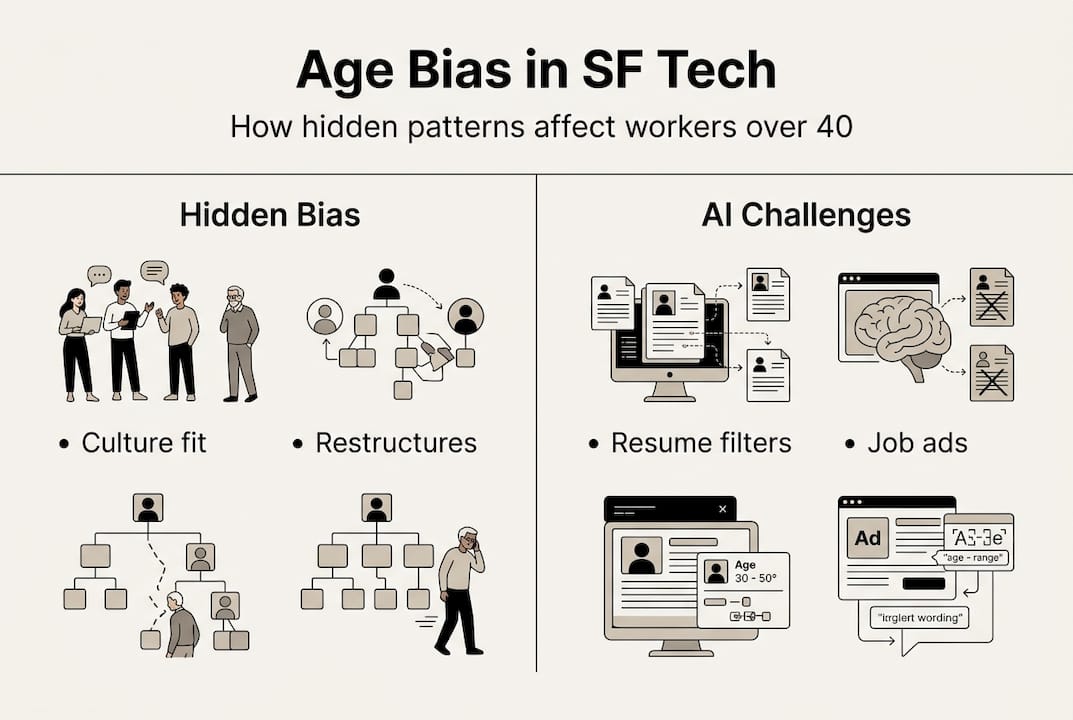
AI tools compound this challenge. They can lock in historical bias invisibly and at scale, making patterns harder to detect without data. Yet those patterns are exactly what an experienced attorney looks for.
Our view at Justice Shield Law is that workers who document steadily and consult legal counsel early have a significant advantage. Persistence matters. A thorough employment law guide can orient you, but personal legal guidance is what converts strong facts into real outcomes.
How Justice Shield Law supports San Francisco tech employees
At Justice Shield Law, we represent employees exclusively. We do not represent employers. That focus means every strategy we develop is built entirely around protecting your rights and maximizing your recovery. If you are an employee in San Francisco's tech sector who suspects age discrimination, whether in hiring, promotion, layoff, or through an AI-driven process, we offer a free initial consultation to review your situation. Our attorneys understand the specific dynamics of tech workplace culture, the growing role of AI in discriminatory hiring, and the procedural steps required to build a strong case. Reach out today to learn what your options are before time limits run out.
Frequently asked questions
Who is protected by age discrimination laws in San Francisco tech?
Employees aged 40+ are protected under California's FEHA for companies with five or more employees and under the federal ADEA for companies with 20 or more employees, covering the vast majority of San Francisco tech firms.
What are signs of age discrimination in hiring?
Red flags include job postings using terms like "digital native," experience caps in job requirements, and AI tools that screen out applicants over 40 using proxies such as graduation year or years of experience.
What should I do if I think I'm facing age discrimination?
Document every incident in writing, report through your company's internal process, and consult an employment attorney as soon as possible, since showing disparate impact on workers over 40 can be legally sufficient even without direct proof of intent.
Are tech companies liable for discrimination from third-party hiring tools?
Yes. San Francisco tech employers are liable for discriminatory outcomes produced by automated or third-party AI systems used in their hiring processes, even when the employer did not design the tool.
Recommended
- Justice Shield Law | California Employment Lawyers — Free Consultation
- Justice Shield Law | California Employment Lawyers — Free Consultation
- Justice Shield Law | California Employment Lawyers — Free Consultation
- Justice Shield Law | California Employment Lawyers — Free Consultation
- Age Discrimination in Irvine Tech Layoffs: Broadcom and Google | Serendib Law Firm